
What Is Cold Email? (Guide to the Perfect Campaign)
Cold email is the digital equivalent of cold calling. It refers to reaching out to prospects who’ve never heard of your business before. Cold email transforms complete strangers into qualified business opportunities through strategic, value-driven messages that resonate with their needs.
Cold email is different from spam because it incorporates personalization, value, and compliance. It focuses on addressing real business needs while maintaining compliance with legal standards.
An effective cold email is personalized, under 90 words, has a clear subject line and CTA, and makes the value obvious. Creating successful cold email campaigns requires verified prospect lists, authenticated domains, personalized messaging, structured follow-ups, and A/B testing. Cold email campaigns achieve optimal results when these components work together. Platforms like Instantly, Apollo, and Clay make it easier to maintain deliverability and personalization even when you’re sending at scale.
Cold email is still highly effective in 2025. It outperforms traditional advertising by getting you straight to decision-makers’ inboxes, and you can track performance in real-time. But success in cold email depends on strategic execution. You need solid technical setup, targeted messaging, personalization and legal compliance rather than volume-based approaches. It is essential to understand what defines a cold email, how it works, and why it stands apart from other outreach methods.
What Is a Cold Email?
A cold email is a personalized message sent to someone you haven’t spoken with before to start a business conversation. The term ‘cold’ in cold email refers to the absence of prior contact or interaction. It’s similar to cold calling, but through email. The goal is starting a conversation that leads to a sale, meeting, or new opportunity. Cold emails are written to show how you solve a specific problem or add value to your recipient’s company. It demands more effort than warm or hot emails to build trust and relevance because it begins without an existing relationship. Success depends on having a clear purpose, tailoring the message to the individual, and a strong understanding of their context.
Cold email is a cost-effective and scalable way to connect with decision-makers in B2B environments. It makes the value obvious and sparks a conversation. It allows targeted outreach based on filters such as industry, job title, or company size. You can deliver personalized messages unlike traditional advertising. Cold email is less expensive than paid ads because it doesn’t require ad spend and is automated at scale. It achieves similar results with clearer performance tracking, when executed properly.
In lead generation, a cold email is a one-to-one message aimed at a specific individual. The goal is to start a business conversation rather than promote a product or service to people.
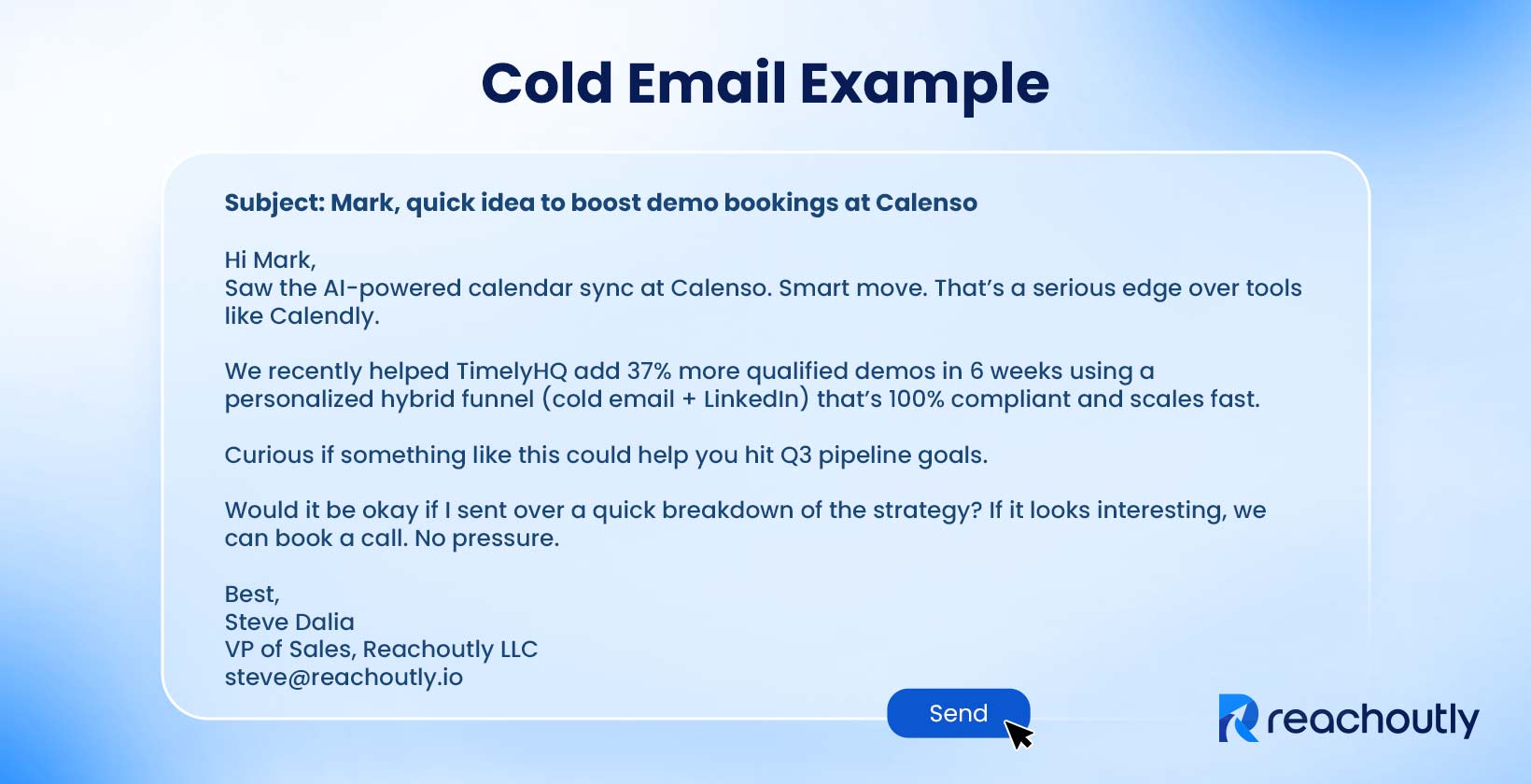
Here’s a high-performing cold email example to convert prospects. We optimized this for personalization, clarity, and response-driven structure:
Cold emailing is one of the most practical ways to drive business growth because you can generate leads at a low cost which allows outreach to thousands of prospects at once. It directly connects with decision-makers such as sales managers and CEOs. Cold email outperforms methods like paid ads and print campaigns, which require higher upfront investment with lower engagement. Personalized cold emails use data like job title, industry, or recent activity to tailor content at scale. You can measure these campaigns in real time using metrics such as open rates and response rates. This allows you to adjust messaging quickly and boost conversion rate. But there are drawbacks too.
The three key drawbacks of cold emailing are low response rates, spam filter blocking, and compliance requirements. Response rates to cold emails are usually low. Spam filters block emails if the content lacks personalization or contains sales-heavy language. Compliance with laws like GDPR and CAN-SPAM requires careful list management and opt-out mechanisms. Poorly executed campaigns harm sender reputation, leading to blacklisting. High inbox volume makes it harder for recipients to notice and engage with unsolicited emails. Because of these challenges, you need to evaluate the real effectiveness by getting a closer look at how strategies and technologies have evolved in 2025.
Is Cold Emailing Effective in 2025?
Yes, cold emailing is still highly effective in 2025. It continues to be a leading sales channel across industries in 2025 with top campaigns reaching up to 15% conversion. The key is doing it with a clear strategy. Success depends on who you target, how well your infrastructure runs and how relevant your message feels. Targeted campaigns and timing optimization usually improve results.
Cold emailing remains effective for lead generation, partnership outreach, and B2B prospecting. It consistently delivers a strong return on investment when targeted at the right people with a clear value proposition. Growth List’s 2025 data reveals that 43% of sales reps still rank email as the most effective sales channel.
Reachoutly is on track to drive $15 million in client revenue and build pipelines worth over $100 million in the first six months of 2025. In 2024, we achieved solid volume with $26 million in client sales. By the end of 2025, we expect to surpass $40 million in client-generated revenue, manage 150,000+ email accounts, and reach $200,000 in MRR as we scale our automated infrastructure and expand our partner network from 100 to 200+ agencies.
Personalization is the key driver of success. Personalized subject lines increase open rates by 26-30%. Segmented campaigns generate 760% more revenue than unsegmented ones. Industry leaders like Al Amin Sohel have helped clients close over $24 million in deals using cold emails that focus on personalized, value-driven messaging. These results emphasize the importance of relevance over volume.
Artificial intelligence (AI) is further increasing cold email effectiveness. Marketers expect AI to be central to cold outreach success over the next two years. AI makes it possible to personalize at scale, pick the right prospects faster, and fine-tune messages in real time. A successful cold email strategy is the difference between effective and ineffective cold emailing.
How Do You Create a Successful Cold Email Strategy?
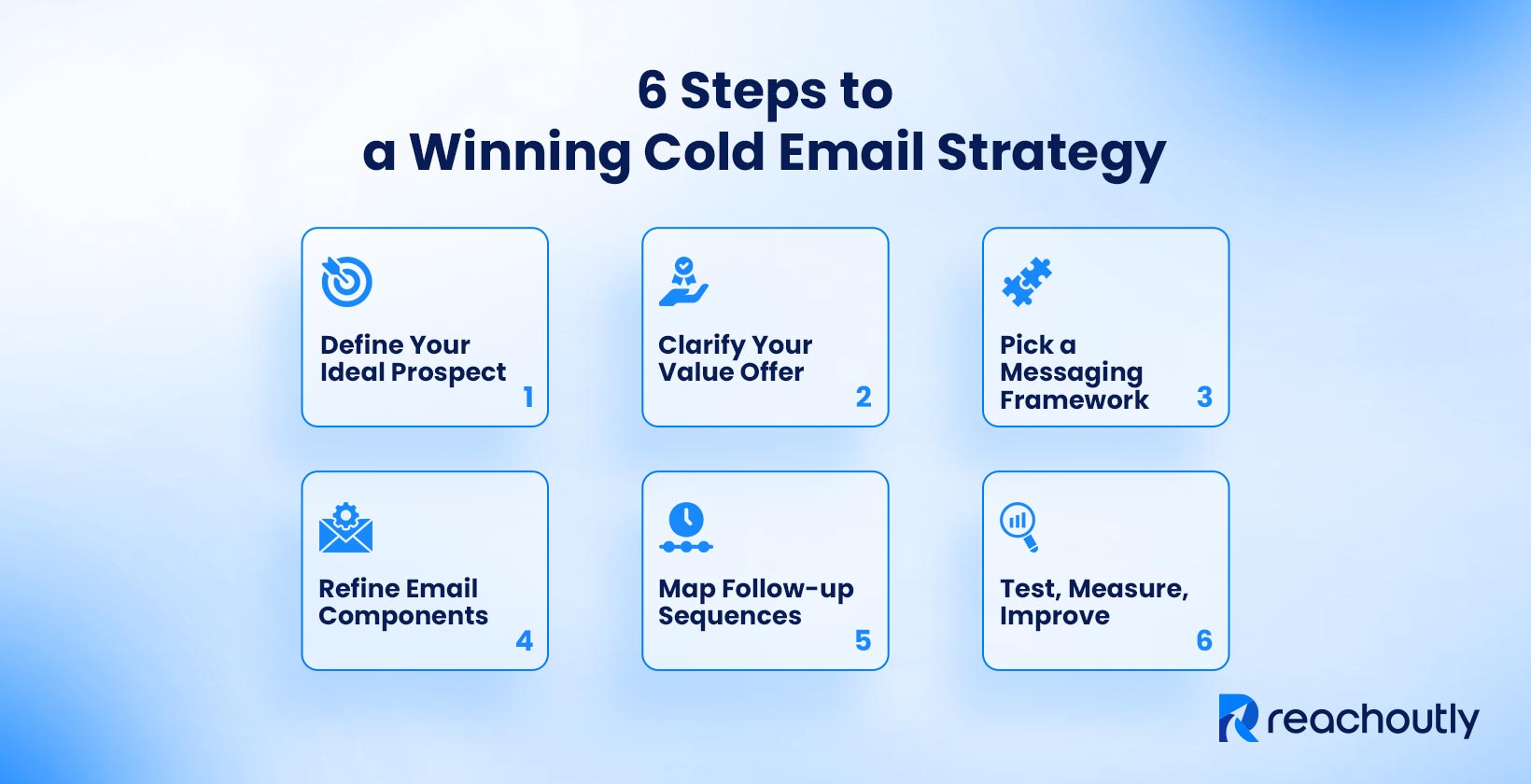
To create a successful cold email strategy, identify ideal customer profiles, define a strong value proposition, choose structured messaging frameworks, optimize key email components, plan sequenced follow-ups, and continuously test for performance improvements.
Step 1: Identify Your Ideal Customer Profile (ICP)
Analyze your best customers and find what they have in common, including their industry, company size, job titles, and challenges. Use your sales calls and customer data to improve who you target.
Step 2: Define Your Offer and Value Proposition
Create your value proposition by figuring out what your customers are trying to achieve, the problems they face, and the gains they want. Then connect these with your product’s features and benefits. This makes your outreach more relevant and useful.
Step 3: Choose a Messaging Frameworks
Choose messaging frameworks like AIDA (Attention-Interest-Desire-Action), BAB (Before-After-Bridge), or PAS (Problem-Agitate-Solution). Structure emails that resonate with prospects and drive responses through clear problem-solution alignment.
Step 4: Optimize Email Components
Personalize beyond names with company details. Write subject lines under 8 words. Keep content under 90 words, and include single clear calls-to-action with specific timeframes.
Step 5: Plan Your Cold Email Sequence and Follow-Up Strategy
Plan email sequences with follow-ups 3-5 days apart, then 1-2 weeks apart. Vary content with insights, case studies, and resources to keep messages fresh and avoid repetition.
Step 6: Implement Testing and Iteration Loops
Implement A/B testing for subject lines, send times, and message frameworks like AIDA, BAB, and PAS. Track open rates, click-throughs, and conversions for continuous refinement and optimal performance.
What Is a Cold Email Campaign?
A cold email campaign is an outreach system to send personalized emails to targeted recipients who haven’t interacted with your business before to generate leads and build relationships.
Core components of a cold email campaign include verified prospect lists, warmed-up mailboxes, 3-7 email sequences, personalized subject lines and messages, automation software, deliverability safeguards, performance tracking, and response management systems. These components work together to deliver value, drive engagement, and convert prospects into business opportunities.
Cold email campaigns succeed through personalization, deliverability, and precise targeting that respects legal boundaries. As David Newman, author of the Amazon #1 bestseller “Do It! Marketing” says, “Email has an ability many channels don’t. Creating valuable, personal touches at scale. The power behind personalization is undeniable.” This shows how tailored communication strengthens connections even before a relationship exists.
Different teams view cold email campaigns differently. Sales teams view cold email campaigns as lead generation engines that fill the pipeline with qualified prospects. Marketers view cold email campaigns as brand awareness tools that introduce new audiences to the business. Executives view cold email as a strategic growth investment. They expect measurable ROI, support for market expansion, and alignment with broader goals. For technical teams, cold email campaigns are systems that depend on proper setup and ongoing maintenance to keep deliverability high.
The goal of a cold email campaign is to start genuine business relationships by transforming strangers into qualified leads through structured, personalized communication. It supports goals such as sales, partnerships, recruiting, fundraising, or content collaboration, depending on intent. Each outreach requires tailored messaging but shares one aim, creating meaningful exchanges that lead to lasting business outcomes. For each outcome knowing how to build and prepare a cold email campaign that performs reliably and stays compliant from the start is essential.
How Do You Build and Prepare for a Cold Email Campaign?
To build and prepare for a cold email campaign, configure domain authentication, warm up inboxes, define your ideal customer profile (ICP), build verified prospect lists, and craft 3-7 step sequences with varied follow-ups.
Step 1: Laying the Technical Foundation
Configure SPF, DKIM, and DMARC records to authenticate your sending domain and prove legitimacy. Warm up new domains over 2-4 weeks, increasing volume over time to build sender reputation. Use 2-3 mailboxes per domain and limit each to 30 to 50 daily sends.
Step 2: Identifying ICP and Building Prospect List
Define your ideal customer profile (ICP) by analyzing companies that match your target criteria and have a higher chance of conversion. Build prospect lists using LinkedIn Sales Navigator, Apollo.io, and ZoomInfo. Before adding prospects to your campaign, verify emails using ZeroBounce to maintain bounce rates under 2% and delivery rates above 98%.
Step 3: Crafting Cold Email Sequences
Create a sequence of 3-7 emails spread over 2-4 weeks. Start with shorter intervals between early touches, then extend the gaps as the sequence progresses. Ensure your pitch is clear and concise with subject lines that are short yet powerful, and intriguing for the recipient. Keep messages under 90 words, focused on one clear value point per email.
Step 4: Testing and Analysis
Run A/B tests on subject lines, message copy, CTAs, and sending times. Test one variable at a time using batches of at least 100 emails per version over 3-5 days. Analyze results to refine future campaigns and identify what combinations of timing, messaging, and personalization drive the best outcomes.
How Do You Write an Effective Cold Email?
To write an effective cold email, use a compelling subject line, establish relevance in the first sentence, provide specific value, and end with one clear call-to-action while keeping the total message short.
Use a clear structure containing hook, relevance, value, and CTA. Start with a compelling subject line under 50 characters that includes company-specific details or recent achievements. Establish immediate relevance by showing research within the first sentence and addressing a real business challenge through specific observations about the prospect or their business. Maintain a conversational tone while including industry-specific insights.
Connect the observation to a likely pain point or opportunity. Follow with a value offer that introduces your solution and includes quick proof points, such as lift in conversion for a fintech client or reduced churn for a SaaS company.
Close with a clear call-to-action. One simple, low-friction step that encourages a reply. Keep emails under 90 words and send them between early mornings or 1-4 PM with follow-ups spaced 3-7 days apart. Focus on one clear message per email. Avoid generic templates. There are various tools that simplify mastering the writing process and personalization, but for a deeper breakdown see our guide on how to write a cold email.
What Softwares Should You Use for Cold Emailing?
Use cold emailing software like Instantly, Smartlead, and Saleshandy for delivery, Apollo.io and ZoomInfo for prospect lists, ZeroBounce for email verification and Lemlist for personalization.
Core Platforms
These comprehensive email automation platforms serve as the foundation for sending, tracking, and managing cold email campaigns at scale.
Instantly.ai focuses on inbox placement with advanced warm-up capabilities, AI-driven deliverability features, and unlimited email account scaling for startups.
Smartlead is built for high-volume cold email campaigns with unlimited email accounts, advanced warm-up tools, AI-powered personalization, and client management for agencies.
Saleshandy provides comprehensive features including lead finder, unlimited email accounts, AI-assisted personalization, unified inbox management, and built-in client management for agencies.
List Building and Prospecting
These specialized data platforms are essential for building targeted lists and enriching lead profiles.
Apollo.io provides powerful sales intelligence with 270 million B2B contacts. It combines lead generation, personalization, multichannel automation, and seamless CRM integration.
ZoomInfo is ideal for enterprise sales teams because it provides accurate data, enriched contact profiles, and insights into complex company hierarchies.
Clay provides advanced data enrichment, multi-source list building, website scraping, and decision-maker qualification. It offers sophisticated data workflows and comprehensive prospect intelligence.
Email Verification and Hygiene
These platforms maintain list quality through verification, prevents bounces, and protects sender reputation.
ZeroBounce provides email verification with 99% accuracy using MX, DNS, SMTP validation, real-time API access, bulk list cleaning, and spam trap detection.
NeverBounce processes 10,000 emails in under 10 minutes with 99.9% accuracy. It uses 20+ step verification, human quality checks, and generous API limits.
Personalization and Copywriting
These advanced personalization tools transform generic outreach into targeted messaging.
Lemlist leads personalization with AI variables, text variables, spintax, personalized images and videos. It offers waterfall enrichment delivering 80% email find rates, and native LinkedIn integration.
Copy.ai provides versatile AI-assisted content creation with workflow automation, social media content, cold email generation, and user-friendly chat interface.
What Are the Best Practices for Sending Cold Emails?
The 4 best practices for sending cold emailing are building verified lists, authenticating domains with SPF/DKIM/DMARC, writing under 90 words, and sending 3-4 follow-ups spaced 3-5 days apart.
- Build and Maintain a High-Quality Prospect List: Build quality prospect lists targeting specific industries and roles matching your ideal customer profile like sales directors in SaaS companies, CTOs in fintech or marketing managers in e-commerce. Use email verification tools to reduce bounce rates under 2%. Remove unresponsive contacts after 30 days.
- Establish a Robust Technical Foundation for Deliverability: Establish strong technical foundations with SPF, DKIM, and DMARC authentication. Use dedicated outreach domains. Keep spam complaints below 0.3%. Warm up new domains gradually starting with 5-10 emails daily.
- Craft Compelling Cold Email Copy: Write a compelling copy. Use hook → relevance → offer → CTA structure. Tie your observation to a real business need and present one specific value point. Close with a clear ask that takes a single step.
- Develop a Strategic Follow-Up Plan: Develop strategic follow-up plans with 3-4 emails spaced 3-5 days apart to stay persistent without overwhelming the prospect. Vary messages with new angles. Reference previous emails, and include clear opt-out options.
How Do You Measure Cold Email Campaign Performance?
To measure cold email campaign performance, track open rates, response rates, conversion rates, unsubscribe rates, bounce rates, and click-through rates. Compare your numbers to relevant benchmarks to judge visibility, engagement, and business impact.
Use these key metrics for quick health checks.
- Open rates of 30-40% are healthy, and above 65% is excellent.
- Response rates of 1-5% are average, and 15% or higher indicates a top campaign.
- Conversion rates of 1-2% are typical, and 3% or higher signals strong fit and timing.
Keep unsubscribe rates under 10% and bounce rates under 4% to protect your sender reputation. Target positive response rates above 8% and click-through rates near 3.7% to indicate strong message engagement.
Check for SPF, DKIM, and DMARC authentication issues, poor sender reputation, or low-quality contact lists, if open rates fall below 25%. Reply rates under 3% suggest message relevance problems. You need to improve personalization and value propositions. High bounce rates above 5% means you need email verification tools and list cleaning.
Compare against benchmarks to know your position. Benchmarks vary by industry. Tech campaigns achieve 24-30% open rates and 0.5-2% response rates, while healthcare and e-commerce reach 35%+ open rates and 4.8-4.9% response rates. Target 25-35% open rates, 5-10% response rates, and 3-8% positive response rates. Use advanced AI-driven personalization to boost results by 40-60%.
Analyzing these metrics reveals where your campaign loses momentum and what you need to optimize for higher engagement.
How Do You Optimize Your Cold Email Campaign?
To optimize cold email campaigns, focus on five key areas including subject lines, personalization, calls to action (CTAs), timing, and follow-up.
Keep subject lines under 8 words and tie them to the recipient’s context. Personalize each email with one specific reference, for example a product launch or a recent LinkedIn post. Use a single CTA that asks for a short conversation instead of a full demo. Send emails between Tuesday and Thursday, from 1-4 PM, for best B2B engagement. Test different copy angles and use narrative intros for senior roles. Refine follow-ups with 3-5 value-driven messages over 2-4 weeks.
A/B test one variable at a time with at least 100 recipients per version, tracking meaningful metrics like positive replies and revenue per email. Avoid common mistakes to ensure these improvements translate into lasting deliverability and engagement.
What Common Mistakes Should You Avoid in Cold Email Campaigns?
Common cold email mistakes you should avoid include failing to authenticate emails with SPF/DKIM/DMARC, not warming domains, using spam words, buying lists, targeting irrelevant roles, lacking value-driven content, including multiple CTAs, ignoring GDPR/CAN-SPAM rules, and omitting unsubscribe options.
- Deliverability and Technical Mistakes: Not authenticating emails with SPF, DKIM, DMARC, including attachments, using spam words, and rushing domain warm-up damage deliverability and sender reputation.
- Targeting and List Mistakes: Buying email lists, targeting wrong audiences, sending same messages to different roles, and ignoring intent data cause high bounce rates and spam complaints.
- Content and Copy Mistakes: Using only first names as personalization feels generic. Self-focused messages highlighting features over value, spam subject lines using “free” or “urgent,” and not using signatures hurt engagement. Long dense emails with multiple CTAs confuse prospects.
- Strategy and Follow-Up Mistakes: Relying on single emails, sending repeated follow-ups without added value train prospects to ignore you. Ignoring optimal timing and depending only on email instead of multichannel outreach limits reach and reduces response rates.
- Legal and Ethical Mistakes: Violating GDPR by emailing EU prospects without consent, violating CAN-SPAM with misleading subject lines, failing to include unsubscribe links, and poor data security increase legal risks and damage reputation.
What Are the Different Use Cases for Cold Email?
Cold email use cases span sales lead generation, investor outreach, partnership development, recruiting, media relations, and marketing campaigns. These outcomes depend on personalization, timing, and alignment with recipient needs.
The use cases for cold email refer to the various applications and purposes and include the following three primary categories.
- Driving Business Growth and Revenue
- Enhancing Brand and Expanding Reach
- Talent Acquisition and Professional Connections
1. Driving Business Growth and Revenue
Cold email remains a key channel for sales and lead generation. Sales representatives identify it as their most effective prospecting method. Klenty’s Top Cold Email Statistics of 2025 notes that 8 out of 10 B2B buyers prefer outreach by email rather than phone.
In networking and partnerships, businesses use cold emails to initiate collaborations. The same message format that books demos can introduce co-marketing ideas or distribution swaps between complementary brands.
Startups rely on cold emails for investor outreach, particularly when they lack warm introductions. A well-researched, value-driven message with consistent follow-ups lead to major funding wins.
Template: Revenue Playbook Breakdown
Subject: How [Similar Company] added $X in revenue, want the breakdown?

Hi [First Name],

Noticed [Company Name] is chasing similar growth goals to [Similar Company]. We just helped them drive a [XX%] boost in revenue in [timeframe] by solving [specific issue].

We used a [brief methodology] that led to:
  1. [XX% increase in revenue efficiency]
  2. [Cost savings: $X per month]
  3. [Other benefit that matters to recipient]

Would it be useful if I shared the exact process we used? I can walk you through it in a quick 15-min call.

Worth a chat?

Best,
[Your Name]
2. Enhancing Brand and Expanding Reach
For marketing and growth, cold email supports launches, events, and product feedback. It highlights exclusive benefits, early access, or discounts to boost engagement.
In media and PR outreach, cold email helps secure press, reviews, and thought leadership by connecting with journalists and influencers. This is ideal for startups seeking visibility without high ad spend.
Template: Mutual Value Collaboration
Subject: [Their Brand] × [Your Brand]: Collab idea your audience will love

Hi [First Name],

Love what [Their Company] is doing with [specific initiative or content]. Your approach to [topic] really resonates with our audience.

I think we could create something valuable together, maybe a co-authored guide on [relevant topic] or a short joint webinar. Our audiences overlap perfectly in [specific area], which makes this a great fit.

A recent collaboration with [Similar Brand] reached [specific metric] people across both networks and generated great engagement.

Would you be interested in exploring something similar? I have a few specific ideas that could work well for both brands.

Best,
[Your Name]
3. Talent Acquisition and Professional Connections
Cold email plays a key role in recruiting, especially for engaging passive candidates. Findem’s research indicates well-crafted recruiting emails see 30-50% response rates. Centralized platforms and chatbots improve speed and reduce drop-off during the hiring process.
Professionals use cold email to request interviews, reach hiring managers directly, and promote job-related events such as webinars and career fairs.
Template: Personalized Candidate Outreach
Subject: Impressed by your work on [Project/Initiative]

Hi [First Name],

I came across your work on [specific project/achievement]. Really impressive results with [specific detail]. It’s clear you know how to make an impact in [area of expertise].

I’m [Your Name], [Title] at [Company]. We’re building a team to take on [specific challenge/project], and your background in [relevant area] immediately stood out.

The role involves [key responsibility] and offers [unique benefit or opportunity]. Based on what you’ve done at [Current Company], I think this could be a great fit.

Would you be open to a quick chat this week to explore it?
Best,
[Your Name]
Is Cold Email Legal?
The legality of cold email depends on the jurisdiction. Sending cold emails without consent is legal in relatively few countries. In most jurisdictions, you need explicit or implied consent and must comply with anti-spam regulations.
Cold email marketing is legal without requiring prior consent in specific countries such as the USA, Singapore, New Zealand, India, Brazil, South Africa, and Mexico. In regions such as Europe, UK and Canada, you need the recipient’s consent or proof of legitimate interest before you send a cold email. Sending cold emails without explicit consent is illegal in countries such as Germany and the United Arab Emirates.
Different countries have their own laws and regulations governing electronic commercial messages. Core requirements of these laws typically include clear sender identification, honest subject lines, and functional unsubscribe options. The United States enforces the Controlling the Assault of Non-Solicited Pornography and Marketing (CAN-SPAM) Act for commercial emails. Violations of the CAN-SPAM Act can lead to penalties of up to $53,088 per email. Canada implements Canada’s anti-spam legislation (CASL) requirements for electronic communications. It carries fines up to $10 million for businesses and $1 million for individuals.
Many regions require strict compliance with data protection laws. The European Union mandates the General Data Protection Regulation (GDPR) and the Privacy and Electronic Communications Regulations (PECR) compliance for email marketing. The GDPR imposes strict obligations on data processing. Fines for noncompliance can reach up to €20 million or 4% of annual global turnover.
Understanding the legal boundaries of cold emailing is the first step, but maintaining compliance and trust over time depends on how ethically and responsibly you apply these laws in practice. For a detailed breakdown of cold email regulations and regional requirements see our guide on whether cold email is legal.
How Do You Stay Compliant, Ethical, and Relevant in Cold Emailing?
To stay compliant, ethical, and relevant in cold emailing, follow CAN-SPAM/GDPR laws, provide genuine value with limited frequency, and target qualified prospects with customized content.
To stay compliant with cold emailing laws, follow regulations like CAN-SPAM and GDPR. Obtain permission before emailing where required. Always include an unsubscribe link and accurate sender information. Identify yourself, your organization, and the purpose of your email.
Stay ethical by providing genuine value, limiting email frequency to 3-4 emails over 2-3 weeks, and keeping emails concise, relevant, and compelling. Stay relevant by targeting people who actually need what you offer and customizing content to their business using verified and ethical data sources. Use relevant subject lines that honestly reflect email content without misleading claims. Build quality lists by getting people to sign up voluntarily and public B2B sources while avoiding purchased databases. Keep data secure and track who gave you permission.
What Are the Differences Between Cold Email and Email Marketing?
The main difference between cold email and email marketing is that cold email targets new prospects without prior consent for sales outreach, while email marketing sends content to opted-in subscribers for relationship nurturing and retention.
Cold email refers to messages sent to individuals or businesses with whom there is no prior relationship. Cold emails are used for outreach related to sales, networking, or partnerships. In contrast, email marketing targets people who have actively opted in, such as subscribers or existing customers.
Cold email focuses on personalized, one-to-one communication aimed at starting new conversations. It is often used for lead generation, introducing products or services, or initiating collaboration. These messages are tailored to address specific pain points or interests of the recipient.
Email marketing, on the other hand, involves sending content such as newsletters, product updates, promotional offers, or customer support messages. It relies on verified opt-in lists and uses automation tools to deliver consistent communication to a broader audience. For example, companies send monthly newsletters, discount announcements, or educational content to nurture existing customer relationships.
Email marketing is designed to maintain engagement, encourage repeat business, and improve customer lifetime value. Marketers track metrics like open rates and click-through rates to evaluate the performance of these campaigns.
Costs differ between cold email and email marketing based on their scope and execution methods. Businesses outsourcing their outreach expect cold email agency pricing to range from $2,000-$15,000 per month, depending on industry, email volume, and campaign complexity. Email marketing costs start from $10-$50 per month for smaller subscriber lists and scale up to $500+ as list sizes grow.