
Cold Email Response Rate (2025 Guide)
Cold email response rate measures the percentage of recipients who reply to your emails. Response rate is the truest indicator of whether a cold email sparks genuine interest. It goes beyond passive engagement like opens or clicks to represent the start of a genuine two-way conversation. Response rate and reply rate are the same metric. Calculating response rate is straightforward: (unique replies ÷ delivered emails) × 100.
Average response rates have plummeted from 8.5% in 2019 to 5% in 2025. Response rates have declined because of inbox saturation and sophisticated spam filters. Understanding and optimizing response rate has become more critical than ever. A good response rate for cold email is now anything above 5%. Top-performing campaigns achieve 10% or higher through meticulous execution. At present, B2B campaigns average a 4.0% response rate. Below 1% response rate is bad and signals major issues.
Achieving a high response rate depends on the implementation of key factors, including precise targeting, deep personalization, value-driven follow-ups, and sending concise, credible emails of under 125 words that feature a clear, low-friction call-to-action.
Low response rates are a symptom of core execution failures such as poor audience alignment, generic messaging that fails to resonate, or technical deliverability issues that prevent emails from reaching the inbox. Tracking the total response rate and the ratio of positive to negative responses provides a clearer picture that helps refine campaign strategy effectively.
Response rate bridges the gap between sending emails and generating revenue. Open rates get your foot in the door, but responses start real conversations that turn into meetings, demos, and deals. A high open rate is necessary to make a reply possible. But, it’s the quality of those responses that directly enables conversions like booked meetings or new clients. Understanding response rate and its behavior is key to turning cold outreach into revenue generation.
What Is Cold Email Response Rate?
Cold email response rate shows how many people reply to your emails compared to how many successfully receive them. Response rate represents the percentage of actual two-way conversations.
Response rate comes after the open rate in the outreach metric measurement sequence. The journey starts when someone opens your email, then moves to a reply, progresses to a positive reply, advances to a meeting booking, and ends up converting to a client. Each stage represents a different metric. Mixing them creates confusion and makes performance tracking impossible. Companies that track each metric separately improve their overall campaign performance.
To calculate response rate accurately, use consistent counting rules. Count only unique human replies from each recipient. Exclude out-of-office autoresponders, delivery confirmations, and automated messages from your prospect. Tag negative replies separately but include them in your total response count. A “not interested” reply still counts as engagement. Count each recipient only once, even if they send multiple replies to your email or follow-ups.
Calculate response rate using this formula:
response (reply) rate (%) = (unique replies ÷ delivered emails) × 100.
To calculate response rate, use delivered emails as your baseline not sent emails. Here’s a quick example to establish clarity. You send 500 cold emails. 30 bounce, leaving 470 delivered. You receive 18 human replies (including 3 negative responses), 5 out-of-office messages, and 2 delivery confirmations. Your response rate equals 18 ÷ 470 × 100 = 3.8%. The out-of-office and delivery confirmations don’t count toward your response rate.
Response rate differs from other engagement metrics. It specifically measures two-way communication initiation. Open rate shows how many people viewed your email. Click-through rate (CTR) tracks link clicks within your email. These metrics signal engagement but don’t indicate actual conversation starts. A campaign with 50% open rate and 10% CTR still has a 0% response rate if nobody replies.
The distinction matters for campaign analysis. High open rates with low response rates suggest your subject lines work but your message doesn’t inspire action. Strong CTR with weak response rates indicates prospects explore your links but don’t want to engage directly. Response rate remains the truest indicator of whether your cold email sparks genuine interest and conversation.
Cold email response rates have declined significantly over recent years. The average response rate dropped from 8.5% in 2019 to 7% in 2023, and further declined to 5% in 2025. Increasingly sophisticated spam filters, inbox saturation, and buyer fatigue from cold outreach are the causes of this downward trend.
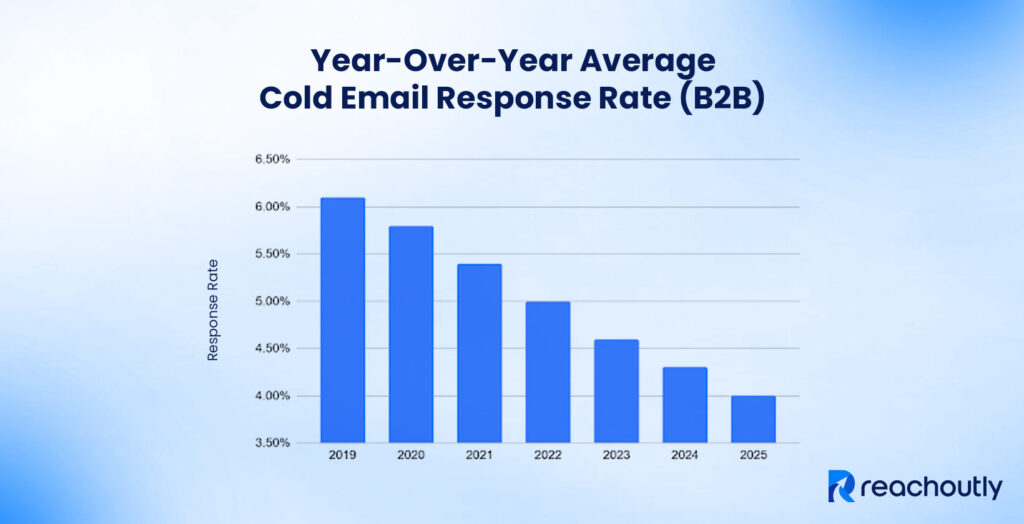
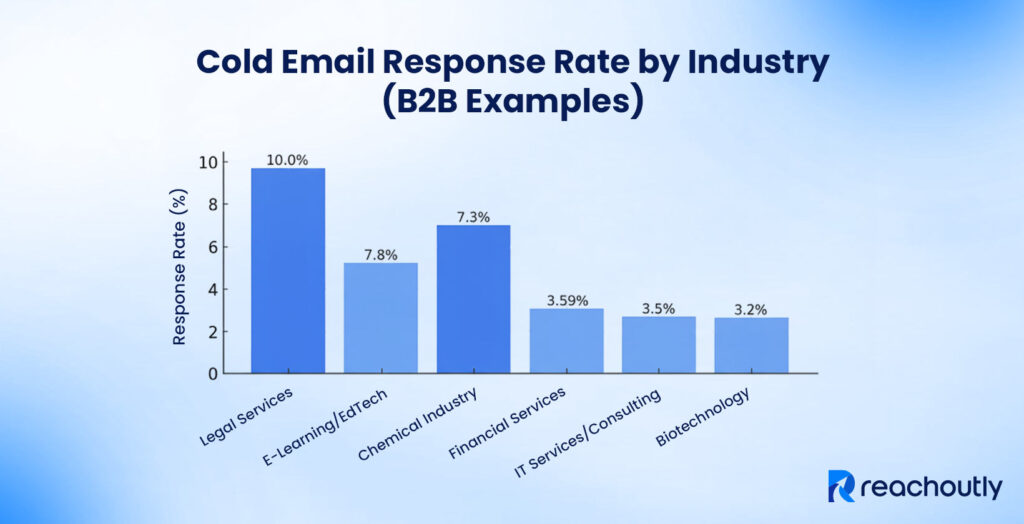
Cold email benchmarks vary significantly across industries and company sizes. The average B2B cold email response rate is 4.0% in 2025. Exceptional campaigns achieve 10% or higher response rates. These numbers shift based on your industry. Technology companies see 7.8% average response rates and healthcare averages 5.2%. Geographic factors play a role too. North American campaigns average 4.1% response rates compared to 3.1% in Europe, according to 2025 data from Mailshake’s analysis of 12 million cold emails.
Understanding cold email response rate helps you diagnose campaign health quickly. Low response rates signal problems with targeting, messaging, or deliverability. High response rates indicate strong audience-message fit. Track reply rate weekly to spot trends early and adjust your approach before wasting resources on ineffective campaigns. Don’t get confused with the terminology of response rate and reply rate.
Are Cold Email Response Rate and Cold Email Reply Rate the Same?
Yes, cold email response rate and reply rate are the same metric in sales and marketing. The cold email reply rate (or cold email response rate) measures how many people respond to your cold email campaigns compared to how many emails are successfully delivered.
Sales teams, marketers, and cold email practitioners use the terms “response rate” and “reply rate” interchangeably. Both terms appear equally in discussion threads on communities like Reddit. A 2025 study by Outreach.io analyzing terminology across 500 B2B companies found that 48% use “response rate,” 47% use “reply rate,” and 5% alternate between both.
People prefer one term over another, but the meaning stays consistent. Marketing platforms, sales teams, and email providers all track this single metric under both names. Response rate reveals how many prospects engage to start a conversation with you. The calculation is the same regardless of terminology. The formula stays: (number of replies ÷ number of emails delivered) × 100, whether you call it response rate or reply rate. Focus on achieving a good response rate for your campaign, not the terminology.
What Are Average, Good and Bad Cold Email Response Rates?
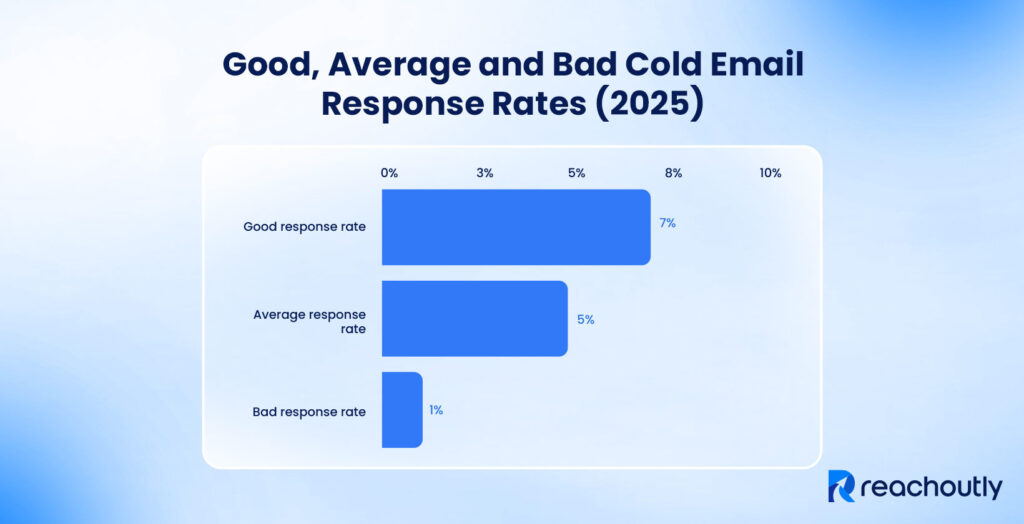
Average cold email response rate is 5%, good response rates start above 5% and below 1% is bad response rate signaling major issues. Top campaigns achieve 8-15% response rate with targeting and personalization.
Average Cold Email Response Rate
Average cold email response rate represents typical campaign performance. It is between the baseline numbers. Average response rates have fallen to 5% across all industries in 2025. The median response rate stands at 3.4%. Rates between 1% and 3% represent typical performance for most cold email campaigns.
Good Cold Email Response Rate
Good cold email response rate shows above-average performance. Good response rates start above 5% and extend to 10% or higher for optimized campaigns. Top-performing cold email campaigns achieve 7-15% response rates through precise targeting and personalization. In the first six months of 2025, Reachoutly achieved a 7% average response rate on all campaigns.
Bad Cold Email Response Rate
Bad cold email response rate denotes performance is below the norm signaling serious problems. Bad response rates fall below 1% and indicate fundamental campaign problems. Zero responses after sending 100+ emails means your approach needs complete restructuring.
A response rate can be good or bad depending on the industry. Technology and software companies achieve average response rates of 3.5%. In manufacturing and logistics, campaigns hover around 6.1% average response rates. Non-profit organizations and educational institutions see the highest rates at 15%. Your industry context determines whether a 4% response rate represents success or failure.
Cold email response rate varies depending on the audience as well. B2B cold emails consistently outperform B2C campaigns in response metrics. B2B recipients expect vendor outreach and evaluate proposals rationally. B2C cold emails face higher skepticism and compete with established consumer brands for attention. B2B campaigns average 4.0% response rates compared to 0.8% for B2C.
Geographic factors influence response rate benchmarks significantly. North American campaigns average 4.1% response rates versus 2.8% in Asia-Pacific markets like Japan or South Korea.
Company size further shapes results. Enterprise-focused campaigns (targeting companies with 1000+ employees) average 5% response rates. Small business outreach (under 50 employees) achieves 7.5% average response rates. Startups and growing companies demonstrate higher receptiveness to cold outreach than established enterprises. Response rate alone doesn’t paint the complete picture. You need to sort them between yes and nos.
What Are Positive and Negative Cold Email Response Rates?
Positive cold email response rates measure replies that show interest (e.g., meeting requests or product questions), while negative cold email response rates track rejections (e.g., “not interested” or unsubscribe messages). Both count as replies and are included in response rate calculation.
Positive response rates show the share of recipients who express genuine interest or move conversations forward. These replies include meeting requests, questions about your product, pricing inquiries, or any message that signals openness to continued dialogue.
Negative response rates track replies that reject your outreach, including “not interested” messages, unsubscribe requests, objection statements, or spam complaints. Both metrics provide deeper insight than total response rate alone.
To calculate positive and negative reply rates, first categorize every reply you receive. After categorizing, calculate the positive and negative response rate using these formulas:
Positive response rate (%) = (positive replies ÷ delivered emails) × 100
Negative response rate (%) = (negative replies ÷ delivered emails) × 100
Here, delivered emails = sent emails − bounces. Exclude out-of-office/autoresponder messages from replies. Count only unique human responses.
Working example:
Imagine you sent 1,000 emails and received 50 replies. Among those 50 replies, 15 expressed interest (positive) and 35 declined (negative).
Total response rate = 50 ÷ 1,000 × 100 = 5.0%
Positive response rate = 15 ÷ 1,000 × 100 = 1.5%
Negative response rate = 35 ÷ 1,000 × 100 = 3.5%
Positive response rates range from 0.5-2% for cold B2B campaigns. Exceptional campaigns achieve 5% or higher positive response rates through precise targeting and value-driven messaging. Negative response rates typically range from 2-5% for average campaigns. High negative rates above 7% signal poor list quality or message-market misfit.
Report positive and negative rates separately alongside your total response rate to understand true performance. This three-metric approach reveals campaign health beyond surface-level engagement. A campaign with 10% total response rate appears successful until you discover 9% are negative replies. Analyze which factors most influence positive responses.
What Factors Influence Cold Email Response Rates?
The seven key factors that influence cold email response rates are accurate targeting, personalization, send timing, persistent follow-ups, concise structure with clear CTAs, sender credibility, and the recipient’s industry and role. Proper execution of each factor boosts response rates, while poor execution cripples them.
- Targeting and Segmentation: Targeting is about picking the right people to email based on who actually needs your service or product. Good targeting drives response rate because you are emailing people who actually need what you’re selling. Bad targeting wastes time and damages your sender reputation. Segmentation is dividing a target list into groups based on shared characteristics like interests, behavior, or industry. You can write relevant messages when you segment your list by job role, company size, or industry. Sending the same message to CEOs and managers guarantees poor performance.
- Personalization: Personalization is making each email specific to the person receiving it. People ignore generic emails that start with “I hope this email finds you well.” Using wrong information or obvious mail merge fails makes you look lazy and untrustworthy. Personalized emails show you did research about the recipient. It encourages responses. Mentioning their recent LinkedIn post, company news, or specific challenges makes them pay attention.
- Follow-Ups: Follow-ups are reminder emails sent to people who didn’t respond to your first email. Most responses originate from follow-up emails, not the first one. Each follow-up should offer something new. Poor follow-ups repeat the same message or sound desperate. Too many follow-ups (8+) annoy people and get you marked as spam.
- Timing: Timing is about the specific days and hours when you send cold emails. Send emails when prospects are most likely to check their inbox to maximize response rate. Time zones are crucial too. Sending in the wrong time zone means your “morning” email arrives at midnight for your prospect. This guide on the best time to send cold emails will help you pinpoint the most effective timing.
- Email Length: The length of an email is the total word and character count you use in your email. People read and answer short emails. Mobile readers (68% of B2B opens) quit reading long emails immediately. Busy executives scan emails in seconds. Long emails signal that you don’t respect their time. Extremely short emails (under 25 words) seem lazy or unclear about what you want. Emails under 100 words generate 51% more responses than emails over 200 words.
- Structure and Call to Action (CTA): A call to action (CTA) is used to guide prospects toward the next step. How you organize your email and what action you ask people to take influences response rates. Prospects scan and understand well-structured emails easily. Long paragraphs, wayward spacing, and multiple CTAs confuse people and reduce response rates.
- Credibility: Your credibility is the trustworthiness and legitimacy signals that prospects evaluate before responding. People respond more when the sender appears genuine. Professional email signatures, LinkedIn profiles, and company websites signal legitimacy. Lack of credibility hurts response rates. Generic email addresses, missing signatures, or sketchy websites make people suspicious. Your response rate becomes low when you ignore these factors that influence response rate.
Why Is Your Cold Email Response Rate Low?
Your cold email response rate is low because of eight core execution failures, including poor targeting, weak personalization, too few follow-ups, bad timing, long emails, unclear CTAs, low sender credibility, and deliverability issues.
- Your offer doesn’t match buyer reality: Sending emails to the wrong audience guarantees failure. Your message about enterprise software won’t resonate with small business owners. Targeting junior employees about C-suite solutions wastes everyone’s time. Poor list quality makes it worse. Outdated contacts, wrong departments, or companies outside your ideal customer profile dramatically decrease response rates.
- You sound copy-pasted: Generic templates scream “mass email” and get deleted instantly. Using only {{FirstName}} merge tags isn’t personalization. Weak personalization includes irrelevant company mentions, outdated information, or surface-level observations anyone could make. Prospects ignore emails that could apply to any company in their industry.
- You don’t follow up or don’t add any value: Sending one or two emails means losing most opportunities. Sending only 1-2 emails means you’re missing out on 75% of potential responses. Repeating the same message instead of adding new value or angles is another mistake. Each follow-up needs a fresh approach.
- You mail when your buyer isn’t paying attention: Sending during low-engagement windows kills your chances of getting a reply. Monday mornings or Friday afternoons are poor choices for sending a cold email. Sending outside business hours or in the wrong time zone pushes your message to the bottom of the inbox before your prospect sees it.
- Your emails are too long or unclear: Lengthy emails lose readers before they reach your call to action. Each extra line reduces the chance of a reply. Unclear value propositions leave prospects confused about why they should care, which causes response rates to plummet immediately. Busy executives scan emails in seconds. They delete and move on if they can’t understand your point quickly.
- You have weak, missing or multiple CTAs: Your call to action is the guide to the next step for your prospect. Vague requests like “let me know your thoughts” generate zero urgency or clear next steps. Missing CTAs leave interested prospects unsure about how to respond, while high-friction requests like “book a 60-minute demo” scare away early-stage interest. Multiple competing CTAs confuse recipients about what you actually want them to do. Most readers never reach the CTA, if it appears late in the email.
- You lack proof: Prospects ignore unknown senders without proof. Apart from being ignored, they are frequently marked as spam by default. Generic claims like “we help companies grow” carry no weight because every vendor says the same thing. Missing social proof, case studies, or specific results makes you indistinguishable from spam emails.
- Your message never reaches the inbox: Technical problems prevent emails from reaching inboxes entirely, making all other efforts worthless. Missing email authentication like SPF, DKIM, and DMARC routes you straight to spam folders. Cold domains without proper warm-up are filtered automatically. Sending high volumes too quickly or using spam-trigger words results in a permanent block. Fix these technical problems along with other mistakes to boost your cold email response rate.
How Do You Increase Your Cold Email Response Rate?
To increase your cold email response rate, execute seven key changes including improving deliverability, segmenting lists, personalizing subject lines and openings, running multi-touch follow-ups, writing concise emails with clear CTAs, testing send timing, and adding social proof.
- Fix technical deliverability first: Resolve technical problems before implementing tactics, since perfect emails are worthless if they never reach inboxes. Verify email addresses to maintain list quality above 95% and avoid bounces that hurt reputation. Warm new domains gradually over 2-4 weeks before full-volume sending to build trust with email providers. Authenticate with SPF, DKIM, and DMARC records to pass spam filters.
- Segment lists and tailor offers: Break your prospect list into focused groups based on company size, industry, role, or growth stage. Each segment gets a different value proposition that matches their specific situation and priorities. Build separate email sequences for each segment with tailored outcomes they actually want.
- Personalize subject lines and openings by segment: Craft unique subject lines and openings for each prospect segment rather than using one generic template. This targeted approach is effective because different audiences respond to different pain points and interests. Reference specific challenges, company initiatives, or industry trends in your subject line and openings to grab attention immediately. Create 5-10 variants per campaign and match them to prospect segments.
- Structure follow-ups with varied angles: Design a 5-7 email sequence where each message approaches from a different angle to maintain interest. Email 1 introduces value. Email 2 shares social proof. Email 3 addresses common objections. Email 4 offers a resource. Email 5 creates urgency. Space them 2-4 days apart initially, then extend gaps to avoid seeming pushy.
- Keep emails concise with one clear CTA: Limit cold emails to 50-125 words or 3-5 sentences maximum to respect busy schedules. Every sentence earns its place by adding value or building toward your specific CTA. Remove filler phrases, redundant information, and unnecessary context that dilutes your message. Include exactly one call-to-action that requires minimal commitment from the prospect. “Worth a quick chat?” outperforms “Can we schedule a 30-minute demo?” If you need a broader framework for structuring outreach, this guide on how to write a cold email clarifies what’s essential.
- Send at tested optimal windows: Schedule emails for Tuesday through Thursday, targeting 8-11 AM or 2-4 PM in the recipient’s time zone. Test these windows with your specific audience since patterns vary by industry and role. Developers engage more with afternoon sends, while executives open early morning emails. Track open and response patterns weekly to refine timing based on actual data.
- Bolster authority with proof elements: Include specific credibility markers that build trust quickly. Name recognizable clients in their industry. Share concrete results like “reduced churn by 34% for [Company Name],” and link to relevant case studies or third-party validation. Reference industry research that supports your approach to show you understand their market.
How Many Emails per Day and per Domain Keep Response Rates High?
Send up to 100 cold emails per day and per domain to keep response rates high. Scale volume slowly and monitor your sender reputation. Use multiple domains for higher volume, but cap each domain at 100/day to avoid spam filters. Exceeding 200/day per domain drops inbox placement rates and damages your deliverability.
Daily email volume per domain directly impacts both deliverability and response rates. The distinction between new and established domains determines your sending capacity. New domains (under 3 months old) face strict scrutiny from email providers. Start these domains with a warm-up period, increasing by 10-20 emails weekly until reaching target volume.
| Week | Daily emails (per inbox) | Instruction |
|---|---|---|
| Week 1 | 10-20 | Begin with low volume to protect reputation. |
| Week 2 | 30-40 | Increase gradually after initial warmup. |
| Week 3 | 50-70 | Continue steady ramp while monitoring metrics. |
| Week 4+ | Prior level +20-30 per week | Keep adding weekly until you reach target volume. |
Established domains with 6+ months of positive sending history handle higher volumes safely. A mature domain with consistent engagement safely sends 50-100 cold emails per day if other metrics remain healthy.
Never jump from 50 to 200 emails suddenly because it triggers instant deliverability problems. Consistent, predictable sending patterns signal legitimate use to email providers.
Industry context affects optimal daily sending volumes. B2B technology companies successfully send 100-150 emails per domain daily due to high engagement rates. Professional services firms stay under 75 daily to maintain premium positioning. Healthcare and financial services limit to 50 daily given strict compliance environments. Adjust your volume based on your industry’s engagement patterns and spam sensitivity.
How Does Cold Email Response Rate Relate to Open Rate and Conversion?
High cold email open rate enables high response rate and high response rate enables high conversion rate because conversion depends on replies and replies depend on opens. Each metric reveals a specific stage in the outreach funnel.
Open rate measures the percentage of delivered emails that recipients actually click to read. It acts as the gateway metric. Prospects open your email first, then decide whether to reply, and interested replies eventually convert to meetings or deals. Response rates stay at zero regardless of email quality without opens.
Open rates influence response rates indirectly through visibility and timing factors. Higher open rates mean more prospects read your value proposition and consider responding. Open rate influences response rate through timing as well. Fresh emails feel relevant and urgent to recipients, while delayed opens signal lower priority, reducing reply likelihood even when prospects eventually read the message.
Conversion rate tracks the percentage of responses that turn into desired outcomes like meetings, demos, or sales. Response quality matters more than quantity for driving actual conversions. Not all replies move deals forward. Many contain rejections, objections, or requests to unsubscribe. Positive response rate (interested replies ÷ delivered emails × 100) predicts revenue better than total response rate. A campaign with 2% positive responses outperforms one with 5% total responses but only 1% positive.
The mathematical relationship between these metrics reveals campaign health at each stage. If 1,000 emails get delivered and 300 open (30% open rate), you have 300 chances for replies. Among those 300 opens, 15 reply (5% reply-to-open ratio, or 1.5% overall response rate). Of those 15 replies, 5 express genuine interest (33% positive reply rate), and 2 convert to meetings (13% reply-to-meeting rate). This cascade effect illustrates how improvements at each stage compound your downstream results.
The key insight remains consistent. Response rate bridges the gap between initial interest (opens) and business outcomes (conversions). Focus on improving response quality through better targeting and messaging rather than chasing vanity metrics like raw open rates. A highly targeted campaign with 20% opens and 5% quality responses gets better conversion than a generic blast with 40% opens but 1% meaningful engagement.
What Is Cold Email Conversion Rate?
Cold email conversion rate measures the percentage of delivered emails that lead to a desired action, such as meetings or purchases. Average B2B conversion rates are around 2-5% for all outcomes such as meetings, free trials, and direct sales. Higher rates than that depend on targeting, message fit, and reply quality.
Conversion rate is the proof of a cold email campaign’s success. It is the percentage of contacted prospects who complete your desired action after engaging with your outreach campaign. This action varies by campaign goal like booking a meeting, signing up for a trial, requesting a demo, or making a purchase. It tracks actual business outcomes beyond just replies.
Calculate conversion rate by using this formula:
total conversion rate (TCR) = (conversions ÷ delivered) × 100
For example, a campaign generating 10 meetings from 1,000 delivered emails achieves a 1% conversion rate.
The formula connects to other engagement metrics in a clear progression. Open rate shows initial interest, click-through rate (CTR) indicates content engagement, response rate measures two-way communication, and conversion rate captures actual business results.
For example:
1,000 emails delivered → 250 open (25% open rate) → 50 click links (5% CTR) → 30 reply (3% response rate) → 5 meetings (0.5% conversion rate). Each metric feeds the next, creating a funnel that reveals where prospects drop off.
B2B conversion rates vary dramatically based on what you’re measuring. Meeting bookings typically range from 0.5% to 2% for cold campaigns. Free trial signups achieve 8-10% conversion rates, while direct sales (especially for lower-ticket items) hover around 1-4%. In 2025, Reachoutly’s cold email campaigns achieved a 2.2% meeting booking rate on average.
Industry context is another element that shapes realistic conversion expectations and tactics. Match your conversion goals and tactics to your industry’s buying patterns for optimal results.
How Does the Average Cold Email Conversion Rate Vary by Industry?
Cold email conversion rates vary dramatically across industries, ranging from 0.3% to 4.5%. These variations reflect different buying behaviors, sales cycles, and receptiveness to cold outreach across sectors.
Industry Conversion Rate Benchmarks (Meeting/Demo Bookings)
| Legend | ▲ higher-than-average vertical | ▼ lower-than-average vertical |
| Industry | Average | “Good” Target | Top Performers |
|---|---|---|---|
| Software / SaaS ▲ | 0.8-1.2% | 1.5-2.5% | 3%+ |
| Business Services ▲ | 1.2-1.8% | 2-3% | 3.5%+ |
| Marketing / Advertising | 0.7-1.2% | 1.5-2% | 2.5%+ |
| Financial Services ▼ | 0.5-0.9% | 1-1.5% | 2%+ |
| Healthcare / Medical ▼ | 0.3-0.8% | 0.9-1.2% | 1.5%+ |
| Manufacturing / Industrial ▼ | 0.3-0.8% | 0.9-1.0% | 1.5%+ |
| Education ▼ | 0.25-0.6% | 0.7-1% | 1.2%+ |
| Non-Profit ▼ | 0.1-0.4% | 0.5-0.8% | 1%+ |
Technology and software companies lead conversion rates because of digital-savvy buyers accustomed to vendor outreach. Healthcare and financial services face HIPAA and compliance restrictions that limit cold outreach effectiveness, explaining their below-average conversion rates.
Seasonal patterns affect industry-specific conversion rates. Retail and e-commerce peak during Q4 planning periods (2.1% conversion) but drop in busy selling seasons (0.4%). Education converts best during summer planning months (1.2%) versus mid-semester periods (0.2%).
B2B software maintains consistent rates year-round with slight dips during traditional vacation periods. Understanding your industry’s seasonal buying patterns helps create better campaigns.
How Many Cold Emails Does It Take to Get a Client?
It takes 500 cold emails on average to get a client based on average benchmarks, with high-performing campaigns closing a client under 50 emails through strong targeting.
The number of cold emails required to land a client depends on your open rate, response rate, click-through rate, and conversion rate. Working backwards from typical B2B benchmarks:
If you achieve a 20% open rate, 5% response rate, 30% positive reply ratio, 50% meeting book rate, and 25% meeting-to-close rate, you need approximately 500 delivered emails per client.
The calculation follows this path:
500 emails → 100 opens → 25 replies → 8 positive replies → 4 Meetings → 1 client.
These numbers shift dramatically based on your targeting precision, offer relevance, and follow-up persistence. The estimation formula helps you calculate your specific requirements. Take your desired number of clients and work backwards:
Emails needed = (clients wanted ÷ close rate ÷ meeting rate ÷ positive response rate ÷ response rate) × safety factor (1.2).
For example, to get 5 clients with industry-average metrics:
5 ÷ 0.25 ÷ 0.50 ÷ 0.30 ÷ 0.05 = 2,667 emails, or 3,200 with the safety factor. This assumes consistent performance across your entire campaign.
Track your specific metrics after 500 emails to establish baseline ratios, then optimize weak points in your funnel. Focus on quality over quantity. 100 perfect-fit prospects outperform 1,000 random contacts every time.