
How to Write Cold Email?
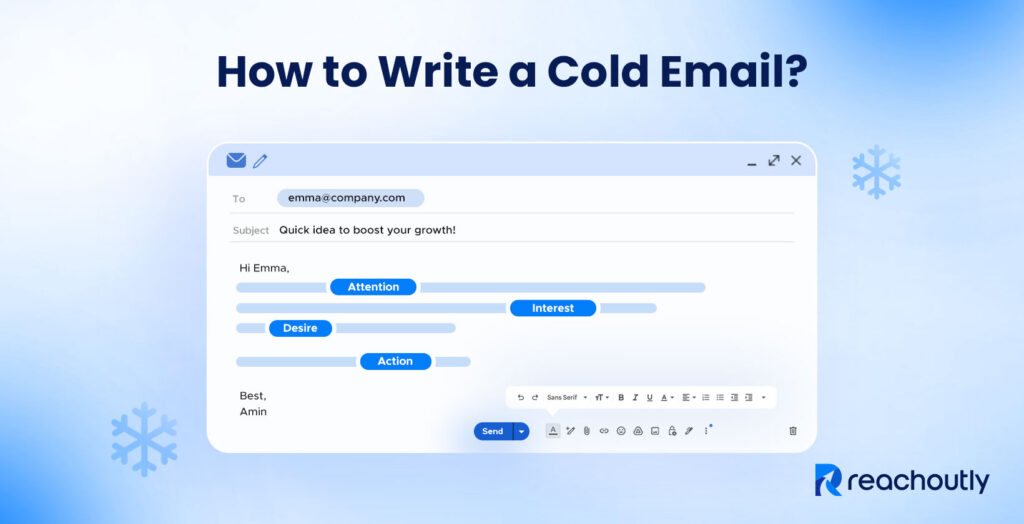
To write an effective cold email, build a qualified lead list, set a clear goal, and thoroughly research each recipient to make your message thoughtful and personal. Then craft an initial outreach message to establish contact with the recipient.
To write a personalized value-driven cold email follow these six components.
- Craft a compelling subject line (30-50 characters) that addresses a specific pain point or sparks curiosity.
- Open with a personalized hook (4-12 words) that references recipient-specific research to establish immediate relevance.
- Keep the body concise (2-3 sentences), to the point, focusing on value propositions that address their needs, not your features. Be less than 90 words.
- End with a low-commitment CTA (4-8 words) that makes the next step specific and easy to take.
- Include a professional signature with essential contact details.
- Maintain optimal length (50-125 words total) to respect their time while demonstrating clear value.
Cold email writing changes in tone, structure, and value emphasis across different contexts such as sales, B2B, affiliate marketing, investor outreach, meeting requests, job applications, internships, networking, and research opportunities.
Effective cold email writing depends on personalization, clear value propositions, and strategic messaging that addresses recipient needs. Start your first cold email campaign. Write your first cold email and follow-up sequences using the cold email templates. But, prepare before drafting the emails.
How Do You Prepare Before Writing a Cold Email?
To prepare before writing a cold email, build a qualified lead list, set clear goals, and research each recipient in depth before drafting. Know your recipient through solid research before you write a single word. It helps create personalized emails that increase response rates and avoid being marked as spam.
You have no relationship with your audience yet. So, prepare before writing a cold email following five steps. These are practical cold outreach tips that help you write effective cold emails.
- Build a qualified lead list: Start with a qualified lead list as your foundation. Write your cold email to a qualified list of relevant decision makers who already have a clear need for your solution. Go beyond surface attributes like job title or industry. Look for signals such as companies using competing tools, hiring for related roles, or showing other buying intent.
- Define your goal: Decide what you want from each cold email such as booking a meeting, securing a reply to a specific question, or starting a conversation. Set clear targets such as a response rate or number of qualified meetings per hundred emails sent. Match your request to the recipient’s role and current business context so it feels specific and doable.
- Research each recipient: Study each recipient’s business challenge, recent milestone, public statements, company priorities, and achievements. Use this research to write emails that feel personal, relevant and valuable. Go beyond using their name. Send a personalized email that is written with one recipient in mind, not a generic list.
- Craft strong subject lines: Prepare 5-7 specific, relevant subject line variations free of spam triggers. Write attention-grabbing subject lines that actually work to improve open rates. Reference a pain point, add a name when it fits, or mention a recent company event.
- Structure the email: Prepare the cold email structure in advance. Keep introductions to 2-3 sentences and use short paragraphs for easy reading. Present your value quickly.
How Do You Write an Effective Cold Email?
To write an effective cold email, craft a compelling subject line, personalize the message, keep content concise, touch on recipient pain points, and include a specific call-to-action element that guides the prospect toward desired outcome.
The process of writing an effective cold email includes the following five steps. These are the top strategies to boost response rate.
- Craft a Compelling Subject Line
- Personalize Your Opening line
- Keep the Email Body Short and Clear
- Include a Specific Call to Action (CTA)
- Add a Professional, Text-Based Signature
1. Craft a Compelling Subject Line
Effective subject lines create curiosity, show clear value, and address the audience’s specific pain point or goal. It uses strategic personalization and concise messaging. According to Klenty’s 2024 research, 33% of recipients use subject lines as the deciding factor to open emails.
There’s no magic subject line that always works. Use these six proven tactics of cold email subject lines to boost open rate.
- Personalize subject lines with names or companies. Use 30-50 characters while including the prospect’s name or company name to trigger immediate relevance. Create subject lines like “Quick question, [Name]” or, “[Company Name] + [Your Company]” that get attention without appearing spammy or overly generic.
- Demonstrate genuine research. Reference specific details that show you’ve done your homework. Test proven B2B examples such as “[XX] implementation question” or “Hi [Name] – noticed your Series B” that connect to business objectives.
- Use curiosity triggers. Apply psychology-backed phrases to spark interest and increase open rates. Insert action-oriented phrases like “Noticed your hiring” or “[Company name] growth question” that address specific pain points while maintaining a professional tone.
- Reference relevant business outcomes and value promises. Create compelling value propositions for decision makers. Focus on tangible results they care about. Boost performance with B2B examples like “ROI increase for [Company]” or “Similar results at [Company]”.
- Test and optimize continuously. Run A/B tests comparing approaches like “[Name], quick question” versus “[Company] partnership opportunity”. Track which formats drive higher conversion rates.
- Avoid spam filters with natural language. Create hooks like “Loved your SaaS metrics post” or “[Mutual contact] recommended I reach out” that spark genuine interest and accurately reflect your email’s value proposition for business prospects.
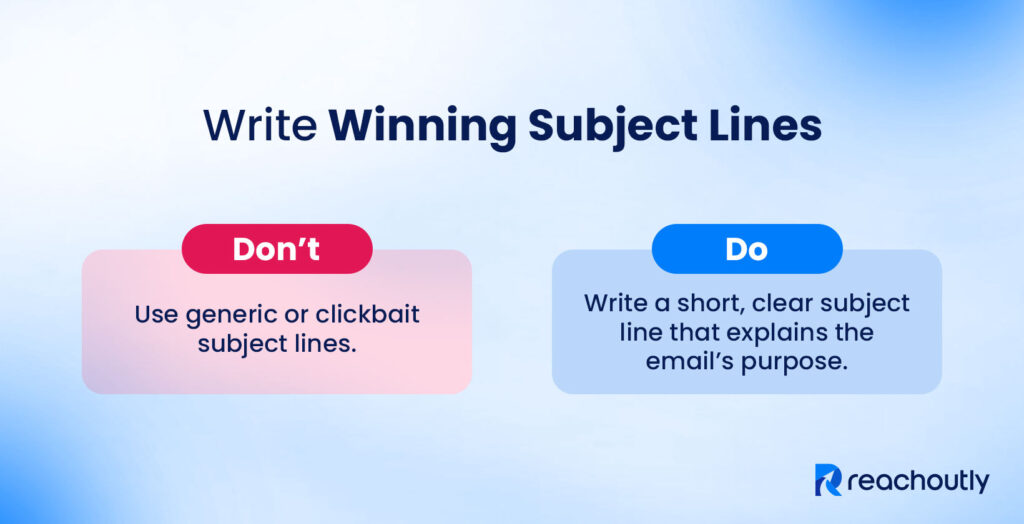
2. Personalize Your Opening line
Personalized cold email first lines increase email response rates. The first sentence of your cold email determines whether recipients read further. These opening strategies create genuine connections without triggering spam filters or sounding robotic.
- Mention specific articles, posts, or interviews your recipient created. Start with a greeting, usually using ‘hello’ or ‘dear’. Introduce yourself briefly after referencing their work with examples like “Hello [Name], loved your piece on SaaS metrics” or “[Name], saw your LinkedIn post about B2B automation.” This approach uses the recipient’s own content to establish legitimate reasons for contact rather than cold outreach. Always use second-person pronouns in your first lines.
- Lead with a compliment plus business insight. Combine authentic praise with relevant business observations. This strategy flatters recipients while demonstrating expertise in their industry or challenges. Open with “Impressive growth trajectory with your Series B funding” or “Your customer retention metrics set industry benchmarks.” These statements acknowledge achievements while positioning you as knowledgeable.
- Highlight recent company milestones or changes. This strategy shows you track their business while creating natural conversation opportunities. Open with “Congrats on the Series A announcement last week.”
- Reference mutual connections or network overlaps. Mention shared contacts, groups, or communities that create instant credibility. This approach leverages social proof while providing legitimate reasons for contact beyond cold outreach. Start with “[Name] suggested I reach out about your API integration project” or “Saw we’re both members of the SaaS Growth Forum.”
- Pose strategic questions and insights or share relevant observations. Generate curiosity without being salesy or robotic. Start with opening lines like “Quick question about your Q4 pipeline strategy” or “Noticed your team’s hiring for SDRs. Timing is perfect for a conversation” that reference specific business situations. It makes the cold email opening line immediately relevant to the recipient.
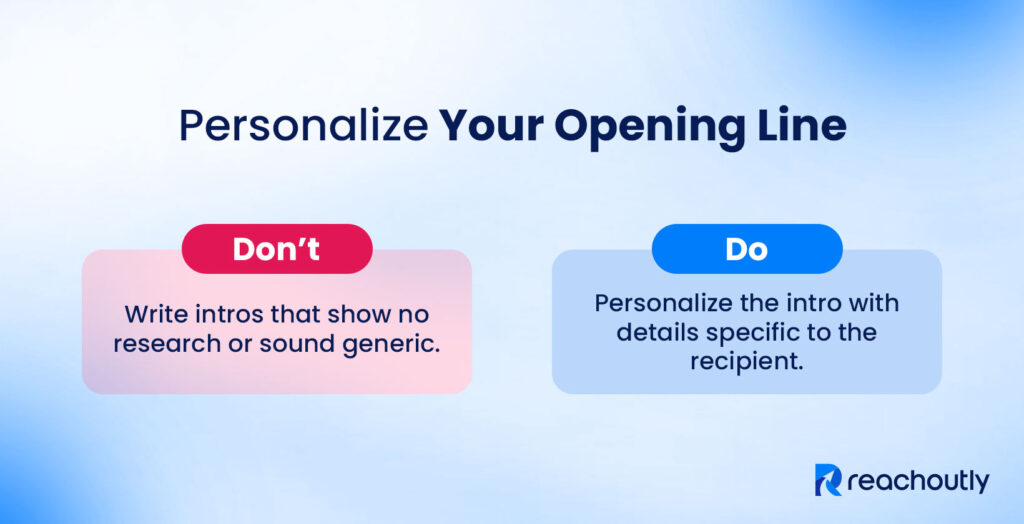
3. Keep the Email Body Short and Clear
Your email body contains the core message that transforms initial interest into meaningful action. This section is your opportunity to demonstrate clear value to busy recipients. It tells recipients why responding benefits them. Respect their time and intelligence through concise, relevant messaging. Create clear, personalized messages that busy recipients actually read and respond to.
- Write your cold email body in 2-3 sentences maximum. Write with your goal in mind. Deliver complete information without overwhelming recipients. This constraint forces you to eliminate unnecessary words and be clear in your message.
- Follow the PAS or AIDA framework. Use proven frameworks like PAS (Problem-Agitate-Solution) or AIDA (Attention-Interest-Desire-Action) that guide readers through logical progression from awareness to engagement.
- Personalize each paragraph. Reference their company, industry challenges, or recent achievements that demonstrate genuine research and relevant connection to your message. Be relevant in your cold email.
- Use bullet points to highlight key value propositions. Break complex information into scannable bullet points that improve readability. This format allows recipients to absorb multiple benefits quickly without reading dense paragraph blocks.
- Include social proof with specific results. Leverage evidence through concrete examples, measurable outcomes, or relevant case studies that build credibility. This approach transforms claims into believable statements by backing promises with proof.
4. Include a Specific Call to Action (CTA)
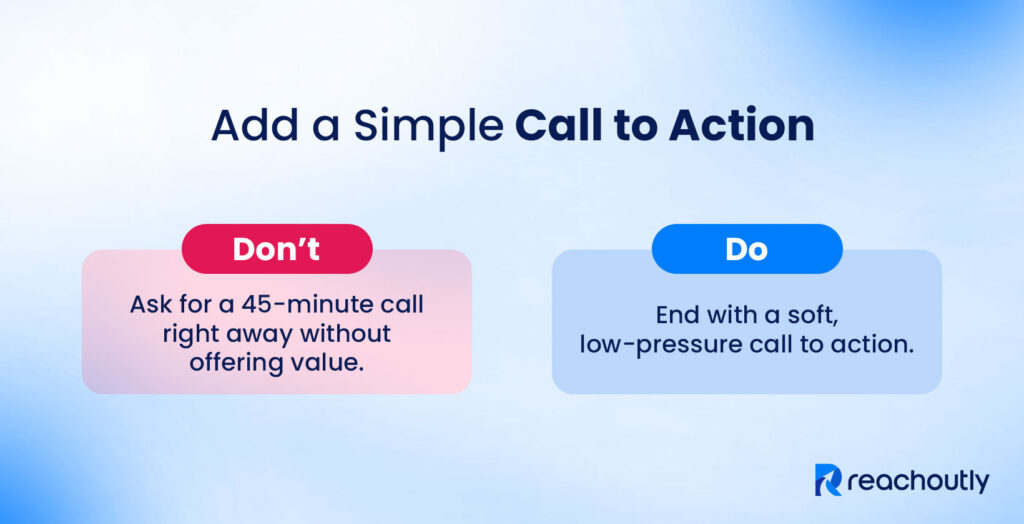
Effective CTAs include specific, low-commitment requests that ask recipients to provide simple responses, schedule brief conversations, or express basic interest without overwhelming decision-making processes. These guidelines create clear requests that busy recipients can answer quickly without extensive deliberation.
- Keep CTAs between 4-8 words. The best cold email CTAs are short. They remain easy to scan and understand. Include proven CTA formats like “Worth a quick chat?” or “Open to a 15-minute call?.” Craft calendar-based options such as “Does Tuesday at 2pm work?” or “Book a brief call here.” Schedule concrete next steps while eliminating back-and-forth coordination challenges.
- Ask for low-commitment, specific actions. Invite engagement through interest-based approaches like “Any interest in learning more?” or “Worth exploring for your team?”. These soft CTAs help measure genuine interest while converting curiosity into conversations.
- Provide multi-choice options when appropriate. Ask questions like “A quick call, email exchange, or send more info?” that give recipients control over engagement level and preferred communication method.
- End with one clear request connected to your value. Avoid multiple competing CTAs that create confusion and reduce response rates. Include your primary request in the final paragraph. Ensure it connects logically to the value proposition presented in your email body. This helps recipients understand exactly what step to take and why responding benefits their specific situation.
5. Add a Professional, Text-Based Signature
Your email signature is your digital business card that establishes credibility and provides contact details for recipients who want to continue the conversation. A well-designed signature includes your full name, job title, company name, and key contact information while keeping the structure simple and professional to boost trust and engagement. These rules create simple, functional signatures that boost trust without hurting deliverability.
- Include 3-5 essential contact details. Add your full name, job title, company name, phone number, LinkedIn profile, or calendar link to create 2-3 touchpoints for interested prospects to connect with you.
- Keep signatures 4-5 lines maximum. This constraint maintains visual simplicity while ensuring recipients find critical details quickly without scrolling or searching.
- Keep signature elements structured from most to least important. It ensures recipients can quickly find the information they need to take next steps.
- Create simple, trust-building designs. Avoid overly complex branding, HTML formatting or multiple images that appear unprofessional or trigger security concerns. Use signature generators or templates that optimize for deliverability. Here’s an excellent example of an effective cold email signature:
Steve Dalia
VP of Sales | Reachoutly
steve@reachoutly.io | +1 (954) 415-4515
LinkedIn: linkedin.com/in/stevedalia
Book a 15-min call: calendly.com/stevedalia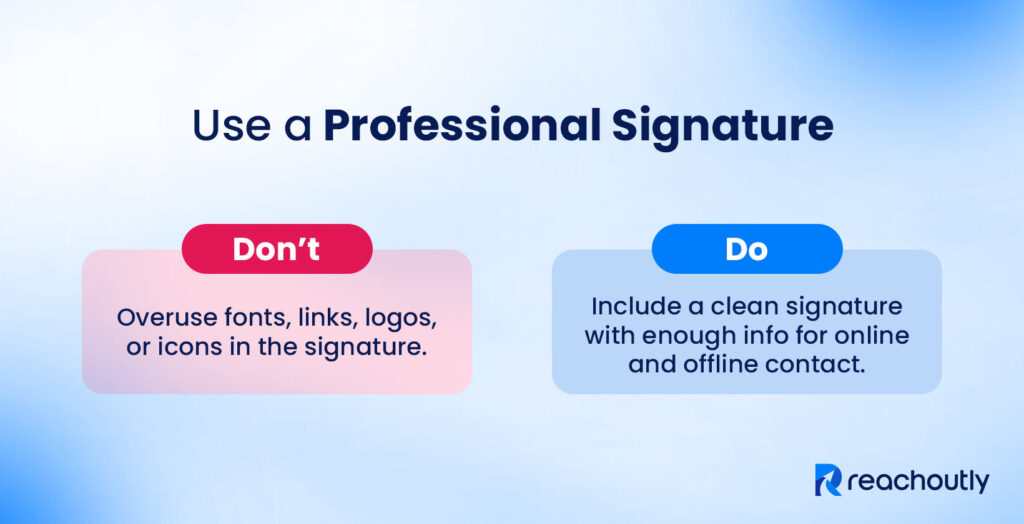
How to Write a Cold Email for Sales?
To write a sales cold email, keep it under 90 words with 4-5 sentences, start with a personalized greeting, address a specific pain point, present a clear value proposition, reference recent company developments, and end with a low-commitment CTA.
An effective sales cold email focuses on sparking conversations rather than closing deals immediately. The goal is to grab attention through personalized opening lines. Present clear value propositions that address specific pain points. Build genuine relationships with prospects who fit your ideal client profile.
Start by researching your audience. Greet the recipient warmly by their name. Use attention-grabbing opening lines. Write 4-5 sentences max to improve readability. Use templates that you deeply personalize for each prospect rather than sending generic messages.
Address the recipient’s specific needs or recent company developments to spark genuine interest. Present how your product or service helps solve their challenges. Avoid overwhelming them with feature lists or sales jargon.
Convert interest through strategic messaging by limiting unnecessary fluff and removing excessive preamble. Convey value through concrete examples rather than vague promises. Generate pipeline opportunities through clear CTAs like “Would you be open to a 15-minute call next week?” that request low-commitment next steps. Here’s an effective example:
Subject: Quick win for [Company Name]'s Q4 targets?

Hi [First Name],

Saw your LinkedIn post about scaling your sales team. Most SaaS teams in growth mode struggle with keeping the pipeline full while maintaining lead quality.

We helped [Similar Company] boost qualified leads by 40% in 90 days using precision-targeted cold outreach.

Open to a quick 10-min call this week to explore if we could replicate that for [Company Name]?

Best,
[Your name]
How to Write a Cold Email for Affiliate Marketing?
To write a cold email for affiliate marketing, introduce yourself, link the offer to the recipient’s needs, keep the tone conversational, and give a clear low-friction call to action (CTA).
Write cold emails for affiliate marketing to promote value rather than pushing products. Introduce relevant offers while building genuine credibility with potential customers. The goal is to spark curiosity by highlighting specific benefits that address recipient pain points.
Write a value-driven message that introduces yourself briefly. Highlight how the affiliate product or program solves specific problems for the recipient’s business or personal situation. Personalize each email by addressing their industry challenges, recent company developments, or professional interests that connect naturally to your affiliate offer.
Include clear CTAs like “Would you like to try [product] free for 7 days?” or “Check out this tool that’s helped [Similar Company] increase [specific metric].” Provide low-barrier entry points rather than aggressive sales language. Here’s an effective example:
Subject: [First Name], tool we used to boost CTR 40% last month

Hi [First Name],

Came across your post about improving email campaign performance. Really resonated since we hit the same wall last quarter.

We tested a tool called [Affiliate Product] and saw a 40% spike in CTR in just 30 days. Total game-changer for our Q3 performance.

They’re offering a free 14-day trial right now. Might be worth testing for your Q4 push?

Want me to send over the link or a quick summary of how we used it?

Best,
[Your name]
How to Write a Cold Email for B2B?
To write a B2B cold email, research the recipient’s company, reference recent developments, show how your solution solves specific business challenges, use a framework like AIDA or BAB, include quantifiable proof, and end with a clear, low-commitment CTA that respects the recipient’s time.
Write cold emails for B2B audiences by focusing on building professional relationships rather than immediately closing deals. Research their company situation to demonstrate clear understanding of business challenges. Personalize messages, state what your product/solution does, and highlight how your it addresses their particular problems.
Create value-driven B2B messages using proven frameworks like AIDA (Attention-Interest-Desire-Action) or BAB (Before-After-Bridge). Structure your outreach around prospect pain points and concrete solutions. Start with professional greetings that reference the prospect’s company or role.
Include specific proof points such as “helped similar manufacturing companies reduce costs by 25%” or “enabled SaaS startups to scale from 10 to 100 employees.” Grab attention through quantifiable benefits rather than generic value propositions. Present clear calls to action that respect the recipient’s busy schedule. Here’s an effective example:
Subject: Curious, how are you managing inventory post-Chicago expansion?

Hi [First Name],

Saw that [Company] recently expanded operations in Chicago. Congrats on the growth!

We’ve worked with manufacturers like [Company Example] during similar growth phases and helped reduce inventory waste by up to 30% with automated tracking systems.

Would it make sense to explore if your logistics process could benefit from something similar? Open to a quick 15-min chat?

Best,
[Your name]
How to Write a Cold Email to an Investor?
To write a cold email to an investor, target those aligned with your thesis, personalize to their portfolio, keep under 90 words, share concrete traction, and request a low-friction next step like sending a deck or booking a short call.
Write a compelling cold email to an investor by introducing yourself as the founder. Highlight your company’s most impressive metrics or recent achievements that demonstrate momentum. Personalize each email by researching the investor’s portfolio companies, recent investments, and stated investment thesis. Show why your startup is a strategic fit for their fund.
Present your company’s unique value proposition concisely. Keep the content under 90 words. Include specific data points like revenue growth, user acquisition, or partnership announcements that prove market traction.
Use low-friction next steps such as offering to share additional details or suggesting a brief introductory call rather than requesting immediate funding. Provide clear reasoning for contacting them by referencing their expertise in your industry or successful investments in similar business models. Attach professional materials and refine your call to action to align with the investor’s evaluation process. Here’s an effective example:
Subject: 300% growth, AI logistics company scaling fast

Hi [First Name],

I'm [Your Name], CEO of [Company]. We’re helping mid-market manufacturers automate logistics with AI. And it’s working.

After seeing your investment in [Portfolio Company], I thought this might be up your alley:
1. 300% YoY revenue growth
2. $2M ARR
3. Trusted by Fortune 500 brands

Can I send over our deck, or would a 15-min call work better for you this week?

Best,
[Your Name]
[Attachment: Executive Summary]
How to Write a Cold Email for a Meeting?
To write a cold email for a meeting, keep it under 90 words, introduce yourself in one line, state clear value, personalize context, and offer specific low-commitment time options.
Prioritizes getting a simple “yes” response rather than explaining every detail about your company or service offering. The goal is to ask for specific meeting types like 15-minute introductory calls while providing clear value propositions. Start with personalized greetings, provide relevant context for why you’re reaching out. Discuss specific values the recipient receives from the meeting.
Write concise messages under 90 words. Create value-focused messages that grab attention through mutual connections, shared business interests, or relevant industry insights rather than generic sales approaches. Provide clear frameworks that explain the meeting’s purpose and expected outcomes. Maintain a friendly, non-pushy tone throughout your request.
Ask for low-commitment time slots like “brief Zoom call” or “quick 15-minute chat” that respect their schedule while creating opportunities for meaningful business conversations. Here’s an effective example:
Subject: Scaling your team without the hiring drag?

Hi [First Name],

Noticed [Company Name] is growing fast. Congrats on the momentum!

We recently helped a SaaS firm cut their time-to-hire by 40% using a repeatable hiring ops system. They went from weeks to days in bringing top talent onboard.

Would love to share how it might work for you. Open to a quick 15-min chat next week to see if there's a fit?

Best,
[Your Name]
[Your Company]
How to Write a Cold Email for a Job?
To write a cold email for a job, introduce yourself in one line, link your skills to the company’s needs, highlight measurable results, personalize with research, and request a brief, low-effort next step.
Introduce yourself professionally and identify specific reasons you’re reaching out to their organization to start meaningful conversations. Write personalized messages under 90 words. Introduce your value proposition by explaining your relevant background concisely. Highlight specific skills or accomplishments that align with their company’s current challenges or growth trajectory.
Identify particular aspects of their business, recent company news, or team structure that attracted your interest. Demonstrate genuine research rather than generic job hunting. Mention specific achievements like “increased sales by 30%” or “led cross-functional teams of 15+ people” that convey your potential contribution to their organization. Maintain a professional tone throughout your outreach message.
Include clear next steps like requesting brief informational interviews or permission to send your resume for relevant positions. Here’s an effective example:
Subject: Inspired by your Q3 campaign - let’s chat?

Hi [First Name],

I’m [Your Name], a digital marketing strategist with 5 years of growth-focused experience in SaaS. Your Q3 product launch really stood out. That positioning was sharp.

At my last role, I led a content marketing push that drove a 40% lift in qualified leads within 3 months. I’d love to explore if those same strategies could support your upcoming initiatives.

Would you be open to a 15-minute chat this week to see if there’s a fit?

Best,
[Your name]
How to Write a Cold Email for an Internship?
To write a cold email for an internship, explain your interest in their company in under 90 words with specific references, highlight relevant skills or projects, and request clear next steps.
Write a cold email for an internship opportunity by explaining why you’re specifically interested in their company, recent work, or industry focus. Include relevant coursework, projects, or experience that demonstrates your preparation for the internship role. Show genuine enthusiasm for learning from their team.
Identify specific aspects of their business, recent company achievements, or team structure that attracted your attention. Prove you’ve conducted thorough research before reaching out. Write concise messages under 90 words.
Ask for clear next steps with professional CTAs that request brief conversations, permission to send your resume, or guidance about potential internship opportunities. Here’s an effective example:
Subject: Loved your [campaign/project], curious about internship openings

Hi [Ms./Mr./Mx. Last Name],

I’m [Your Full Name], a [Your Year] marketing student at [Your University]. I was genuinely inspired by your recent [campaign/project/initiative]. The [brief praise: e.g. storytelling, creativity, impact] really stood out.

At [Your University or Organization], I [what you did e.g. led social media for XYZ club] and increased engagement by [specific % or stat] through a targeted content strategy. I’d love to bring that same energy to your team. Especially in [your strength area: e.g. social strategy, content design, campaign planning].

Would you be open to a quick 15-minute call next week? I’d love to learn more about your team and how I might contribute this summer.

Warmly,
[Your Full Name]
[Your Email]
[Your Phone Number]
How to Write a Cold Email for Networking?
To write a cold email for networking, keep it under 90 words, introduce yourself authentically, reference specific achievements of the recipient, highlight shared interests, and request a brief low-commitment interaction like a short call or coffee meeting.
Write cold emails for networking by focusing on making meaningful professional connections rather than pitching products or services to busy industry professionals. The goal is to ask for brief conversations turning into valuable mentorship or collaboration opportunities. Keep this email as short as possible.
Introduce yourself with purpose by explaining your current role, background, or career stage. Connect your message to specific aspects of the recipient’s work, recent achievements, or industry contributions. Research their recent projects, published content, or professional accomplishments to find genuine points of connection that demonstrate your sincere interest in their expertise.
Write concise messages under 90 words. Ask for low-commitment interactions like brief phone calls, coffee meetings, or simple advice requests. Allow them to choose their level of engagement based on their availability and interest. Respond graciously whether they accept or decline your networking request. Maintain long-term relationship perspectives rather than expecting immediate responses. Here’s an effective example:
Subject: Really enjoyed your article on [article_topic]

Hi [First Name],

[Your Name] here. I’m a [Your Title] at [Your Company], focusing on [niche/topic]. Your recent [Article Publication] piece on [Article Topic] really stood out, especially your take on [Specific Framework/Insight].

We’re seeing similar challenges with our [Target Client Type], and your framework sparked a few ideas I’d love to bounce off you.

Would you be open to a quick 15-minute call to chat further?

Thanks again for sharing such valuable insights. I've already shared your article with a few colleagues!

Best,
[Your Name]
[Your Email]
How to Write a Cold Email for Research?
To write a cold email for research, use a formal academic tone, reference the professor’s publications, state your qualifications, and request a defined opportunity under 90 words while explaining how you can contribute to current projects.
Write cold emails for research opportunities that address professors with proper titles. Introduce your academic credentials by stating your name, school, year level, and major. Explain your specific interest in their research area or recent publications. Show that you’ve reviewed their work by mentioning particular papers, projects, or methodologies that align with your academic interests and career goals.
Write respectful messages under 90 words. Ask for specific research opportunities like undergraduate research positions, lab assistant roles, or summer internship programs. Demonstrate your motivation to contribute meaningfully to their ongoing work. Link your previous coursework, relevant skills, or research experience to their current projects. Explain how you add value to their team. Include clear contact information for follow-up communications. Here’s an effective example:
Subject: Research Collaboration Inquiry - [Lab Name or Topic]

Dear [Dr. Last Name],

I’m [Your Full Name], a [Year] majoring in [Your Major] at [Your University] ([Your GPA] GPA). I recently read your paper on [Specific Paper Topic], and it strongly aligns with my research on [Your Research Topic or Thesis].

With coursework in [Relevant Coursework or Skills], I’m particularly interested in your lab’s work on [Specific Methodology or Focus Area]. If any undergraduate research positions are available for [Timeframe, e.g., Spring Semester], I’d love the opportunity to contribute.

Would you be open to a quick conversation to explore this further?

Warm regards,
[Your Full Name]
[Your Email] | [Your Phone Number]
How to Write a Follow up Cold Email?
To write a follow-up cold email, keep it 2-4 sentences, reference your original outreach, add new value, send after 2-3 business days, plan 4-9 total touchpoints, and maintain a polite tone with a clear call to action. The process of writing a follow-up cold email includes the following components.
- Timing and Frequency Strategy: Wait 2-3 business days after your initial cold email before sending your first follow-up. Then use systematic spacing that gradually increases intervals between subsequent messages. Track email opens and responses to optimize your follow-up schedule and boost response rate. Include 4-6 total touchpoints over several weeks. Use consistent subject lines that reference your original message to maintain conversation continuity.
- Follow-up Message Structure: Reiterate your initial value proposition briefly while adding new elements like resources, case studies, or relevant insights. Write shorter messages than your original email, typically 2-4 sentences maximum. Maintain a polite, helpful tone throughout your sequence. Use familiar greetings that acknowledge your previous outreach. Include clear call-to-action elements that make responding easy for busy recipients.
- Content and Tone Guidelines: Ensure your follow-up emails remain professional and valuable rather than desperate or demanding throughout your sequence. Provide specific value additions in each message. Respond to the recipient’s potential concerns by addressing common objections, providing social proof, or sharing relevant industry insights that demonstrate your expertise. Check your tone to ensure each message sounds helpful rather than pushy. Use simple language that avoids jargon while maintaining conversational professionalism.
- Recipient-Responsive Sequence: Use tracking software to monitor email opens and engagement if needed. Personalize each message based on recipient behavior or new information about their company. Know when to stop your sequence. Send follow-ups that gradually shift your approach from direct value propositions to soft opt-out messages that maintain relationship potential.
For practical guidance on follow-up writing and sequencing strategy, including what to send and when, read our cold email follow-up guide.
What Is the Ideal Structure of a Cold Email?
The ideal structure of a cold email consists of a 30-50 characters personalized subject line, a one-sentence introduction, a value proposition addressing recipient pain points, and a clear CTA. An ideal cold email remains within 50-125 personalized words containing research and social proof.
Effective cold emails use frameworks like AIDA (Attention, Interest, Desire, Action) or WIIFT (What’s In It For Them) to structure content logically. Every element serves the recipient’s interests rather than the sender’s needs.
Subject line and introduction components grab attention through personalization. Write subject lines between 30 and 50 characters that include the recipient’s name, company, or reference specific pain points they’re experiencing. Begin the cold email body with a strong, personalized opening line. Introduce yourself in one sentence that establishes credibility and explains why you’re reaching out to them specifically. Use research about their company, recent achievements, or industry challenges to demonstrate genuine interest. Get straight to the point and avoid formalities and preamble.
Value proposition and body structure explain clearly what problem you solve and how your solution benefits their specific situation. Use 2-5 sentences maximum to present your solution while highlighting outcomes. Include social proof or relevant case studies that provide credibility. Offer concrete benefits that address their identified pain points. Personalize your value proposition based on their role, industry, or recent company developments. Show you understand their unique challenges and you have meaningful solutions.
Call to action and closing elements provide clear next steps that make responding easy. Requests to make: a specific ask, a quick call, a meeting. Ask for specific actions like “open to a 15-minute call next week?” rather than vague requests. End professionally with complete contact information. Include professional email signatures with your name, title, company, and key contact details to establish credibility and make follow-up communication seamless.
This structure works for 3 key reasons. It respects the recipient’s time through brevity. It demonstrates value immediately through personalization and relevant solutions. It removes friction from the response process through clear action steps. The framework optimizes for human psychology by leading with curiosity, establishing credibility quickly, presenting relevant solutions, and making the next step obvious. This results in significantly higher response rates than unstructured approaches that focus on sender needs rather than recipient benefits. The next step is deciding how much to say so each part stays concise enough to read and strong enough to earn a reply
How Long Should a Cold Email Be?
A cold email’s length should be between 50 and 125 words or about 2-5 sentences, to maximize response rates.
Most email marketing professionals recommend keeping cold emails under 200 words maximum, though shorter messages perform significantly better. The optimal cold email length is between 50 and 125 words, which translates to roughly 2-5 sentences. This allows you to write personalized greetings, state your value proposition clearly, and include compelling calls to action without losing reader interest.
At Reachoutly we try to keep our cold emails under 90 words. This sweet spot maximizes response rates because it respects busy professionals’ limited attention spans while providing enough content to demonstrate value and credibility.
Concise cold emails focus on the recipient’s needs rather than lengthy explanations that overwhelm or bore prospects. Brevity optimizes engagement, as recipients quickly scan and understand short messages within their busy schedules. Because of the concise message, personalization becomes key.
What Is Cold Email Personalization and How to Do It?
Cold email personalization customizes outreach to each recipient by referencing their achievements, company news, or specific challenges. To personalize cold email effectively research their background, tailor subject lines and value propositions to their needs, and use authentic human touches.
Cold email personalization is the practice of customizing your outreach messages to address specific recipients individually. It demonstrates that you’ve researched their company, industry, and professional background. It involves referencing the recipient’s recent achievements, company news, mutual connections, or specific pain points that show genuine understanding of their situation.
To personalize effectively, research each prospect thoroughly. Gather information about their company, recent projects, blog posts, or industry challenges they’re facing. Use this research to craft subject lines that reference specific company developments. Tailor your introduction to mention their recent work. Customize your value proposition to address their pain points or business objectives.
Segment your audience by industry, company size, or job title to personalize further and create targeted campaigns that address common challenges within each group. Mention specific achievements, congratulate them on recent company milestones, or reference mutual connections that provide legitimate reasons for outreach. Highlight how your solution connects to their specific situation. Personalize your CTAs based on their role and decision-making authority. The method of personalization changes between straightforward writing and copy built to prompt action.
Cold Email Writing vs. Cold Email Copywriting: What Is the Difference?
The main difference between cold email writing and cold email copywriting is that writing focuses on clear communication, structure, and relationship building, while copywriting emphasizes persuasion, psychological triggers, and conversion optimization.
Cold email writing focuses on the fundamental process of creating outbound messages to reach prospects without prior contact. It emphasizes proper structure, personalization techniques, and basic communication principles. This approach concentrates on building authentic connections through research-based messaging, clear value propositions, and professional tone. It helps initiate business conversations with potential clients or partners.
Cold email copywriting uses advanced persuasion techniques and psychological frameworks to create high-converting messages that drive specific actions from recipients. Copywriters make strategic decisions about word choice, emotional triggers, and compelling offers that get higher response rates through tested formulas and proven cold email templates. This approach teaches marketers to craft messages that speak directly to pain points. It uses sophisticated frameworks like AIDA or PAS to engage prospects more effectively.
The key difference lies in execution. Writing focuses on clear communication and relationship building. Copywriting emphasizes conversion optimization and persuasive techniques that drive specific actions and maximize response rates. Now, you can plan your first cold email campaign.
How to Start Your First Cold Email Campaign?
To start your first cold email campaign, define your ideal customer profile, build verified prospect lists, create personalized value-focused templates, write strong subject lines, schedule follow-ups, track metrics, test variations, and optimize performance. Starting your first cold email campaign includes the following six steps.
- Define Ideal Customer Profile: Choose your target audience carefully. Outline clear outreach goals. Identify decision makers who fit your solution.
- Build Prospect Lists: Create targeted and verified lists with accurate contact information to ensure relevance and deliverability.
- Create Email Templates: Develop value-focused effective email templates. Personalize for different segments while keeping an authentic tone and clear value propositions. The specific sections above for sales, B2B, job etc. have the best examples of cold email templates.
- Write Subject Lines and Messages: Craft subject lines that hook recipients. Personalize messages to address specific pain points and spark conversations.
- Schedule Follow-Ups: Plan follow-up sequences to increase response rates while respecting recipient schedules.
- Track and Optimize: Implement proper tracking. Monitor open and reply rates. Test different approaches. Adjust based on deliverability and engagement metrics.