
How to Follow Up on a Cold Email? (10 Templates Included)
Cold email follow-ups are a series of emails that are scheduled to be sent after your initial email. Cold email follow-ups are sent to guide leads along the sales pipeline. If a prospect does not respond, assume they are too busy and follow up until they have a chance to respond. Most replies come after the second or third touch. Wait at least 2-3 business days before sending a follow-up cold email.
To write an effective follow-up cold email after no response, lead with new value, keep the message under 125 words, be polite, not pushy, and make the reply a one-stroke task. An effective follow-up starts with a friendly reminder, provides context, shows empathy, and follows a structured step-by-step approach. Pair a short subject line with a friendly context reminder, add social proof or a relevant case study, and close with a single low-effort question. Below is an example of a cold email follow-up that works.
Subject: [ Relevant topic ] question
Hi [ First Name ],
Quick question on [ relevant topic ].
Which is the bigger issue right now at [ Company Name ]: [ option A/option B/option C ]?
If you reply with a letter, I can send a [ 2 minute suggestion/quick idea/short example ] that has worked for similar teams.
Best,
[ Your Name ]
Sending a cold email follow-up the right way means choosing the right channel and timing, striking a helpful tone, and stopping after a clear “no.” Sending a cold email and following up only once is not effective. You need to follow up at least twice for every cold email. The ideal number of follow-ups in a cold email sequence is 3-5, spaced over 14-21 days. Sending more than 5 follow-ups is too many in most cases.
Follow-up frequency and response rate benchmarks tie the entire strategy together. A proven cadence starts at Day 2-3 after the initial email and graduates to Day 21-24 for the final breakup message. Cold email campaigns with 3-5 follow-up steps produce an 8.3% reply rate compared to 4.1% without follow-ups.
This guide below covers how to write well-timed, value-adding, and personalized cold email follow-ups that actually have a chance of being read. Here are 10 ready-to-use templates for getting started, including sales and B2B outreach, and the right number and frequency of follow-ups.
How Long Should You Wait Before Sending a Follow-Up Cold Email?
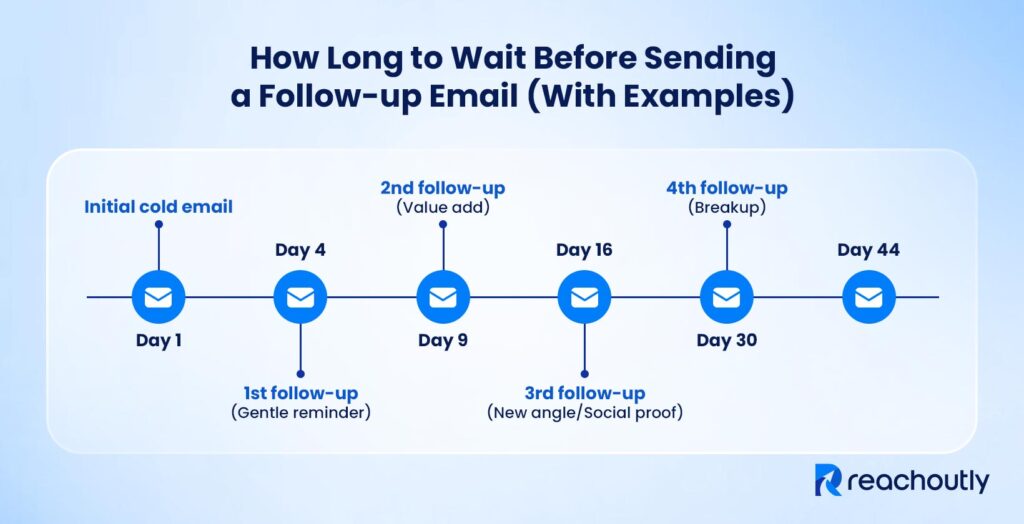
You should wait 2-3 business days before sending a follow-up cold email, according to the consensus among sales experts and data from successful cold email campaigns. Sending out follow-up emails too soon makes it seem as though you don’t respect the prospect’s time. Waiting for too long makes the original message get cold on the other hand.
For the first follow-up email, wait 3-5 business days after your initial email to a cold prospect. Even waiting 3–5 days is appropriate for non-urgent matters. This gives the recipient enough time to see and consider your email.
How early is too early to send a follow-up email? Don’t send a follow-up cold email on the same day as the first email. It ensures you’re not perceived as too aggressive.
How long to wait before sending another follow-up? Space out any additional follow-ups by 4-7 days. This balance keeps your emails consistent without overwhelming the recipient. A proven spacing pattern looks like below.
- Wait 3 days after your first email
- Then wait 5 days
- Then wait 7 days
This graduated spacing keeps you visible without overwhelming the recipient. Aim for 3-5 follow-ups spaced over 2-3 weeks for a complete sequence.
The exceptions to the standard cold email follow-up wait time are listed below.
- C-level executives: Wait 3, 5, or 7 days. Senior leaders have packed inboxes and longer review cycles.
- Time-sensitive offers: Follow up within 24-48 hours when a deadline or limited opportunity exists.
- Warm prospects who are already engaged: Wait for only 2 days in this case, as these contacts already recognize your name.
- Different time zones: Give an extra business day so recipients can see your message during their working hours.
The best practices for cold email follow-up timing are listed below.
- Send mid-week: Tuesday or Wednesday consistently delivers peak engagement.
- Stop after no response to 5-7 touchpoints: Switch to a long-term nurture approach at that point.
- Add fresh value each time: Every follow-up brings a new insight, a relevant case study, or a different angle that earns the prospect’s attention.
How to Write a Follow-Up Cold Email After No Response?
To write an effective follow-up cold email after no response, lead with new value, keep the message short, and make the reply process effortless for your prospect. Below are the steps to write a follow-up cold email that gets responses.
- Use a solid subject line that grabs the prospect’s attention. Make the subject line short and specific. Keep it under 50 characters. Reference the previous conversation or hint at a new value proposition.
- Keep your follow-up emails short and sweet. Write follow-up cold emails under 125 words. Short messages respect your prospect’s time and get read faster. Every sentence earns its place by delivering value or moving the conversation forward.
- Completely avoid starting with lazy openers. “Any updates,” “Just following up,” and “Just checking in” signal zero effort. These phrases tell your prospect you have nothing new to offer.
- Start with a friendly reminder that provides context about your original message. It should be a brief recap of your original call to action. So the prospect does not search for your previous message.
- Lead with value. Share a relevant case study, a useful data point, a resource, or a fresh insight connected to the prospect’s business challenge that they did not see before.
- Include social proof. Mention a recognizable client name, a specific result, or a recent success story to build credibility and reduce hesitation. Make sure it’s relevant to your niche.
- Be polite, not pushy. Strike a helpful tone. Show empathy and acknowledge the prospect’s limited time. Don’t be vague or redundant.
- Make replying a one-stroke task. Ask one question that requires minimal effort to answer.
Design a cold email follow-up strategy that ties the writing steps above to increase conversion. Below is the blueprint of the best follow-up strategy.
- Follow up in the same email thread so the prospect sees context without searching.
- Wait 3-7 days between each follow-up, increasing the gap as the sequence progresses.
- Tell the prospect exactly why you are contacting them in each message.
- Personalize your emails as much as possible. Reference the prospect’s role, company, or a recent event.
- Use a cold email tool to schedule your follow-ups automatically so no prospect falls through the cracks.
Below is an example of a cold email follow-up sequence that goes through five distinct stages.
- The “more information” follow-up (Email 2): Use this follow-up to provide more value. Add missing context like a case study, a stat, or proof that backs your original offer.
- The “second pitch” follow-up (Email 3): Reframe your value from a different angle or highlight a different benefit.
- The “bump-up” follow-up (Email 4): Ask if the prospect is the right person to talk to, or request a referral to the right contact.
- The “feedback” follow-up (Email 5): Ask one direct question about their biggest challenge related to your offer.
- The “last chance” follow-up (Email 6): Send a friendly breakup email that closes the loop and leaves the door open for future conversations.
What Are Effective Cold Email Follow-Up Templates?
We gathered 10 real-world cold email follow-up templates from our outreach campaigns that increase responses, including 5 sales and B2B sales templates. Use these cold email follow-up examples below to help you get started. Test and refine them according to your offer and ICP as you go along with your cold email campaigns.
1. Cold Email Follow-Up Template After No Response
Your first email landed but got buried. This follow-up cold email template resurfaces your value in one line. Swap the metric and timeframe to match your prospect’s biggest priority right now.
Send 2-3 business days after your first email.
Subject: Thought you should know about [ topic from your last email ]
Hi [ First Name ],
Bumping this to the top of your inbox, re: [topic from your last email].
We help teams like [ Company Name ] improve [ one metric, e.g., “reply rates” / “booked demos” / “close rates” ] in about [ timeframe, e.g., “30 days” ] by [ what you do in 3-6 words, e.g., “fixing cold email sequences” ].
Open to a quick 10-minute chat, or I can send the 2-sentence summary here?
Best,
[ Your Name ]
2. Cold Email Follow-Up Template After You’ve Already Sent a Follow-Up
You sent two emails and got zero replies. This follow-up cold email template stops asking and starts giving free value instead. Replace the tip with one actionable fix your prospect can use today without buying anything. Send 5-7 business days after your second email.
Subject: Small idea for [ Company Name ]
Hi [ First Name ],
Not sure if this is on your radar, but teams in [ their industry, e.g., “B2B SaaS” / “staffing” / “ecommerce” ] run into [ pain point, e.g., “low reply rates on follow-ups” ], especially when [ trigger they relate to, e.g., “sequences go past 5 emails with no personalization” ].
One quick fix that works: [ one actionable sentence, e.g., “swap your second follow-up from a reminder to a case study, it reframes the conversation from ‘chasing’ to ‘proving.'” ]
I have a 3-bullet plan for improving [ same pain point ] if you want it. Just say the word.
Best,
[ Your Name ]
3. Cold Email Follow-Up Template After a While Has Passed
Silence stretched past a week. This follow-up cold email template reintroduces you through a peer’s success story. Swap the client name and results for a company in your prospect’s industry and size range. Send 7-14 days after your last follow-up.
Subject: How [ Client Name ] improved [ metric ]
Hi [ First Name ],
Quick example from a [ their industry or role, e.g., “B2B staffing” ] team.
[ Client Name ] was dealing with [ pain point, e.g., “sub-5% cold email reply rates” ] and wanted [ desired outcome, e.g., “20+ booked calls per month” ]. After working with us, they saw:
- [ Result 1 + timeframe, e.g., “18% reply rate in 45 days” ]
- [ Result 2 + timeframe, e.g., “34 booked demos in month two” ]
Want the 3-bullet breakdown of what we did?
Best,
[ Your Name ]
4. Cold Email Follow-Up Template After Tweaking an Email
Your original angle did not land. This follow-up cold email template pivots to a different pain point they care about more. Change the alternative benefit to reflect a challenge you spotted on their website or LinkedIn. Send 5-7 business days after the previous follow-up got no response.
Subject: Another angle on [ topic from your last email ]
Hi [ First Name ],
I pitched [ topic ] from the angle of [ original angle, e.g., “reply rates” ], but for teams like yours, [ alternative benefit, e.g., “cutting lead response time” ] is the more urgent win.
For example, we helped [ Client Name ] achieve [ specific result, e.g., “a 3-hour average response time, down from 26 hours” ] in [ timeframe, e.g., “30 days” ] using this approach.
Which matters more for [ Company Name ] right now, [ alternative benefit, e.g., “faster response time” ] or [ original angle, e.g., “higher reply rates” ]?
Best,
[ Your Name ]
5. The Breakup Cold Email Follow-Up Template
You have followed up 4-5 times. This final follow-up email creates closure that makes prospects reply to avoid losing access. Reference the exact topic from your sequence so the close feels personal, not automated. Send 7-10 business days after your last follow-up as the final email in your sequence.
Subject: Closing the loop
Hi [ First Name ],
I do not want to keep pinging you about [ business aspect ].
Should I put this on hold, or is it worth a quick chat?
Reply with [ close/hold/talk ], and I will follow your lead.
Best,
[ Your Name ]
The 5 cold email follow-up templates below are designed specifically for sales and B2B sales. Use these cold email follow-up templates to revive stalled deals and close revenue.
6. After Trigger Event Follow-Up Cold Email Template
A prospect just announced funding, a launch, or a key hire. This trigger event follow-up cold email template ties your solution to their momentum. Name the exact achievement and connect it to a growth challenge that comes with their milestone. Send within 2-5 days of the news breaking.
Subject: Quick note on [ achievement, e.g., “the Series B”/”the product launch”/”the new VP of Sales hire” ]
Hi [ First Name ],
Congrats on [ same achievement ], saw it on [ source, e.g., “LinkedIn” / “TechCrunch” / “your company blog” ].
After a [ type of event, e.g., “funding round” / “product launch” / “leadership hire” ], teams tend to double down on [ relevant area, e.g., “outbound pipeline” / “lead gen” / “sales hiring” ]. Is that on your list for the next [ timeframe, e.g., “30” / “60” / “90” ] days?
If yes, I have one quick idea for [ same relevant area ]. Want it here, or open to a 10-minute chat this week?
Best,
[ Your Name ]
7. After Meeting Follow-Up Cold Email Template
You just finished a live conversation. This meeting follow-up cold email template locks in accountability before momentum fades. Include the exact goals, benchmarks, and phrases they used during your call, not your own words. Send within 24 hours of the meeting.
Subject: Recap and next steps
Hi [ First Name ],
Thanks again for today. Confirming our next conversation on [ day, e.g., “Thursday” ] at [ time, e.g., “2 PM EST” ].
Quick recap from my notes is below.
- Priorities: [ goals, e.g., “scale outbound to 500 prospects/week”, “improve reply rates past 8%”, “book 30+ demos/month” ]
- Success looks like: [ benchmarks, e.g., “15% reply rate by Q3”, “50 booked meetings per month” ]
- How we help: [ your product/service, e.g., “our done-for-you cold email system” ] helps by [ short mechanism, e.g., “building targeted lists, writing sequences, and managing deliverability, so your team focuses on closing” ]
I am sharing a short case study from a [ their industry, e.g., “SaaS” ] team that tackled something similar.
Next step on my end: I will send [ deliverable, e.g., “the custom outreach plan” ] by [ date, e.g., “Friday EOD” ]. Does that still work?
Best,
[ Your Name ]
8. After Demo Follow-Up Cold Email Template
The demo went well, but no commitment yet. This demo follow-up cold email template provides a clear path forward with zero guesswork. Fill in the next steps with your actual onboarding process, dates, and deliverables specific to their account. Send within 24 hours of the demo.
Subject: Next steps (from today)
Hi [ First Name ],
Great talking about [ topic discussed, e.g., “your Q3 outbound strategy” ] at [ Company Name ].
If you want to move forward, here are the next steps on my side:
- [ Step 1, e.g., “I send the onboarding form by Friday” ]
- [ Step 2, e.g., “We schedule a 30-minute kickoff call for next week” ]
- [ Step 3, e.g., “First campaign goes live within 10 business days” ]
Does this line up with how you want to proceed, or is there anything you want adjusted?
Best,
[ Your Name ]
9. After Sales Call Follow-Up Cold Email Template
You promised resources during the call. This sales call follow-up cold email template delivers on that promise and keeps the door open. Replace guide titles with the actual materials you discussed. Nothing they didn’t ask about, and nothing generic either. Send the same day or the next morning after the sales call.
Subject: Resources + next step on [ pain point, e.g., “low reply rates” ]
Hi [ First Name ],
Great speaking earlier. I appreciated hearing how [ pain point, e.g., “low cold email reply rates” ] is showing up for you at [ Company Name ]. As promised, here are the two guides we discussed:
- [Guide 1 title, e.g., “The 5-Step Follow-Up Sequence That Books Demos”]
- [Guide 2 title, e.g., “Cold Email Deliverability Checklist for 2026”]
If it helps, I can send a quick 2-3 step plan for how teams typically tackle [ same pain point ] with us. Want that here, or set up 15 minutes to map it to your situation?
Best,
[ Your Name ]
10. After Proposal Follow-Up Cold Email Template
You sent pricing and heard nothing back. This proposal follow-up cold email template opens a conversation about what is stalling the decision. Mention a specific line item from the proposal or offer flexibility on the element most likely blocking approval. Send within 3-5 business days after delivering the proposal.
Subject: Any questions on the proposal?
Hi [ First Name ],
Following up on the proposal I sent over for [ project or area, e.g., “the Q3 cold email campaign” / “the outbound lead gen retainer” ].
Where is it on your side, approved, in review, or on hold?
If something is blocking it, is it scope, pricing, or timing? Reply with one word and I will send a quick option to address it.
Best,
[ Your Name ]
How to Send a Cold Email Follow-Up?
To send a cold email follow-up, make sure to use a subject line that grabs attention. Open with a friendly, gentle reminder, always provide value, and show empathy with a helpful tone. Send 2-3 well-timed follow-ups, and always stop after a clear “no”. Below are the best ways to send a follow-up after no response.
- Use cold emailing tools to streamline your follow-ups. You can use cold emailing tools to automate sending, schedule follow-ups at the right intervals, and stop sequences when a prospect replies.
- Use the subject line to grab the prospect’s attention. The subject line decides whether your email gets opened or deleted.
- Write an opening line that references the topic, not your last email. Your opening line makes or breaks the rest of the follow-up cold email. The prospect stops reading if it feels robotic or salesy.
- Always provide value. Never use “just checking in.” Give the prospect a new reason to care if you want a reply. Share a relevant case study, a useful stat, a short tip, or a resource that connects to their pain point.
- Show empathy to the recipient, especially by acknowledging their time. Tell the prospect you see them as a person, not a lead. This builds rapport faster than any pitch.
- Strike a helpful tone. Don’t be grumpy or demanding. Your follow-up reads best when it sounds like a colleague offering help, not a salesperson chasing a quota.
- Do not follow up on negative responses. If a prospect replies with “not interested” or “remove me,” respect that boundary immediately. Sending another follow-up after a clear “no” damages your sender reputation, risks a spam complaint, and burns the relationship for good.
- Send at least 2-3 follow-ups. Top performers send minimum 2-3 follow-up emails after the initial cold email. Tuesday, Thursday, and Wednesday are the best days to send follow-ups. The best send windows are 6-7 AM, 10-11 AM, and 1-2 PM in the prospect’s local time zone.
- Time your follow-ups so you don’t send too soon. Sending follow-up emails too soon makes it seem as though you do not respect the prospect’s time.
- Use templates as a starting point, not a final draft. Customize the opening line, pain point, value-add, and CTA to match each prospect’s situation.
How Many Follow-Ups Should You Send in a Cold Email Sequence?
Most cold email experts agree that sending 3-5 follow-up emails is the sweet spot for effective lead nurturing. This range maximizes your chances of engagement while minimizing the risk of spam complaints. You can keep 5 follow-ups without any harm as long as your content is genuine and you space them at decent time intervals.
Here’s the data to back this up: according to Robert Clay of Marketing Wizdom, 80% of sales require 5 or more touches, yet 44% of salespeople quit after just one attempt. That gap between persistence and quitting is where revenue lives. Every follow-up you skip hands that revenue to a competitor who kept showing up.
Going beyond 5 follow-up emails is too many. Sending too many follow-up emails leads to frustration, disengagement, and the loss of a valuable prospect. If you have sent 5 well-timed, varied messages with no response, try pausing or shifting strategy. Beyond that point, you risk damaging your sender reputation and triggering spam filters.
Test and adapt your sequence. Change one variable at a time while testing. Adjust the number of follow-ups, then measure results before modifying spacing or copy.
What Is the Ideal Frequency for Sending Cold Email Follow-Ups?
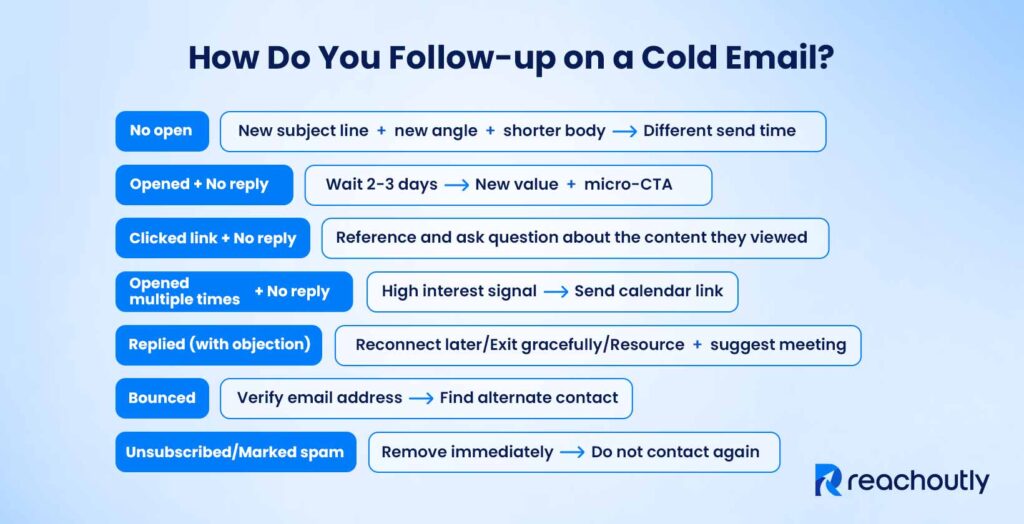
The consensus among sales experts and data from successful cold email campaigns points to 3-5 cold email follow-ups as the ideal range. Below is a proven cold email follow-up frequency schedule.
| Days After Initial Email | |
| Initial cold email | Day 0 |
| Follow-up 1 | Day 2-3 |
| Follow-up 2 | Day 7-10 |
| Follow-up 3 | Day 14-17 |
| Final breakup email | Day 21-24 |
The follow-up cadence above significantly boosts conversion rates without triggering spam complaints. Send Tuesday through Thursday between 9 and 11 AM in your prospect’s local time zone for maximum engagement. Start with more frequent follow-ups immediately after the initial contact. Then space out your follow-ups so you get a positive response while prospecting, not a negative one. If you have sent 5 well-timed, varied messages with no reply, pause the sequence or shift strategy.
For B2B cold outreach, a common best practice is 3 emails total per prospect, including 1 initial email, 1 follow-up after 3 days, and 1 final follow-up after another 5 days.
What Are the Response Rate Statistics for Cold Email Follow-Up?
The widely accepted average response rate across all cold emails is approximately 1-5%. According to the 2026 Cold Email Benchmark Report by Instantly, the overall average reply rate is 3.43%, with elite performers exceeding 10% by keeping emails short, personalized, and well-timed. That means for every 100 cold emails sent, you can expect to receive roughly 3-5 replies at baseline.
Follow-ups change that number dramatically. Cold email campaigns with follow-ups of 3-5 steps produce an 8.3% reply rate compared to 4.1% without follow-ups. That is a 2x difference just from adding follow-up steps. Just sending one or two polite reminders can more than double your response rate. The breakup email, as your final message in the sequence, shows a response rate bump on its own. Closing the loop professionally triggers responses from prospects who intended to reply but had not gotten around to it.
B2B cold email rates sit at the lower end because decision-makers receive dozens of pitches daily. Outliers in this spectrum reveal a growing divide between generic blasts and precision outreach.
Reply rate is the most important statistic in cold emailing, aside from win rate. It is the ultimate indicator of how well-targeted and how well-written your cold email is. By targeting the right audience, crafting personalized emails, and leveraging follow-ups, you can surpass the average cold email benchmarks and consistently land above 8%. To boost your response rate, see our complete guide on cold email response rate.
When Cold Email Follow-Ups Require Expert Help?
Cold email follow-ups require expert help when your follow-up sequence shows open rates below 30%, unsubscribes exceed 1%, or you get zero replies after 5 well-spaced follow-ups.
Low open rates and response rates stem from a few root causes. A weak value proposition, follow-ups that repeat the same pitch, poor timing, and deliverability issues cause ordinary results from your campaigns.
Reachoutly redesigns your sequence architecture to match your sales cycle and prospect behavior. Reachoutly helps you create personalized, value-driven cold email follow-ups that convert, using A/B testing to find what works best for your audience. Use Reachoutly’s cold email services when you want a predictable sales pipeline instead of guessing what to send next.