
Cold Email Conversion Rate: Average Benchmarks by Industry (2026)
Cold email conversion rate measures the percentage of cold emails that produce a desired action, calculated as (number of conversions / number of emails delivered) × 100. The desired action can be a booked meeting, a reply, a sign-up, or a closed deal, and the benchmark shifts depending on which one you’re tracking.
The average cold email conversion rate sits between 1 and 5% when tracking replies, but drops to just 0.215% (roughly 1 deal per 464 emails) when measured all the way to a closed deal, according to Reachoutly’s 2025 cold email campaigns data analysis. On average, 306 cold emails generate one qualified B2B lead (meetings/demos). These averages shift significantly from one industry to the next. Target audience, offer type, and email content all push conversion rates up or down within that 1-5% window when tracking replies.
In 2026, a 3.5%-4.5% cold email conversion rate is considered good based on Reachoutly’s year by year analysis of cold email campaigns, taking into account deal-close rates, meeting booking rates, and funnel-stage drop-off across industries. A January 2026 Breakcold benchmark analysis supports this range, placing 4.2% at the top tier. We have been benchmarking our campaigns and reviewing case studies from 2019 onward. Our findings indicate that conversion rates have declined by approximately 75% between 2017 and 2026, and by 20% from 2024 to 2025.
Reaching the top tier cold email conversion rate requires every piece of the funnel working together. Open rates, reply rates, click-through rates, inbox placement, and bounce rates each act as a filter that lifts or drags your final number. Those metrics shift by industry, sending volume, and ticket size.
Cold emailers that consistently improve their conversion statistics do three things. They refine targeting before writing a single word, they personalize beyond the first-name token, and they protect deliverability as they scale. The gap between average and top-tier performance is wide, and the data shows exactly what causes low conversion rates. Poor list quality, weak CTAs, missing follow-up sequences, and broken sending infrastructure are the main reasons. Let’s break down cold email conversion rate, benchmarks for 2026, what controls conversion rate, and how to move conversion rate from average to top-tier.
What Is Cold Email Conversion Rate?
Cold email conversion rate measures the percentage of recipients who take a desired action after receiving your cold email. That desired action includes booking a meeting, signing up for a demo, or becoming a paying customer. The formula for calculating cold email conversion rate is below.
Cold email conversion rate = (Number of Conversions ÷ Number of Emails delivered) × 100
For example, a cold email campaign generating 1 meetings from 100 delivered emails achieves a 1% conversion rate.
The formula connects to other cold email engagement metrics in a clear progression. Open rate shows initial interest, click-through rate (CTR) indicates content engagement, response rate measures two-way communication, and conversion rate captures actual business results. Below is an example for better understanding.
1,000 emails delivered → 250 open (25% open rate) → 50 click links (5% CTR) → 30 reply (3% response rate) → 5 meetings (0.5% conversion rate). Each metric feeds the next, creating a funnel that reveals where prospects drop off.
The widely accepted average cold email conversion rate is 1-5%. That range depends on what you count as a “conversion.” Campaigns that track replies land on the higher end, such as 1-5%. Campaigns that track booked meetings or closed deals drop sharply. The average deal-close conversion rate from cold email is around 0.2%, or roughly 1 deal for every 464 emails sent.
What Is a Good Cold Email Conversion Rate in 2026?
A good cold email conversion rate in 2026 is 4.2%, which puts a campaign in the top tier of outbound performance, according to a January 2026 Breakcold benchmark analysis.
The widely accepted average cold email conversion rate is 1-5%, so any campaign converting above 5% signals exceptionally targeted outreach. “Good” changes shape depending on which action you track and how aggressive your targeting is.
Cold email-to-meeting conversion rate averages 0.1% across B2B campaigns. A good cold email-to-meeting conversion rate is anything above 0.4%, according to a Salesforge benchmark report of 2025 data. Reachoutly’s cold email campaigns achieved a 2.2% meeting booking rate on average. It means for every 100 emails sent, roughly 2 prospects booked a meeting.
Cold email-to-deal conversion rate sits much lower. Martal Group’s analysis, consisting of data from 12 months of 2025, placed the average deal-close rate from cold outreach at 0.2%. A good cold email-to-deal conversion rate is anything above 0.2%. The downstream funnel tightens at each stage. Only 25-40% of booked meetings convert into qualified opportunities and cold-sourced opportunities close at an average rate of 10-25%.
What Are the Average Cold Email Conversion Rates by Industry?
The cross-industry average cold email conversion rate, when tracked all the way to a closed deal, is just 0.215%, or roughly 1 deal for every 464 emails sent, according to a Focus Digital analysis report of 2025 data. That number climbs to the more commonly cited 1-5% range, when conversion tracks a reply instead. This is why, average conversion rate from cold email outreach by industry is one of the most requested and misquoted data points in outbound sales. The benchmark table below, breaks down deal-close conversion rates and open rates by sector.
| Industry | Deal-Close Conversion Rate | Emails per Deal | Open Rate |
| Energy Management Systems | 0.40% | 250 | 46.31% |
| Legal Services | 0.31% | 323 | 31.45% |
| Real Estate (B2B) | 0.25% | 400 | 38.51% |
| Healthcare Services | 0.22% | 455 | 27.96% |
| Manufacturing / Industrial | 0.18% | 556 | 26.19% |
| Education | 0.13% | 770 | 28.09% |
| Financial Services | 0.096% | 1,042 | 27.87% |
| Marketing & Advertising | 0.085% | 1,176 | 27.20% |
| Consulting Services | 0.074% | 1,351 | 28.93% |
| Non-Profit | 0.06% | 1,667 | 20.00% |
| IT Services | 0.05% | 2,000 | 27.35% |
| SaaS | 0.03% | 3,249 | 25.71% |
Cold email response rates and deal-close rates shift dramatically across sectors as you can see from the table above. A SaaS company targeting VP-level buyers operates in a different conversion environment than a recruiting firm reaching passive candidates or a real estate agency contacting property owners. Industry, target audience, email quality, and offer type push conversion rates up or down within that 1-5% window when measuring responses as conversions.
What Is the Average B2B Cold Email Conversion Rate?
The average B2B cold email conversion rate is a razor-thin number, 306 cold emails generate one qualified B2B lead.
The average B2B conversion rate lands at 0.215%, or about 1 deal for every 464 emails sent, when tracked to a closed deal. The range climbs to 1-5%, when conversion counts a reply, with B2B campaigns clustering between 2% and 5%.
To achieve a good B2B cold email conversion rate in 2026, set baseline targets for cold outreach programs such as, open rates of 15-20% at minimum, reply rates of 5-10%, and bounce rates under 2%.
Which Metrics Affect Cold Email Conversion Rate?
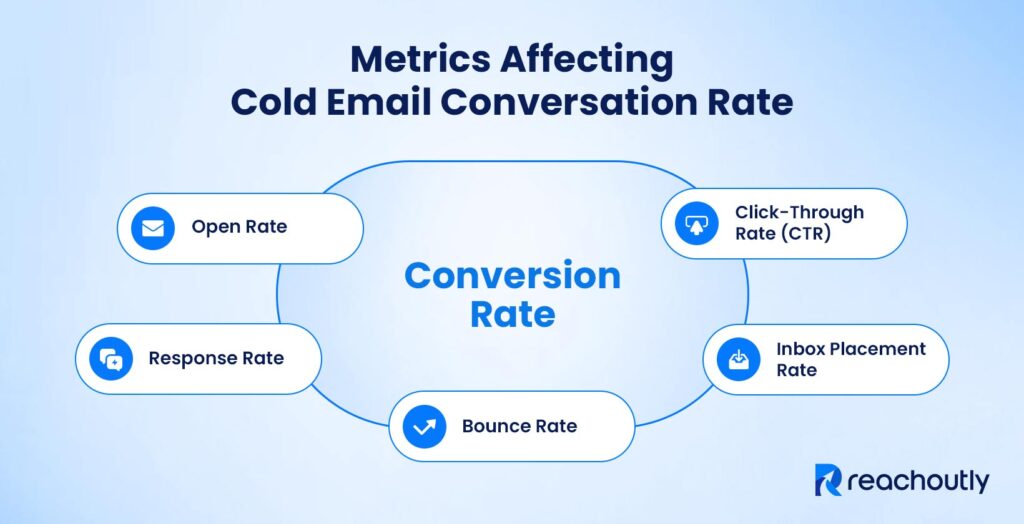
Cold email conversion rate is the output of every metric that comes before it in the outreach funnel including open, reply, click-through, inbox placement and bounce rate. Each one of these metrics acts as a filter, and a weakness at any stage drags the final conversion number down.
Open Rate
Open rate measures the percentage of recipients who opened your cold email. Open rate is the first indicator of whether your subject line and sender reputation do their job.
Click-Through Rate (CTR)
Click-through rate (CTR) tracks the percentage of recipients who click a link inside your cold email. CTR matters most when your campaign uses landing pages or booking links instead of direct reply CTAs. It serves as a secondary engagement signal then. A high open rate paired with a low CTR signals that your email body or call-to-action fails to drive action.
Response Rate
Response rate measures the percentage of cold email recipients who reply. Response rate shows whether the messaging resonates with the target audience. This metric is known as reply rate as well in the cold email industry.
Inbox Placement Rate
Inbox placement rate measures the percentage of emails that land in the recipient’s primary inbox. No amount of copywriting or personalization fixes the conversion problem, if cold emails are hitting spam folders.
Bounce Rate
Bounce rate tracks the percentage of cold emails that fail to deliver. High bounce rates signal list quality issues like outdated contacts, invalid domains, or poorly verified data.
How Does Cold Email Conversion Rate Vary by Sending Volume?
The average cold email conversion rate is 0.215%. That means a team sending 1,000 emails per month can expect roughly 2 deals, while a team sending 5,000 can expect around 10. But those numbers hold only when deliverability, targeting, and copy quality stay constant as volume increases. Deliverability takes the first hit as volume climbs. Sending more than 100 per mailbox risks triggering spam filters and damaging domain reputation. The benchmark table below shows how conversion metrics shift as daily sending volume increases.
| Daily Volume per Mailbox | Avg. Reply Rate | Avg. Bounce Rate | Deliverability Risk |
| 10-25 emails | 8-25% | Under 2% | Low |
| 50-100 emails | 3-8% | 2-3% | Moderate |
| 200-500 emails | 1-3% | 5%+ | High |
| 1,000+ emails | Under 2% | 7%+ | Severe |
The benchmark table above shows how campaign size directly shapes reply rates. The pattern is consistent. Precision beats volume every time. At lower volumes with tight targeting, great messaging, the right contacts, and a disciplined cadence the conversion rates increase. At higher volumes, conversion rates decrease because larger lists inevitably include less-qualified prospects.
How Does Cold Email Conversion Rate Vary by Ticket Size?
The relationship between ticket size and cold email conversion rate is inverse. As deal value goes up, conversion percentages come down, but revenue per email goes up. A campaign converting at 0.5% on a $50,000 annual contract generates far more revenue than one converting at 5% on a $500 product. The benchmark table below breaks down how conversion rates and revenue shift across ticket sizes.
| Ticket Size | Avg. Conversion Rate | Revenue per Email Sent | Sales Cycle |
| Under $1,000 | 1-10% | $5-$20 | Days to weeks |
| $1,000-$25,000 | 0.5-3% | $15-$75 | Weeks to months |
| $25,000-$100,000 | 0.03-0.5% | $30-$120 | Months |
| $100,000+ | Under 0.06% | $60-$200+ | 3-12 months |
What Causes Low Cold Email Conversion Rates?
Low cold email conversion rates are caused by a chain of breakdowns across targeting, messaging, infrastructure, and follow-up. The most common causes of low cold email conversion rates are listed below.
- Poor targeting and list quality: Sending emails to the wrong people is the fastest way to tank conversion rates. Teams waste budget on prospects who have no buying intent, Without a refined ideal customer profile.
- Weak deliverability and sending infrastructure: Around 17% of cold emails never reach the inbox because of poor domain authentication, high bounce rates, or spam-triggering language. No amount of copy improvement changes the outcome when emails land in spam folders.
- Ineffective subject lines and generic or irrelevant messaging: Recipients mark emails as spam based on the subject line alone. Inside the email, weak hooks, template-sounding copy, and a lack of personalization make your message feel like mass outreach.
- Vague or overloaded CTAs: A cold email can reach the right person, get opened, and get read, but if the call to action asks for too much or competes with a second CTA, the reply never comes.
- Too little follow-up: Campaigns with no follow-up sequence rely entirely on the first email. Skipping follow-ups in cold email leaves nearly half of your replies on the table.
- Bad timing: Email timing affects open rates, clicks, and conversion rates. Sending at the wrong time reduces performance regardless of copy quality.
How Do You Improve Your Cold Email Conversion Rate?
Improving your cold email conversion rate is about building a system where targeting, messaging, timing, and infrastructure all reinforce each other. The highest-leverage improvements to boost your cold email conversion rate are listed below.
- Refine your targeting before writing a single email. Deeply understand your buyers and create segments based on pain points, buying triggers, and role-specific challenges. It drives conversion more than any subject line trick.
- Take the time to segment and qualify prospects. It ensures outreach reaches people who are a genuine fit for the offer.
- Make emails feel personal and relevant by researching and understanding the recipient. Research each recipient’s company, recent activity, and specific challenges.
- Personalize beyond the first name token. Personalize and focus on building a relationship rather than selling in the first touch.
- Make the message about the prospect, not about you or your product. Messages that reference a prospect’s real situation shift the email from feeling like outreach to feeling like a conversation.
- Write attention-grabbing subject lines paired with engaging email copy. Focus on clear benefits. Keep messaging concise.
- Sell benefits rather than features. Introduce yourself with credibility rather than a pitch.
- A/B test subject lines, CTAs, and send times. Test one variable per week. Subject lines first, CTAs second, and send windows third. Then scale the winners.
- Build a follow-up sequence of 4-7 emails. According to Instantly’s January 2026 Benchmark Report, 58% of replies come from the first email, with the remaining 42% generated by follow-ups.
- Protect deliverability as you scale. Warm your domains gradually over 3-6 weeks, keep bounce rates under 2%, verify every email address before adding it to a sequence, and maintain SPF, DKIM, and DMARC authentication.
- Add multichannel touches: Combine email with phone and LinkedIn to increase response rates. A multi-touch cadence compounds conversion across channels.
Building and optimizing cold outreach pipelines in-house feels overwhelming when you can’t identify the actual bottleneck. If you’ve tried the steps above and conversions are still underperforming, partnering with experts like Reachoutly for a Done-With-You cold email service can help identify what’s holding your campaigns back and fix it faster.