
What Is the Best Time to Send Cold Emails?
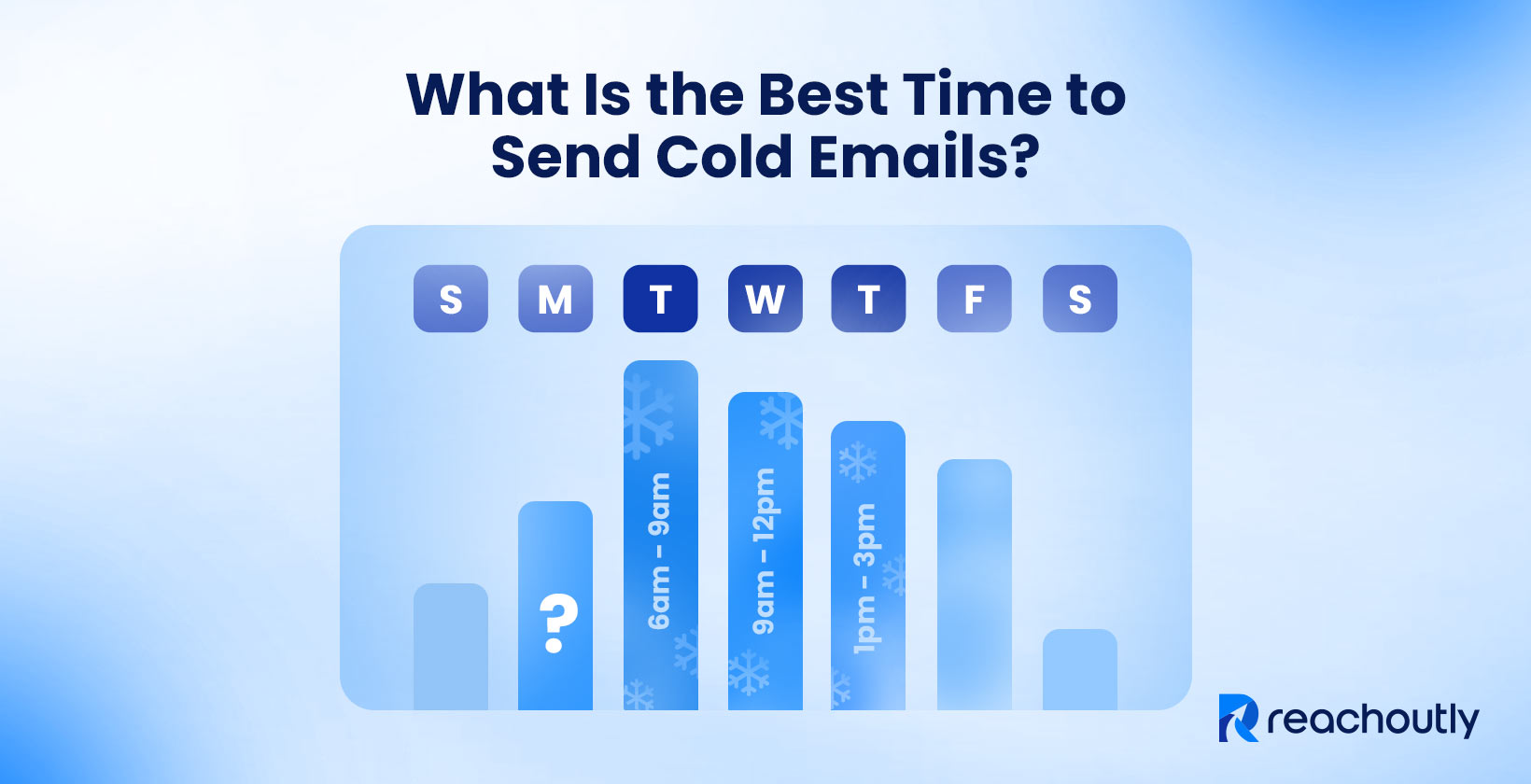
The best time to send cold emails is from Tuesday to Thursday between 6 AM and 3 PM local time because it’s easier to catch people’s attention during these hours. Peak engagement times are 6-9 AM for open rates, 10 AM-12 PM for response rates, and 1-3 PM for midday attention. Avoid evenings, Mondays, Fridays, and weekends for most audiences.
The timing of a cold email is critical for success because sending it during optimal windows boosts open and response rates, improves inbox placement, and ultimately drives conversions. Poor timing causes significant losses in replies and pipeline opportunities. The strategy is to land in the inbox when professionals are actively working but are past their initial morning rush of tasks. This sweet spot catches people when they have time to read and respond. Early morning, around 6-9 AM, is the best time of day for reaching executives who start their day earlier. These professionals check email before their calendar fills up.
The best days of the week to send a cold email varies based on the recipient’s industry, role, and time zone, but mid-week, from Tuesday to Thursday, is considered the most effective period. Within these days, the peak windows for engagement are the mid-morning and early afternoon. Executives skim cold emails 6-9 AM before meetings, while sales teams respond between meetings. Time zones decide visibility, so schedule by recipient-local time and account for regional weekends. Different goals and audiences follow different clocks. B2B outreach is most successful during work hours, whereas B2C engagement works best in the evenings and on weekends.
There is no single best time for every campaign. Each audience has unique patterns. True success comes from segmenting your audience, adjusting for different time zones, and testing send times to discover what yields the best results for your specific targets. Start with mid-week, morning slots per segment. Avoid low-intent periods such as weekend afternoons and major holidays. A/B test 2-3 distinct windows over 2-3 weeks to find your audience’s preferences. Use timezone-aware sending tools like Lemlist, HubSpot, or Apollo, and refresh timing quarterly to match seasonality and shifting work rhythms.
Why Does the Timing of Cold Emails Matter for Success?
The timing of cold emails matters for success because sending them during midweek (Tuesday-Thursday) early to mid-morning (6-11 AM) attention windows boosts open and response rates, improves inbox placement through stronger engagement signals, reduces inbox competition, and increases conversions.
Replies depend on cognitive load. Let’s understand how the brain works with email. People make decisions based on perceived benefits rather than rational analysis. Timing affects cognitive load and decision-making capacity. Decision fatigue reduces email engagement quality as recipients make too many choices throughout the day. Emails sent during peak decision periods compete with numerous other priority tasks. This reduces the cognitive resources available for engaging your message.
The average professional receives 121 emails daily according to data from OutlookTracker. This creates a narrow attention window where delivery time determines whether your message captures immediate focus. A 2023 Litmus report found that email reading time dropped from 13.4 seconds in 2018 to 9 seconds in 2022, declining further in 2025. This change intensifies the importance of an optimal send schedule for capturing attention.
Open rates depend on availability. Messages sent mid-morning or early afternoon perform better because they hit inboxes during active checking windows. Tuesday through Thursday represent optimal sending windows because recipients have settled into weekly routines without Monday overwhelm or Friday distraction.
Harvard Business Review’s 2021 article “Decision Fatigue Exhausts Our Willpower” reported that response likelihood declines later in the day due to depleted mental resources for continuous task switching.
Each profession has its own email patterns. Tailoring cold email timing to industry-specific work rhythms boosts engagement across diverse sectors and roles. SaaS account executives respond during late morning and early afternoon between meetings when their attention is more flexible. Healthcare administrators engage with emails outside of shift change windows and peak patient care periods, such as mid-morning lulls.
Time zone personalization matters too. Sending emails at 3 AM recipient time guarantees poor performance regardless of message quality.
Timing of cold emails becomes more important because of spam filtering algorithms and priority inbox systems. Modern email systems are smart and watch user behavior. Gmail uses machine learning algorithms that analyze user behavior patterns. Timing affects whether emails reach the inbox or get filtered to promotional folders. Sending emails in top-of-the-hour bulk batches triggers rate limiting filters that delay or block delivery entirely.
A poorly timed email missing optimal windows leads to significant losses in replies and sales pipeline. In a 10,000-send campaign, the gap between peak and off-peak send time equals hundreds of missed replies and significant pipeline loss. That’s why identifying the exact hours that capture attention is crucial.
What Is the Best Time of Day to Send Cold Emails?
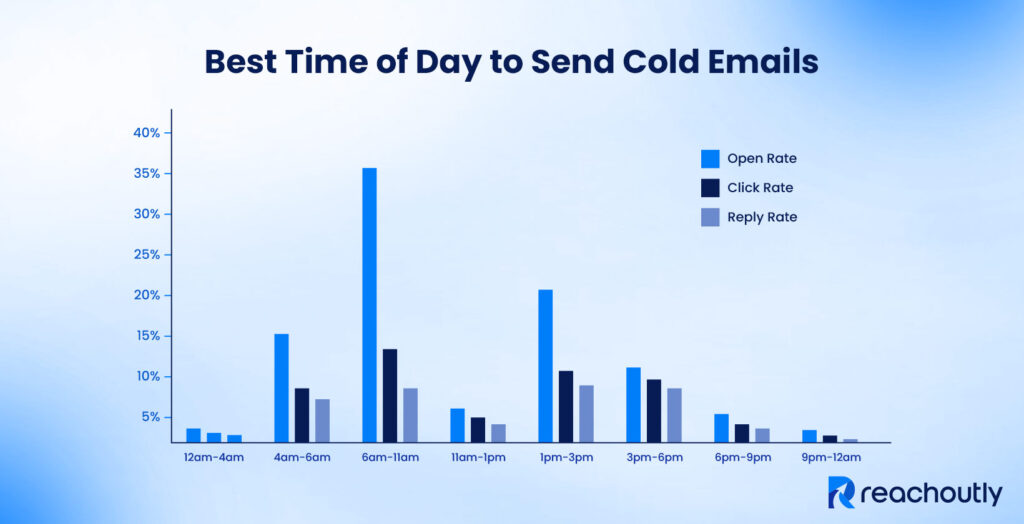
The best time of day to send cold emails is between 6 AM and 3 PM local time, with peak windows of 6-9 AM for high open rates, 9-11 AM for replies, and 1-3 PM for midday attention. Engagement drops sharply after 4 PM across B2B audiences.
Early morning cold emails between 7-9 AM achieve higher open rates by capturing professionals checking email as their first daily task. These messages position inbox tops when attention levels peak highest.
Mid-morning outreach from 8-11 AM peaks response rates and delivers high engagement because recipients check email after organizing daily priorities.
Afternoon deliveries from 1-3 PM align with lunch break patterns when professionals process non-urgent communications, creating secondary engagement peaks.
Evening sending times between 5-7 PM target small business owners and executives working extended hours, though general engagement is poor during these windows.
Peak business hours present distinct advantages and constraints that impact email performance across different industry sectors. Let’s break down what happens during each window.
- Early business hours from 7-8 AM benefit executives who review communications before meetings begin, particularly effective for consulting, finance, and professional services sectors.
- Mid-morning timing between 9-11 AM captures post-meeting availability when professionals organize daily priorities and process accumulated communications.
- Marketing and PR professionals experience morning email overload from press releases and industry communications, responding better to mid-afternoon cold emails when influx volume decreases.
- HR and recruiting personnel check emails first thing in the morning to catch job applicant inquiries and time-sensitive hiring communications.
- Sales professionals maintain varied patterns depending on call schedules, though Tuesday through Thursday mornings produce optimal engagement.
- Traditional 9-5 schedule maximizes reach for education and government sectors with strict working hour patterns.
Late business hours after 4 PM face declining engagement as professionals transition to personal time, causing message deferrals and reduced attention spans.
Smart cold emailers leverage the commute window and lunch break to boost performance metrics. These windows offer unique opportunities.
- Commute timing between 6-8 AM captures mobile email checking during travel time, with many professionals reviewing messages while going to work.
- Lunch break timing from 12-1 PM provides secondary peak opportunities when professionals step away from primary responsibilities to process non-urgent communications.
Different professional roles maintain distinct email checking patterns that determine best outreach windows for targeted campaigns. Understanding these patterns helps you time your emails perfectly.
- CEOs and executives frequently review communications between 6-8 AM before daily meetings commence, making early morning send times highly effective for C-suite targeting.
- Financial executives and consultants dedicate specific morning blocks for administrative tasks, creating predictable engagement windows.
- Mid-level managers process emails during mid-morning periods between 9-11 AM after completing urgent morning responsibilities and organizing daily priorities.
- Small business owners review emails during evening hours between 7-9 PM while wrapping up daily operations and planning next-day activities.
For B2B outreach, mid-morning aligns with work routines, while B2C engagement rises in the evening between 7-9 PM when people browse personal mail at home. There’s no universal “perfect hour” that works for everyone. Testing across morning and early afternoon slots remains the most reliable strategy. Segmenting by role helps you target the right windows for each group. Understanding which days amplify those hours completes the timing strategy.
What Are the Best Days of the Week to Send Cold Emails?
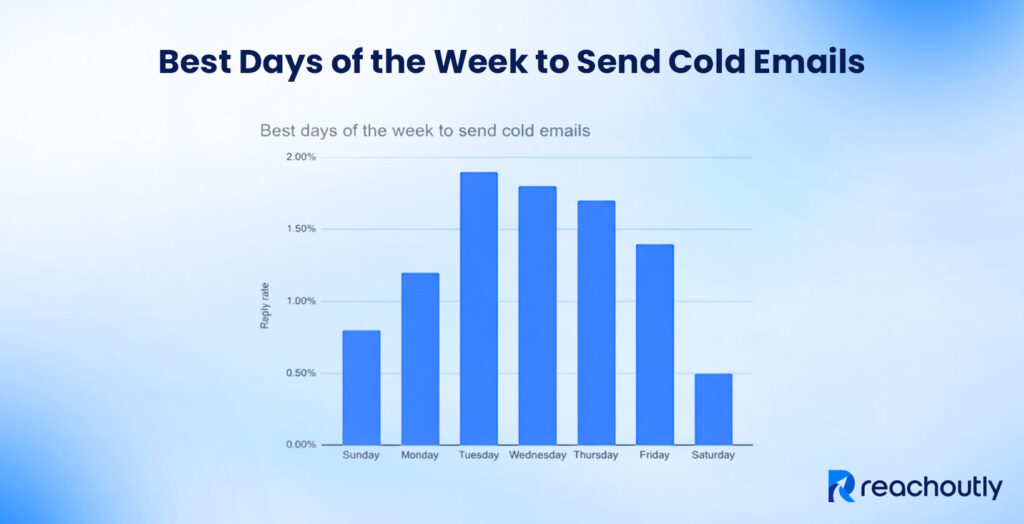
The best days of the week to send cold emails are Tuesday, Wednesday, and Thursday as they see the highest open and reply rates. Tuesday leads in open rates and response rates, Wednesday and Thursday sustain strong mid-week engagement. Monday and Friday show lower performance. Weekends represent niche plays, working only in select segments.
- Tuesday has the highest potential engagement, with 27-28% average open rates. Professionals complete Monday’s accumulated tasks by Tuesday and enter execution mode. This shift creates higher receptivity to new opportunities and outreach messages.
- Wednesday maintains solid engagement at 17-18% open rates, positioning recipients in mid-week productivity flow when they’re most responsive to business communications.
- Thursday preserves strong performance at 25-26% average open rates because professionals remain active before weekend mental transitions. They’re accessible for meetings and follow-up discussions.
Project planning cycles during mid-week periods create optimal windows. Decision-makers evaluate new solutions and vendors during these times.
According to HubSpot’s 2025 analysis, Tuesday generates 16% higher open rates than other weekdays as professionals settle into their work rhythm after Monday’s backlog. Research from the Omnisend Email Marketing Benchmarks 2025 shows that Tuesday averages 20% response rates, while Thursday delivers steady engagement at 25-26% open rates. This data confirms why Tuesday and Thursday are considered the best days for cold email outreach.
Industry and role exceptions matter for your success. Different professionals have unique email habits.
- Recruiters achieve higher candidate replies on Sunday evenings, when job seekers prepare for the week.
- HR professionals check email first thing in the morning to catch job applicant inquiries, making early Tuesday or Wednesday effective sending times.
- Small business owners read emails on Friday mornings or weekends, as they operate outside strict corporate schedules.
- E-commerce and retail campaigns see stronger weekend engagement.
- B2B recipients respond best during Tuesday-Thursday business hours while B2C audiences engage during evening and weekend personal time.
Global outreach requires adjusting for local weekends. Middle Eastern markets operate Sunday through Thursday schedules. This requires Monday to Tuesday targeting adjustments. Testing your specific audience remains essential because individual prospect behavior patterns override general timing principles, potentially doubling response rates through personalized scheduling.
Does the Best Send Time Differ for B2B vs. B2C Cold Emails?
Yes, the best send time differs for B2B vs. B2C cold emails because these audiences have completely different email habits. B2B cold emails perform best Tuesday-Thursday between 9-11 AM and 1-3 PM during work hours, while B2C cold emails get higher engagement in the evening (7-9 PM) and on weekends because timing aligns with each audience’s daily habits and decision flow.
B2B professionals check email during standard work hours when they focus on business-related tasks. Consumers browse personal email during leisure time at varying hours throughout the day. The decision-making cycles between these audiences create distinct timing patterns.
B2B purchases involve multiple stakeholders. These groups require extended deliberation periods. Consistent business-hour outreach becomes effective for nurturing long sales cycles. B2B audiences are often a group of stakeholders who need to justify every dollar and take longer to agree with each other.
B2C urgency operates differently as consumers check for products and services depending on an urgent need. They purchase items with little research, allowing for flexible timing strategies around immediate emotional triggers.
Mid-morning periods between 9-11 AM on Tuesday-Thursday see highest engagement rates as decision-makers review reports, prepare for meetings, or catch up on tasks. Early afternoon slots from 1-3 PM capture professionals returning from lunch breaks with refreshed focus. B2B cold email reply rate is highest during these core business hours when recipients actively process professional communications rather than personal content.
Evenings and weekends are more effective for B2C or e-commerce audiences, since that’s when consumers have spare time to browse offers. Evening sends between 7-9 PM capture consumers winding down after work. This creates relaxed browsing mindsets conducive to shopping decisions. Promotional emails see their highest conversion rates on Fridays and Sundays. Shoppers are in buying mode during these periods.
B2B vs B2C Email Timing Comparison
| Aspect | B2B Timing | B2C Timing |
|---|---|---|
| Optimal Days | Tuesday-Thursday | Friday-Sunday |
| Peak Hours | 9-11 AM, 1-3 PM | 7-9 PM, weekends |
| Response Context | Business decisions during work | Personal purchases during leisure |
| Inbox Competition | Lower mid-week mornings | Higher during business hours |
B2B follow-ups perform best during focus windows when professionals dedicate time to vendor evaluations. Tuesday-Thursday mornings work best because decision-makers review proposals or strategic initiatives. B2C follow-ups around leisure hours capture consumers during relaxed browsing sessions. They actively seek entertainment, deals, or lifestyle improvements without work pressure or time constraints. Understanding these differences helps you reach each audience when they’re most receptive to your message.
How Do Time Zones Affect Cold Email Send Times?
Time zones affect cold email send times by ensuring messages arrive in each recipient’s inbox during local business hours. This improves visibility, open rates, and response rates. Mistimed sends land in off-hours. They get buried by newer emails, and harm deliverability and campaign success.
A cold email sent at 9 AM from New York arrives at 2 PM in London, 6:30 PM in Mumbai, and midnight in Sydney. This affects open rates and engagement differently in each location. Cold emails landing at 3 AM local time get buried under new messages by morning. This reduces open rates compared to optimally timed sends. Recipients perceive off-hours emails as low-priority and ignore them.
Business hours vary across regions too. US professionals check emails between 8 AM and 6 PM local time, European executives engage with their inboxes earlier, starting at 7 AM. APAC professionals check messages until 8 PM local time.
GetResponse data from analyzing the sending times of millions of emails reveals that emails arriving during recipient business hours achieve 23% higher open rates and 2x better click-through rates compared to those arriving overnight.
Daylight Saving Time creates additional complexity. It shifts optimal send windows twice yearly across different regions. The US and Europe create temporary 1-hour variations in time differences during March and November transition periods.
Regional weekend differences are important considerations too. Middle East weekends run Friday-Saturday, affecting B2B engagement patterns for UAE and Saudi Arabian markets.
Quick reference for major business centers helps calculate optimal windows rapidly:
London (GMT/BST), New York (EST/EDT -5), Singapore (SGT +8), Sydney (AEDT +11), Dubai (GST +4).
| Sender Location | Target Region | Send Window (Sender Time) |
Arrival in Prospect Inbox |
|---|---|---|---|
| US (Eastern) | Europe (EU) | 3-5 AM ET | 9-11 AM local |
| US (Pacific) | APAC | 5-7 PM PT | 9-11 AM local (Next day) |
| Europe (GMT) | US (Eastern) | 2-4 PM GMT | 9-11 AM ET |
| APAC | Europe (EU) | 11 PM-1 AM local | Morning peak in EU |
| APAC | US (Eastern) | 8-10 PM local | 9-11 AM ET (Same day) |
These windows account for the 5-9 hour difference between US Eastern and European time zones. They factor in the 13-16 hour gap between US Pacific and major APAC business centers.
Schedule by the recipient’s local time for best results. Modern CRMs make this easy. HubSpot and Salesforce automatically capture timezone data through form submissions. They integrate with enrichment services to get accurate location data. Lemlist’s “Send in recipient timezone” feature automatically adjusts delivery times based on prospect location data. Apollo.io offers timezone-aware throttling that spaces out sending times across different regions. Use these tools to eliminate the guesswork and ensure your emails arrive at the perfect moment, as timing influences all important metrics.
How Does Email Timing Affect Different Goals (Open, Click, Reply)?
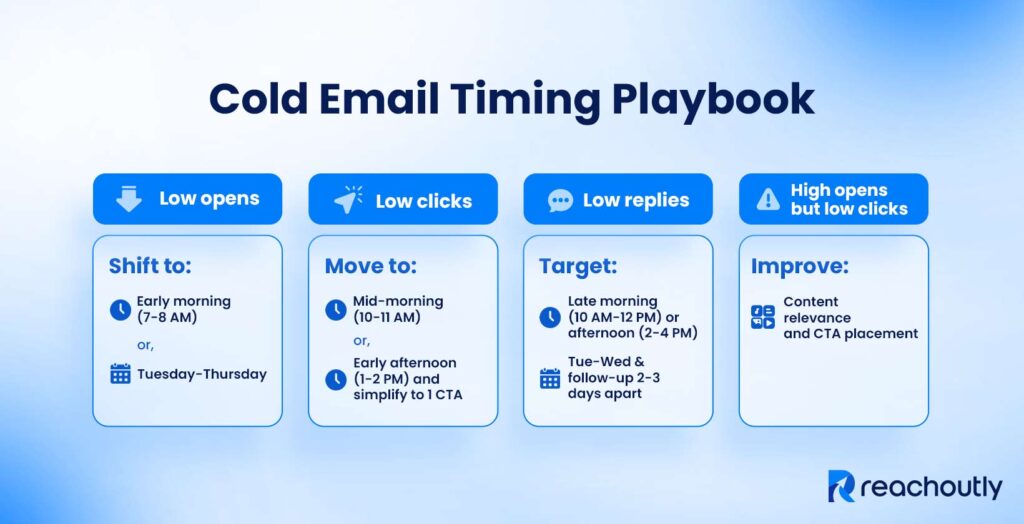
Email timing affects different goals by producing peak open rates in the morning (8-10 AM) and at end-of-day scans, higher clicks in the mid-morning and early afternoon (10 AM-3 PM), and the strongest responses on Tuesday-Thursday between 9-11 AM. Spaced follow-ups every 2-4 business days boost response rates.
Open rates peak during Tuesday-Thursday, 7-9 AM windows when recipients scan inboxes for priority messages. You require compelling subject lines that stand out amidst morning email traffic. 8-10 AM is the peak time when people open their emails on Monday, suggesting a secondary opportunity window exists for catching attention.
Click-through rates demand different timing considerations because clicking requires deeper engagement than opening. Recipients click links during active work periods. They have bandwidth to explore content during 10 AM-12 PM and 1-3 PM on weekdays. Sunday evenings outperformed weekday mornings in most campaigns for promotional content. This indicates weekend timing works for non-urgent, browsable content when people are relaxed.
Response rates represent the highest engagement level. They require both attention and cognitive effort from recipients. First-touch emails perform best when sent Tuesday-Thursday at 9-11 AM. People are fresh and ready to engage.
Follow-ups show an increase in responses when sent 2-3 days after the initial email. Send them inside 9-11 AM or 2-4 PM windows. Give your prospects time to consider your proposal and reply to you to avoid appearing pushy. Wait 5-7 days for the next touch, if your first follow-up is ignored. Test and discover your own best cold email send times.
How Can You Test and Find Your Own Best Cold Email Send Times?
To test and find your own best cold email send times, run a 5-step A/B test by selecting time windows, segmenting your list, calculating sample size, tracking opens/clicks/replies per variant, and validating the result. Adopt the best send times and continue optimization.
Define Your Testing Time Windows
Select 2-3 distinct time windows for comparison. Take 8-10 AM versus 2-4 PM versus 7-9 PM Tuesday in your recipient’s time zone. Keep every other element identical between test groups such as subject line, email content, sender name, and day of the week.
Segment Your List
Segment your audience by industry, role, and engagement history before randomizing into test groups. Start with similar people first. Mix different customer segments only after establishing baseline performance for homogeneous groups. Combining B2B executives with entry-level employees skews results and makes data unreliable.
Calculate Required Sample Size
Divide your list into approximately 1,000-3000 contacts per test variant. This helps detect a 5-10% lift in open rates with 95% confidence. Test your entire list split 50/50 between two time slots, for smaller lists under 1,000 total contacts. Don’t attempt statistical significance on tiny samples. Work with what you have.
Execute Testing Tools and Track Results
Deploy your A/B test using platforms like Lemlist or dedicated testing tools that support timezone-based sending. Use Gmail’s native scheduling feature for smaller volumes. Run the test for 2-3 weeks to gather enough data. Export performance metrics after reaching 100+ opens per variant. Track open rates, reply rates, click-through rates, and unsubscribe rates in a spreadsheet. Create columns for time slot, sample size, opens, clicks, and replies to analyze.
Validate Statistical Significance
Check if your results are real or just random. Use a simple comparison test. For example, if one group gets a 22% open rate and another gets 18%, that 4% gap usually means your results are about 90% reliable. This happens because, with enough emails sent, the difference is large enough that it’s unlikely to be caused by chance. If your gap is smaller, or your test group is tiny, run it again with more contacts or over a longer period to be sure.
Update your email sending schedule to the best time slot. Test quarterly to adapt to seasonal changes and evolving recipient behavior. At Reachoutly, we schedule 80% of campaigns at our proven best sending time and reserve 20% for ongoing experiments. It ensures continuous optimization without risking established performance.
How Should You Adjust Send Times for Cold Email Campaigns?
To adjust send times for cold email campaigns, segment recipients, send first touches 8-11 AM local time, follow-ups 2-4 PM, avoid lunch hours and weekends for B2B, run A/B tests quarterly and use AI-based tools to optimize strategy based on engagement data.
At Reachoutly, we identify the most effective send times for each segment by analyzing audience behavior and performance data through continuous A/B testing. Follow these steps for best results.
Segment by Cohort
Segment prospects by industry, role, and time zone. Different groups have different email habits. Optimize your send time to match their patterns.
Adopt Baselines
Use starter windows of 8-11 AM, 10 AM-12 PM or 2-4 PM Tuesday-Thursday in the recipient’s local time as your default. These times work for most professionals. Start here and adjust based on results.
Use a Sequence Strategy
Position first-touch emails during peak open windows (8-11 AM local time) to maximize initial visibility. Schedule follow-ups during reply windows (2-4 PM) when prospects actively respond. Space follow-ups 2-3 days apart during the first week, then extend intervals to 5-7 days for subsequent touches.
Use Past Engagement and Test
Analyze prior engagement data to identify best sending time. Look for patterns in your data. For example, schedule future sending time 9:15 or 9:00 to land at the inbox top, if the recipient consistently opens emails at 9:30 AM. Implement A/B testing across different time slots, tracking open rates, click rates, and reply rates for each segment.
Recalibrate Seasonally and Quarterly
Optimize seasonal patterns throughout the year. Adjust timing strategies quarterly to align with budget cycles, industry events, and holiday schedules. Stay flexible as business rhythms change.
Avoid Lower Engagement Periods
Skip lunch-hour (12-1 PM) where engagement typically drops. Respect “quiet hours” outside business hours (before 7 AM, after 9 PM) unless targeting specific roles known for off-hours engagement.
Optimize With AI
Scale personalized timing across thousands of prospects using automated scheduling powered by machine learning. These tools boost open rates by adjusting based on behavior patterns. They analyze engagement history, industry norms, and real-time performance data.
When Is the Worst Time to Send Cold Emails?
The worst time to send cold emails is Monday morning (8-10 AM) in terms of replies. Closely behind are late evenings (after 8 PM), early mornings (before 5 AM), late Friday afternoons, weekends, and holidays, in terms of low open and reply rates. These periods align with personal time and inbox backlog.
- Monday mornings between 8 AM and 10 AM presents a challenge despite seeming logical for early-week outreach. Professionals spend these hours clearing weekend backlogs, attending planning meetings, and prioritizing internal tasks over external communications.
- Late-night emails sent between 9 PM and 5 AM face the immediate disadvantage of being ignored or buried by morning. Recipients process these messages when energy levels are low, reducing engagement.
- Friday afternoons after 4 PM similarly underperform, as professionals mentally transition toward weekend plans rather than engaging new business propositions.
- Weekends, and public holidays like Thanksgiving or Christmas generate the lowest engagement rates in B2B outreach. These windows coincide with recipients disconnecting from business communications and prioritizing personal time. A 2025 analysis by Growth List reveals Sunday emails achieve only 0.54% response rates, with Saturday at 1.57%, representing 2% of total responses.
- Lunchtime hours (12-1 PM) create another engagement dead zone, as professionals step away from desks for meals and meetings, leaving emails to accumulate unread.
Poor timing can hurt your entire email program because off-hours blasts overlap with spammy send patterns. They increase deliverability risk for your domain, as Gmail limits sending rates for bulk senders that accumulate low engagement.
What Are the Common Myths About Cold Email Send Times?
The six common myths about cold email send times are “Tuesday at 10 AM always works,” “mornings are best,” “weekends never work,” “everyone checks email at lunch,” “sending on the hour boosts visibility,” and “more volume fixes bad timing”. In reality, success depends on segmentation, relevance, and continual testing.
1. There’s one universal best time: Believing one universal best time (e.g., Tuesday 10 AM) ignores segmentation by industry, role, and time zone. Sales professionals waste countless hours chasing mythical best send time when achieving a 5% reply rate marks success in 2025, with top campaigns reaching 8-10% through strategic targeting.
2. Mornings are always best: Morning emails face a “busy market” where messages get lost in weekend backlogs or compete with other early senders. Engagement peaks in two different windows, at 6-8 AM and again in early afternoon. Consider sending at 2 PM when professionals tackle less urgent tasks, or test late-morning windows when recipients clear their priority items.
3. Weekends never work: Cold emailers avoid Saturdays and Sundays, yet weekends work for specific segments and offers, with niche audiences responding well to weekend outreach. Audiences with non-traditional schedules break conventions completely. Startup founders engage Sunday evenings. Retail managers respond Saturday mornings. Know your audience before ruling out weekends.
4. Everyone checks email at lunch: Lunch hour checking habits vary across roles. Some professionals eat at desks scanning emails. Others disconnect completely for a mental break. Don’t assume everyone follows the same pattern.
5. Sending on the hour boosts visibility: Sending exactly on the hour screams automation to prospects. Randomize delivery windows between 9:47 AM and 10:23 AM to appear human. Gmail advises sending at a consistent rate and avoiding sudden volume spikes, so distribute your sends across a randomized window instead of blasting exactly at :00.
6. More volume fixes bad timing: Gmail warns high complaint rates damage reputation, so increasing volume without relevance worsens results. Your message relevance, personalization depth, and offer strength determine success rates. A compelling value proposition sent at noon outperforms generic templates at the “perfect” 10 AM slot.
How Do Timing Strategies Compare for Cold Emails vs. Marketing Emails?
Timing strategies comparison for cold emails vs marketing emails shows the biggest gap in send time and day, where Tuesday-Thursday from 10 AM-4 PM works best for cold emails matching decision making windows while weekday evenings from 6-8 PM, lunch or weekends work best for marketing emails matching consumer browsing. Sending frequency differs too.
Cold emails are targeted and benefit from precise, workday timing to elicit a quick response from a busy professional, while marketing emails reach broader audiences who engage with content during personal browsing time.
Cold emails aim for the primary inbox to compete for immediate attention, while marketing emails arrive in the promotions tab where recipients browse at leisure. Marketing emails achieve higher open rates during after-work hours (6-8 PM), while cold emails generate more responses during business hours (10 AM-4 PM).
Marketing emails leverage subscriber preferences and behavioral data, such as previous click history and purchase times, allowing automated sends based on individual engagement patterns. It allows frequent touchpoints. Cold emails demand workday rhythms that respect professional schedules. Cold outreach requires strategic spacing based on professional courtesy such as 3-5 touchpoints over 2-3 weeks.
Always test timing variations, such as morning vs. afternoon or Tuesday vs. Thursday delivery within your specific industry vertical for best results.