
Cold Email Follow-Up: Complete Guide with Templates (2026)
Cold email follow-up is sending additional emails to prospects who didn’t respond to your first outreach message to move them toward action. A strategic cold email follow-up unlocks your sales pipeline and generates more leads. A single follow-up boosts response rates by up to 1.5x.
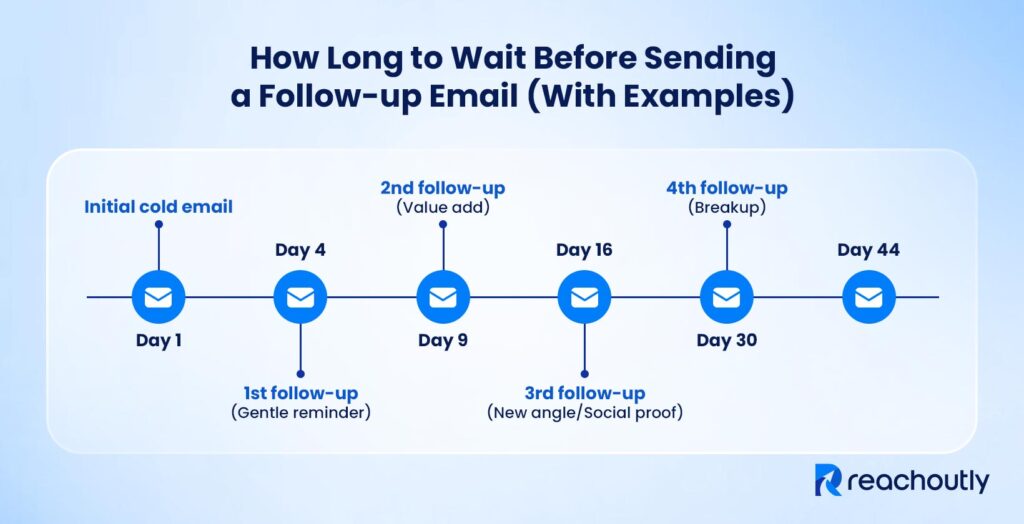
Timing is the foundation of successful cold email follow up. The best rule of thumb is waiting 2-3 business days before you send your first bump email, then wait at least 4-7 days for subsequent emails while widening the gap as you send more follow-ups. This strategy respects the prospect’s time while keeping you visible. Send between 4-9 follow-up cold emails in total to maximize results.
Brevity and added value drive engagement. To write a follow-up cold email after no response, keep it concise, polite, and direct. Reference the previous message to provide additional context, add one fresh point of value such as a case study to leverage social proof, and include a clear call to action. Avoid sounding overly pushy by adopting a conversational tone and focusing on the recipient’s needs.
Templates provide a proven structure to get you started immediately. Below is a proven follow-up cold email template from Reachoutly that gets replies.
Subject: Quick follow up on [ topic ]

Hi [ First Name ],
Quick bump in case my last note got buried.
If it’s relevant, I can share [ 1 helpful resource/quick example ] and you can tell me if it’s worth a chat.
Should I send it to you, or is there someone else on your team who owns [ topic ]?

Thanks,
[ Your Name ]
[ Title ]
[ Company ]
Templates are a starting point. You need to send your follow-up cold emails properly. Keep messages in the same thread. Include 4-5 follow-up emails in a sequence. Test the ideal frequency for follow-ups.
Most sales happen after the initial cold email. A single follow-up boosts response rates. Take help from cold email experts if you struggle with follow-up best practices like the timing and want to improve your pipeline and maximize results.
How Long Should You Wait Before Sending a Follow-Up Cold Email?
You should wait 2-3 business days before sending your first cold email follow-up. Then for subsequent follow-up emails wait 4-5 days, then 7-10 days, then 10-14 days, then 14-21 days for a breakup message. Adjust timing by seniority, sales cycle, engagement signals, industry norms, send day, and time zone.
The waiting time of 2-3 days gives recipients breathing room to read your initial message without feeling pressured. Reachoutly’s 2025 campaign data shows that response rates drop sharply when you follow up within 24 hours or wait longer than five days.
Use this default cadence in the table below to balance persistence with professionalism, if you’re unsure about the timing.
| Follow-Up Number | Days After Previous Email | Primary Goal | What Changes |
| First | 2-3 days | Gentle nudge | Reference original email, add one new value point |
| Second | 4-5 days | Different angle | Share a case study or alternative benefit |
| Third | 7-10 days | Re-engage interest | Ask a simple question or offer a resource |
| Fourth | 10-14 days | Final check-in | Low-pressure ask with clear opt-out option |
| Fifth (breakup) | 14-21 days | Graceful close | Signal this is your last message |
Notice how the intervals widen with each follow-up cold email. This general progression respects the recipient’s inbox while keeping you visible over several weeks. To avoid annoying recipients, wait at least 4-7 days between follow-ups.
Consider these factors when adjusting your timing to choose a gap that fits your buyer, your deal size, and your message.
- Audience seniority. C-level executives and decision-makers receive hundreds of emails daily. Wait five to seven days between follow-ups to avoid appearing pushy.
- Sales cycle length. Enterprise deals and high-ticket services involve multiple stakeholders. Extend gaps to 7-10 days so prospects can consult their teams.
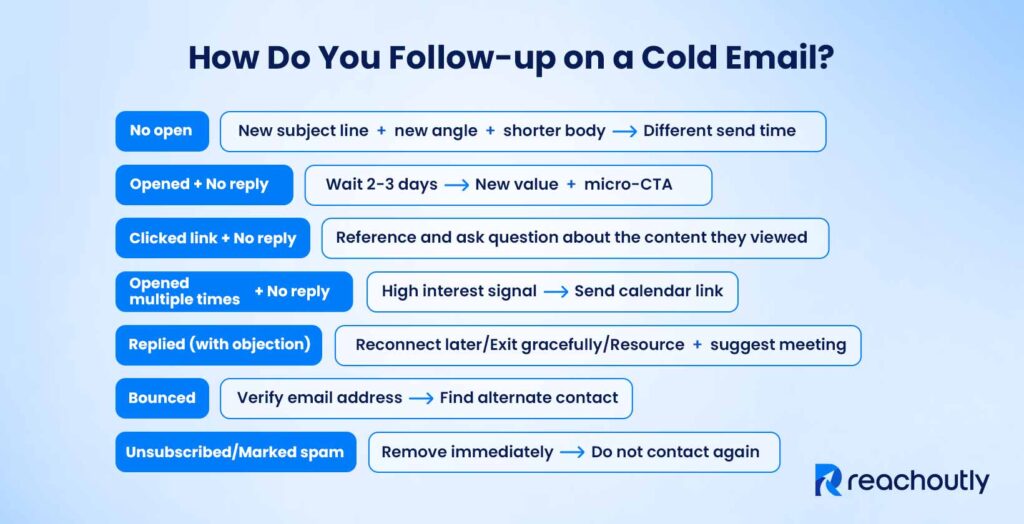
- Positive signals. Shorten the wait to 24-48 hours, when someone opens your cold email or clicks a link. Their engagement indicates interest.
- Industry norms. Tech startups and real estate professionals are suitable for faster outreach. Manufacturing, legal, and finance sectors prefer slower pacing of 3-5 days between contacts.
- Initial email timing. Sending your first cold email on Monday warrants a Wednesday or Thursday follow-up. Tuesday sends work with Thursday or Friday nudges.
- Time zones. International prospects receive your message at different hours. Add an extra day to account for their business schedule.
Start with one gap, then watch opens, clicks, and replies across your next few sends. Keep the gap consistent long enough to spot a pattern.To maintain excellent deliverability, avoid sending multiple emails within 24 hours. Rapid-fire messaging triggers spam filters and damages your sender reputation. Space out your sequence to protect your domain health and keep future emails landing in primary inboxes.
A well written follow-up cold email is most effective when the timing is right. Use the next steps to turn silence into a reply without being pushy.
How to Write a Follow-up Cold Email After No Response?
To write a follow-up cold email that earns a reply, briefly recap your previous message, add one new value point, keep the message to 40-60 words, and end with one simple low-pressure CTA.
A proven follow-up cold email reminds the recipient who you are, delivers fresh value, respects their time, and asks for one simple action. The goal is not to repeat your original pitch. The goal is to earn a reply by making engagement easy and worthwhile. Follow this five-step process for writing follow-ups that get responses.
- Write a short, specific subject line. Keep it under 50 characters. Reference the previous conversation or hint at a new value proposition.
- Open with a one-line context recap. Remind them why you reached out without restating your entire pitch.
- Add value. Share an insight, resource, or case study they did not see before.
- Include a single low-pressure CTA. Ask one question that requires minimal effort to answer.
- Review for length and tone. Be polite. Don’t be pushy, vague, or redundant.
Keep in mind the best practices of writing follow-up cold emails that are below.
Keep Them Short
The ideal follow-up cold emails contain 40-60 words. Busy professionals skim messages in seconds. Long emails signal extra work. People ignore them. Aim for under 90 words maximum.
Each follow-up cold email communicates one idea and includes one CTA. Avoid copying your original pitch into the follow-up. Recipients already received that information. Repeating it wastes their time and makes you appear desperate.
Before (too long, 103 words)
Hi Jessica,

I wanted to follow up on my previous email about our marketing automation platform.

As I mentioned, we help B2B companies streamline their lead nurturing process through AI-powered sequences. Our clients typically see a 40% increase in qualified leads within 90 days.

I know you’re probably busy, but I really think this could be valuable for your team given your recent expansion into new markets.

Would you be open to a quick 15-minute call this week to discuss how we might be able to help? I’m available Tuesday or Thursday afternoon.

Let me know what works best for you.
After (short, 46 words)
Hi Jessica,

Following up on my note about automating your lead nurturing.

One quick thing, Acme Corp (similar size, B2B SaaS) cut their manual follow-up time by 60% in their first month.

Worth a 10-minute call to see if this fits your expansion plans?
The rewritten email version removes redundant context, delivers one proof point, and ends with a single low-friction ask.
Recap Previous Message
Start each follow-up email with a one-line context recap. This line answers the question “Why is this person emailing me?” Recipients receive dozens of messages daily. They forget conversations quickly. A good recap includes, “Following up on my note about reducing your customer churn rate.” This approach provides instant clarity without forcing the recipient to search their inbox.
Add Value, Don’t Just “Check In”
Grab attention in every follow-up email by adding value. A “value inventory” gives you options for each message in your sequence. Lead with these seven types of value.
- Insight: A relevant trend, statistic, or observation about their industry
- Benchmark: Data showing how similar companies perform
- Teardown: A brief analysis of something they published or launched
- Case snippet: One specific result from a client in their space
- Relevant resource: An article, report, or tool that helps them
- Objection answer: A response to a common hesitation buyers have
- Mutual connection: A shared contact who can vouch for you
Use these seven value types across your cold email follow-up sequence to maintain engagement.
| Value Type | Definition | Best Template Fit |
| Insight | Industry trend or data point recipient has not considered | Value-add, New angle |
| Benchmark | Specific metric comparing performance to peers | Social proof, Quote follow-up |
| Teardown | Brief analysis of recipient’s current approach | Value-add, Quick question |
| Case snippet | 2-3 sentence client success story | Social proof, Objection handler |
| Relevant resource | Article, video, or guide addressing their challenge | Value-add, After meeting |
| Objection answer | Direct response to common hesitation | Objection handler, Breakup |
| Mutual connection | Shared contact, event, or community | Trigger event, Right person finder |
Here are some examples of these types of values.
- Insight example: “Saw that email open rates in SaaS dropped 12% this quarter according to Mailchimp’s latest benchmark. Curious how that’s affecting your outreach?”
- Case snippet example: “Quick win to share: A fintech startup your size booked 23 demos last month using a three-email sequence. Happy to show you the framework.”
- Relevant resource example: “Found this teardown of high-converting SaaS landing pages from the Baymard Institute. Thought it might help with your upcoming rebrand.”
Rotate through these value types across your sequence. Each follow-up feels fresh because you offer something different every time.
Always Be Polite
Polite follow-up emails acknowledge that the recipient is busy. Direct follow-ups get to the point fast. The best messages balance both qualities. Respect the recipient’s autonomy and never assign blame.
Too passive: “I’m so sorry to bother you again. I know you’re incredibly busy, and I feel bad reaching out, but I just wanted to see if maybe you had a chance to look at my previous email whenever you get a moment.”
Too aggressive: “This is my third email. Are you interested or not? I need an answer by Friday.”
Balanced rewrite: “Know your plate is full. Quick question: is improving your demo booking rate something you’re focused on this quarter? If not, happy to close the loop.”The balanced version respects their time, states the purpose clearly, and offers an easy exit. This approach maintains professionalism while moving the conversation forward.
Use the practical examples below to better understand how to write follow-up cold emails and to get started writing.
Use This Tried and Tested Gentle Reminder Follow-up Template
Use this gentle reminder follow-up template when your first email got no reply, and you want to nudge without adding pressure.
Subject: Quick follow-up on [ topic ]

Hi [ Name ],

Following up on my previous email about [ value proposition ].

Know your plate is full, just wondering if [ pain point ] is something you’re focused on this quarter?
Happy to discuss or close the loop.

Thanks,
[ Your Name ]
Use This Subject Line Library to Get Started
These subject line options help you signal a follow-up without sounding pushy. Use one of these as-is, then swap in the topic.
- Quick follow-up
- One quick question
- Thought this might help
- Following up on [ topic ]
- How [ Client Name ] achieved [ result ]
- Different idea for [ company Name ]
- Congrats on [ achievement ]
- Could you point me in the right direction?
- Did this land at a bad time?
- Worth another look?
- Should I close your file?
- Any questions about the proposal?
Use This CTA Library by Stage to Get Started
These CTA choices help you match the ask to the buyer’s stage. Pick one stage, use one question, and keep it easy to answer.
| Funnel Stage | CTA Type | Example Phrase |
| Early | Interest question | “Would you like to learn more?” |
| Early | Permission request | “Mind if I send a quick resource?” |
| Early | Soft inquiry | “Is this something you are facing too?” |
| Mid | Value exchange | “Can I share how we solved this?” |
| Mid | Availability check | “Do you have time to connect this week?” |
| Mid | Meeting Request | “Worth a quick 10 minutes?” |
| Mid | Demo offer | “Would a quick walkthrough help?” |
| Mid | Ask direction | “Who’s the best person to discuss next steps?” |
| Late | Direct booking | “Does [ Day ] at [ Time ] work?” |
| Late | Decision prompt | “Which of these describes your situation?” |
| Late | File closure | “Can I close your file for now?” |
| Late | Re-engagement | “Want me to check back in Q2?” |
Pair one subject line with one CTA and craft your 40-60 word follow-up cold email around a single value point.
What You Should Avoid While Writing Follow-up Cold Emails?
You should avoid these phrases and habits that kill follow-up cold emails performance and increase spam complaints.
- Using a subject line like “Just checking in”. This type of phrase adds no value and signals laziness. Recipients skip past it because nothing useful follows.
- Re-pasting your entire original pitch. Recipients already received that information. Repeating it signals desperation and disrespects their time.
- Being vague. Recipients move on, when they can’t immediately understand your purpose.
- Using guilt-tripping language. Phrases like “I noticed you didn’t reply” or “You must have missed my email” create defensiveness.
- Being pushy. Aggressive language damages relationships. “I need an answer by Friday” puts pressure that backfires.
- Over-following up. Limit your sequence to 3-4 follow-ups before switching channels. Connect on LinkedIn or try a different contact at the company.
- Adding multiple asks. When you request three things, recipients do none.
Follow-up cold email templates remove these mistakes because a template gives structure. You can customize these ready-to-use follow-up templates fast and get replies.
25 Effective Cold Email Follow-Up Templates
A cold email follow-up template helps beginners keep follow-ups short, lead with value each time, and ask for one simple next step. Reachoutly’s cold email experts compiled 25 proven cold email follow-up templates for different industries and stages of the outreach including early emails that start a low-pressure conversation, mid-stage emails that add proof or resources, and late-stage emails that prompt a clear decision or a clean exit. This collection of follow-up cold email templates includes
- Reminder follow-up templates
- Value-driven follow-up templates
- Conversation starter follow-up templates
- Closing follow-up templates
- Industry-specific follow-up templates
- Job search follow-up templates
- A Complete follow-up sequence
Let’s start with the reminder follow-up templates.
1. The Gentle Reminder Follow-Up Cold Email Template
Sales reps, marketers, and founders use this gentle reminder template to nudge prospects who missed or forgot the initial email.
Subject: Quick follow-up

Hi [ First Name ],

Just following up on my note about [ topic ].

We help teams like [ Company Name ] [ achieve/improve/reduce ] [ specific benefit/pain point ] without [ adding headcount/changing tools/a long rollout ].

Open to a 10 min chat this week, or should I send a 2 sentence summary?

Best,
[ Your Name ]
Use this gentle reminder template when your prospect has not responded within 2-3 days of your initial outreach. It works best as your first follow-up in any sequence.
To personalize this gentle reminder template, use a result relevant to their industry. Reference their company name to show this is not a mass blast.
This gentle reminder template works because it respects the recipient’s time while restating your core value in one sentence. The soft CTA “Would you like to learn more?” generates higher response rates than aggressive asks. The brief format matches how busy professionals scan emails.
2. The Value-Add Resource Follow-Up Cold Email Template
Business development reps, content marketers, and consultants use this value-add resource template to share helpful content that demonstrates expertise without asking for commitment.
Hi [ First Name ],

I put together a [ 2 minute video/short walkthrough ] on [ Pain Point ]: [ Video Link ]

It covers:
1. One way to [ prevent/fix/reduce ] [ impact ]
2. [ how a client solved it/the exact change that helped/what worked for another team ]

Worth exploring for [ Company Name ], or not a priority right now?

Best,
[ Your Name ]
Use this value-add resource template when you want to provide immediate benefit before asking anything in return. It fits best as your second or third follow-up.
To personalize this value-add resource template, name specific impacts their role faces daily. Create a short video addressing their exact industry challenge. Reference a client in their space.
This value-add resource template works because it shifts focus from selling to helping. That’s why emails offering relevant resources see higher engagement rates. The question-based CTA invites conversation without pressure.
3. The Social Proof Follow-Up Cold Email Template
Account executives, agency owners, and SaaS sales teams use this social proof template to build credibility through specific client results.
Subject: How [ Client Name ] improved [ metric ]

Hi [ First Name ],

Quick example from [ Industry ].

After using [ your product name ], [ Client Name ] saw [ X% ] lift in [ metric ] in [ timeframe ].

The change was simple: [ the key workflow tweak ].

Want me to send the [ 3 bullet breakdown/short recap/exact steps ]?

Best,
[ Your Name ]
Use this social proof template when prospects need evidence that your solution delivers results. Position it as your third follow-up after initial contact and value-add emails.
To personalize this social proof template, feature a client from the same industry as your prospect. Include specific percentage improvements rather than vague claims. Match the metric to what matters most to their role.
This social proof template works because B2B buyers trust peer recommendations over vendor claims. Concrete numbers create believability. The mid-funnel CTA requests connection without demanding immediate commitment.
4. The Interest CTA Follow-Up Cold Email Template
SDRs, marketers, and solo founders use this interest CTA template to generate responses through low-pressure closing questions.
Subject: A couple of ideas for [ Company Name ]

Hi [ First Name ],

I took a quick look at [ Company Name ] and saw a few opportunities around [ relevant metric ], especially [ area ].

I put together a [ 2 min video/short walkthrough/quick loom ] showing changes to help [ achieve benefit ].

Want me to share it here, or would you prefer [ the video/3 bullets/a quick checklist ]?

Best,
[ Your Name ]
Use this interest CTA template when you want maximum response rates with minimum friction. It works at any funnel stage but excels in early outreach.
To personalize this interest CTA template, mention a specific metric visible on their website or public profiles. Create a short video addressing their exact situation. Reference their industry’s common challenges.
This interest CTA template works because the phrase “Would you like to learn more?” generates higher response rates than specific time-based CTAs. The “no pressure” line removes anxiety and invites honest response.
5. The Quick Question Follow-Up Cold Email Template
SDRs, recruiters, and business owners use this quick question follow-up template to re-engage silent prospects through direct inquiry about their challenges.
Subject: [ Relevant topic ] question

Hi [ First Name ],

Quick question on [ relevant topic ].

Which is the bigger issue right now at [ Company Name ]: [ option A/option B/option C ]?

If you reply with a letter, I can send a [ 2 minute suggestion/quick idea/short example ] that has worked for similar teams.

Best,
[ Your Name ]
Use this quick question follow-up template when standard follow-ups have not generated response. It works well mid-sequence to restart stalled conversations.
To personalize this quick question template, reference a specific topic from your research on their company. Ask about challenges tied to their job title. Mention a recent change in their industry that creates new problems.
This quick question template works because questions trigger the brain’s natural response instinct. Single-question emails receive 45% higher reply rates than multi-request messages according to reachoutly’s 2025 campaign data. The format respects their time while inviting meaningful dialogue.
6. The New Angle Follow-Up Cold Email Template
Sales professionals, marketing consultants, and service providers use this new angle follow-up template to pivot messaging when the original approach did not resonate.
Subject: Another angle on [ topic ]

Hi [ First Name ],

I have been reaching out about helping [ Company Name ] [ value proposition ] faster.

Earlier I mentioned [ original pain point ]. It might be more relevant to look at [ alternative pain point ] instead.

We helped a [ industry ] team with that and got [ specific result ] in [ timeframe ].

Is [ alternative pain point ] on your radar, or is [ original pain point ] still the bigger priority?

Best,
[ Your Name ]
Use this new angle follow-up template when prospects ignore multiple emails focused on one pain point. Position it as your fourth follow-up to test different messaging.
To personalize this new angle follow-up template, research secondary challenges their role faces. Check their LinkedIn activity for clues about current priorities. Reference industry trends affecting their specific department.
This new angle follow-up template works because it acknowledges your first approach may have missed the mark. This honesty builds trust. Offering alternative value shows you understand their business has multiple needs. The soft CTA invites exploration rather than demanding commitment.
7. The After Meeting Follow-Up Cold Email Template
Sales reps, consultants, and partnership managers use this follow-up after meeting template to maintain momentum following a live conversation.
Subject: Recap and next steps

Hi [ First Name ],

Thanks for meeting today. Confirming our next conversation on [ agreed day/time ].

Quick recap:
1. Priorities: [ 2-3 goals ]
2. Success looks like: [ 2-3 benchmarks ]
3. How we help: your [ product/service ] helps by [ mechanism ]

I attached a case study from a [ same industry ] team facing something similar.

Next step: I will send [ deliverable ] by [ date ]. Does that still work?

Best,
[ Your Name ]
Use this follow-up after meeting template when you finish a discovery call, demo, or in-person meeting. Send within 24 hours while the conversation remains fresh.
To personalize this follow-up after meeting template, include exact phrases they used to describe their goals. Reference specific numbers or timelines they mentioned. Attach a case study from their industry vertical.
This follow-up after meeting template works because it demonstrates active listening by recapping their priorities. The structure creates accountability for next steps. According to 2025 sales data of Reachoutly, follow-ups sent within 24 hours of meetings have 3x higher close rates than those sent later.
8. The Trigger Event Follow-Up Cold Email Template
Business development reps, enterprise sales teams, and startup founders use this trigger event follow-up template to leverage recent company news as conversation starters.
Subject: Quick note on [ achievement ]

Hi [ First Name ],

Congrats on [ achievement ].

Often after a [ funding round/launch/new hire/award ], teams focus on [ relevant area ] to [ move faster/scale cleanly/hit targets ]. Curious if that is on your list too.

If yes, I can share a quick idea on how we help with [ relevant area ]. Open to a quick call this week?

Best,
[ Your Name ]
Use this trigger event follow-up template when a prospect’s company announces funding, launches a product, wins an award, or hires key executives. Send within days of the news.
To personalize this trigger event follow-up template, mention the specific achievement with accurate details. Connect the news to how your solution becomes more relevant now. Reference growth challenges that accompany their milestone.
This trigger event follow-up template works because it shows you pay attention to their business. That’s why trigger-based emails see higher response rates than generic outreach. The congratulations create positive association before your ask.
9. The Right Person Finder Follow-Up Cold Email Template
SDRs, agency salespeople, and B2B marketers use this right person finder follow-up template to identify the correct decision-maker when current contact is unresponsive.
Subject: Right person for [ topic ]

Hi [ First Name ],

Quick question, who is the best person at [ Company Name ] to speak with about [ topic ]?

If it is you, are you open to a 10 min chat to see if we can help with [ pain point ]?

If not, could you point me to the right person?

Thanks,
[ Your Name ]
Use this right person finder follow-up template when you suspect the recipient lacks decision-making authority. It works well after 2-3 unanswered follow-ups to the same contact.
To personalize this right person finder follow-up template, mention the specific department or role you need to reach. Reference a project or initiative that relates to your offering. Keep the ask simple.
This right person finder follow-up template works because it gives recipients an easy way to help without committing themselves. Lower-level employees often forward valuable opportunities to prove their initiative. The polite tone increases likelihood of assistance.
10. The Objection Handler Follow-Up Cold Email Template
Experienced sales reps, account managers, and founders use this objection handler template to address common hesitations around timing, budget, or existing solutions.
Subject: Quick question on [ timing/budget ]

Hi [ First Name ],

Totally fair if now is not the right time.

Quick question, is the main blocker [ timing/budget/already using something ] for [ problem ]?

For context, [ Client Name ] said the same thing, then we helped them [ specific result ] without [ common obstacle ].

If you tell me which one it is, I will [ send a relevant example/share a quick option/circle back at a better time ].

Best,
[ Your Name ]
Use this objection handler template when prospects express hesitation or when silence suggests unspoken concerns. Position it late in your sequence after value-focused emails.
To personalize this objection handler template, address the specific objection their industry typically raises. Feature a client who overcame the exact same hesitation. Include results that directly counter their concern.
This objection handler template works because it validates their hesitation instead of dismissing it. The case snippet provides proof that others in similar situations found success. This empathy-first messaging builds trust and reduces defensive responses.
11. The Breakup Follow-Up Cold Email Template
Sales professionals, recruiters, and service providers use this breakup template as a final attempt that creates urgency through graceful closure.
Subject: Should I close this out?

Hi [ First Name ],

I do not want to keep pinging you about [ business aspect ].

Should I put this on hold, or is it worth a quick chat?

Reply with [ close/hold/talk ] and I will follow your lead.

Best,
[ Your Name ]
Use this breakup template when you have sent 4-5 follow-ups without response. Position it as your final email in the sequence.
To personalize this breakup template, reference the specific topic you have been discussing. Adjust the timeframe for re-contact based on their buying cycle. Keep the tone warm, not passive-aggressive.
This breakup template works because people respond to avoid losing an opportunity. The numbered options make replying easy. That’s why breakup emails generate higher response rates than standard follow-ups.
12. The Quote Follow-Up Cold Email Template
Account executives, freelancers, and agency owners use this quote follow-up template to re-engage prospects after sending pricing without appearing desperate.
Subject: Any questions on the proposal?

Hi [ First Name ],

Checking in on the proposal I sent over.

Is it [ approved/pending review/on hold ] on your side?

If there is a snag, is it [ scope/pricing/timing ]? If you reply with one word, I will send a quick option to fix it.

Best,
[ Your Name ]
Use this quote follow-up template when a prospect requested pricing but went silent. Send 3-5 days after delivering your proposal.
To personalize this quote follow-up template, reference specific line items from the proposal. Mention flexibility on payment terms if relevant. Offer to discuss scope adjustments that match their budget.
This quote follow-up template works because it opens dialogue about concerns rather than pushing for immediate decision. The offer to adjust scope signals partnership rather than rigid selling. Shorter call requests (5-10 minutes) reduce commitment anxiety.
13. The Free Trial Check-In Follow-Up Cold Email Template
SaaS companies, product-led growth teams, and customer success managers use this free trial check-in template to re-engage prospects whose trial ended without conversion.
Subject: Quick question about your trial

Hi [ First Name ],

Noticed your [ Company ] trial ended.

Quick question, what stopped you from moving forward: [ did not have time/missing a feature/pricing/not the right fit ]?

If you want, I can [ extend the trial for a few days/help you get set up in 10 minutes/show the best use cases ] so you can evaluate it properly.

Worth revisiting, or should I close it out?

Best,
[ Your Name ]
Use this free trial check-in template when a prospect’s trial period ends without purchase or engagement drops during the trial. Send within 24-48 hours of expiration.
To personalize this free trial check-in template, reference specific features they used or ignored during the trial. Mention usage patterns that suggest confusion. Offer a demo focused on their particular use case.
This free trial check-in template works because it opens dialogue about obstacles rather than pushing for purchase. The offer to help positions you as a partner, not a salesperson. Personalized trial follow-ups recover a large number of churned trial users.
14. The B2B Sales Follow-Up Cold Email Template
Enterprise sales teams, B2B service providers, and resellers use this B2B sales follow-up template to target business decision-makers with ROI-focused messaging.
Subject: [ Company Name ] ROI check

Hi [ First Name ],

We helped [ similar B2B company ] cut [ cost/time metric ] by [ X% ] while increasing [ revenue/efficiency metric ] by [ Y% ].

Implementation was under [ timeframe ], and they saw impact within [ result timeframe ] of launch.

Worth a quick call to see if this is realistic for [ Company Name ]?

Best,
[ Your Name ]
Use this B2B sales follow-up template when targeting operations managers, procurement teams, or C-suite executives focused on measurable outcomes.
To personalize this B2B sales follow-up template, feature a client from the same industry vertical. Include specific percentages rather than vague improvements. Match the metrics to what their role cares about. For example, CFOs want cost reduction, COOs want efficiency gains.
This B2B sales follow-up template works because B2B buyers make decisions based on ROI projections. Dual metrics (cost down, revenue up) demonstrate comprehensive value. The short timeframe reduces perceived implementation risk.
15. The B2B Enterprise Follow-Up Cold Email Template
Enterprise sales teams, strategic account managers, and solution architects use this B2B enterprise follow-up template to navigate longer sales cycles with multiple decision-makers.
Subject: Evaluation pack for [ Company Name ]

Hi [ First Name ],

To make evaluation easier for [ Company Name ], I can send a small pack with:
- An ROI calculator for [  industry ]
- A case study from [ similar enterprise company ]
- Technical documentation for IT team

Would it be helpful if I sent this over?

If technical questions come up, I can also loop in our [ solutions team/technical lead/implementation team ].

Best,
[ Your Name ]
[ Your Title ]
[ Company Name ]
[ Phone Number ]
Use this B2B enterprise follow-up template when selling to companies with 500+ employees, complex procurement processes, or buying committees.
To personalize this B2B enterprise follow-up template, name each stakeholder role involved in their buying process. Feature a case study from a recognizable company in their industry. Match technical documentation depth to their IT team’s sophistication level.
This B2B enterprise follow-up template works because enterprise deals average 6-12 months and involve 6-10 decision-makers. Providing role-specific resources enables your contact to share materials internally. The permission-based CTA respects their evaluation timeline without pushing for premature commitment.
16. The SaaS Product Follow-Up Cold Email Template
Software sales teams, technical founders, and product marketers use this SaaS product follow-up template to address integration concerns and adoption barriers.
Subject: Does [ Company Name ] use [ their current tool ]?

Hi [ First Name ],

Quick question, are you using [ their current tool/platform ] at [ Company Name ]?

If so, [ Your SaaS Product ] integrates with it so your team can get live in about [ timeframe ] without [ migrating data/long setup/extra engineering work ].

[ SaaS client ] saw [ X% ] improvement in [ relevant metric ] in the first month.

Want a 90 sec demo video of the integration?

Best,
[ Your Name ]
Use this SaaS product follow-up template when prospects use complementary tools your product integrates with. It works well mid-sequence after initial interest.
To personalize this SaaS product follow-up template, research their tech stack through job postings, BuiltWith, or LinkedIn. Mention the exact tools they use. Highlight integration speed to reduce switching anxiety.
This SaaS product follow-up template works because integration complexity blocks the majority of SaaS purchases. Addressing this concern directly removes the primary objection. The demo video offer provides proof without requiring commitment.
17. The Agency Services Follow-Up Cold Email Template
Marketing agencies, design studios, and creative consultancies use this agency services follow-up template to showcase portfolio work and pitch improvements.
Subject: A few ideas for [ Company Name ]

Hi [ First Name ],

I put together a few ideas for [ Company Name ] to [ specific benefit ] around your [ website/ads/content ], especially [ specific observation/area/funnel stage ].

Similar work for [ agency client ] led to [ Result ] in [ time period ].

Want me to share the breakdown here, or should I keep it on my side?

Best,
[ Your Name ]
Use this agency services follow-up template when pitching creative, marketing, or consulting services to businesses with visible online presence.
To personalize this agency services follow-up template, audit their current website, ads, or content before emailing. Note specific improvement opportunities. Feature a client in their industry with measurable results.
This agency services follow-up template works because it demonstrates effort and expertise before asking for anything. The teardown approach shows you understand their business. Multiple results create comprehensive proof of capability.
18. The Job Application Follow-Up Cold Email Template
Job seekers, career changers, and recent graduates use this job application follow-up template to stand out after submitting an application.
Subject: Following up on [ Job Title ] application

Hi [ First Name ],

I applied for the [ Job Title ] role at [ Company Name ] and wanted to check on the hiring timeline.

I am especially interested in [ specific company initiative/value ]. In my last role, I [ did/led/improved ] [ relevant project/metric ], and I believe that experience maps well to what you are building.

If helpful, I can share [ a short work sample/a 1 page summary/a quick portfolio link ] related to the role.

Thanks,
[ Your Name ]
[ Your Phone Number ]
[ Your LinkedIn URL ]
Use this job application follow-up template when you have not heard back 5-7 business days after submitting an application.
To personalize this job application follow-up template, reference a specific company project, product, or value from their website. Connect your experience directly to their stated requirements. Mention something specific that attracted you to the role.
This job application follow-up template works because it demonstrates initiative without appearing desperate. That’s why candidates who follow up receive more interviews than those who do not. The offer to provide additional information opens dialogue.
19. The Job Interview Follow-Up Cold Email Template
Candidates at any career level use this job interview follow-up template to reinforce their candidacy and thank interviewers within 24 hours.
Hi [ First Name ],
Thank you for speaking with me about the [ Job Title ] role today. I enjoyed learning more about [ specific topic discussed ], especially [ specific detail ].
Based on our conversation, I would be excited to help with [ specific goal/project mentioned ] by applying [ relevant skill ], similar to how I [ did/delivered/led ] [ past example/result/project ] in my previous work.
If there is anything else I can provide, happy to send it. What are the next steps on your side?
Best,
[ Your Name ]
[ Your Phone Number ]
[ Your LinkedIn URL ]
Use this job interview follow-up template when you complete a phone screen, video interview, or in-person meeting. Send within 24 hours while the conversation remains fresh.
To personalize this job interview follow-up template, reference exact topics from your conversation. Mention a specific challenge they described and how you would address it. Include something that genuinely excites you about the role.
This job interview follow-up template works because it demonstrates listening skills and genuine interest. Hiring managers receive many generic thank-you notes. But specific references stand out.
Complete Follow-Up Cold Email Sequence Framework
This ready-to-use follow-up sequence takes prospects from first contact to final follow up. The sequence follows proven timing intervals. Each email builds on the previous message while adding new value.
Sequence Email 1: The Initial Cold Email Template
This first touch outreach template introduces you, states your core value, and ends with an interest-based CTA.
Subject: Idea for [ Company Name ]

Hi [ First Name ],

Saw [ Company Name ] and noticed [ personalized observation about their business ].

We helped [ similar company ] achieve [ specific result ] by [ how you do it in 3 to 6 words ].

If you do not see [ outcome ] in [ timeframe ], you do not pay.

Worth a 10 min chat?

Best,
[ Your Name ]
This initial cold email template works because it leads with personalization, offers social proof immediately, and reduces risk with a guarantee. The interest CTA maximizes response potential.
Sequence Email 2: The Quick Bump Follow-Up Cold Email Template
This short quick bump template checks if they saw your message while restating the core benefit in one line.
Subject: Quick check in

Hi [ First Name ],

Quick follow up on [ topic ].

We help teams like [ Company Name ] improve [ metric ] in [ timeframe ].

Open to a quick call, or should I send a 2 sentence summary?

Best,
[ Your Name ]
This quick bump email template works because brevity respects their time. The empathetic acknowledgment of busy inboxes builds rapport. Restating the benefit reinforces your value without repeating the entire pitch.
Sequence Email 3: The Value-Add Follow-Up Cold Email Template H5
This value-add follow-up template shares a helpful tip or insight related to their pain point without asking for anything substantial.
Subject: Small idea for [ Company Name ]

Hi [ First Name ],

Not sure if this is on your radar, but a common issue in [ industry ] is [ industry pain point ].

Quick idea that often helps: [ actionable tip ].

If you want, I can send [ 2 more ideas/a short checklist/a 3 bullet plan ] for improving [ improving X ]. Interested?

Best,
[ Your Name ]
This value-add email template works because it shifts from asking to giving. Free value builds trust and positions you as an expert. The soft CTA invites continued conversation without pressure.
Sequence Email 4: The Social Proof Follow-Up Cold Email Template
This social proof follow-up email introduces a case snippet showing specific results for a similar company.
Subject: [ Client Name ] Case study

Hi [ First Name ],

Quick example from a team like yours.

[ Client Name ] was dealing with [ pain point ] and wanted [ desired outcome ]. After working with us, they saw:
1. [ Result 1 with timeframe ]
2. [ Result 2 with timeframe ]

Want me to send the [ 3 bullet breakdown/short recap/exact steps ]?

Best,
[ Your Name ]
This social proof follow-up email works because peer success stories create credibility. Specific results with numbers are believable. The mid-funnel CTA requests connection without demanding immediate purchase.
Sequence Email 5: The New Angle Follow-Up Cold Email Template
This new angle follow-up email pivots to a different pain point, acknowledging the first approach didn’t resonate.
Subject: Another angle on [ topic ]

Hi [ First Name ],

I may have been focusing on [ original angle ], but you might care more about [ alternative benefit ] right now.

We helped [ Client Name ] get [ specific result ] in [ timeframe ] using this approach.

Is [ alternative benefit ] on your radar, or is [ original angle ] still the bigger priority at [ Company Name ]?

Best,
[ Your Name ]
This new angle follow-up email works because it shows flexibility and deeper understanding of their business. Admitting the first approach missed the mark builds trust. Offering alternatives demonstrates comprehensive capability.
Sequence Email 6: The Breakup Cold Email Template
This final breakup template gives permission to say no while creating subtle urgency through closure.
Subject: Closing the loop

Hi [ First Name ],

I have not heard back from you, so I will assume the timing is not right.

I will close your file for now, but please know my inbox is always open if you find yourself needing help with [ pain point ] down the road.

Wishing you and the team at [ Company Name ] all the best.

Best,
[ Your Name ]
This breakup email template works because it triggers loss aversion without manipulation. The warm tone leaves a positive impression for future contact.
The best approach depends on your industry, ICP and stage. Use the follow-up examples above as building blocks. Create your own sales follow-up email templates by pairing one value type with one simple CTA. Use a consistent follow-up sending strategy so each message lands well and gets replies.
How to Send a Cold Email Follow-Up?
To send a cold email follow-up, check conversation, keep it in the same thread, add context from your previous email, personalize, time it according to your cadence schedule, and track your results.
Check Whether the Prospect Already Replied Before You Send
Check whether the prospect already replied or not. Make sure not to follow up the prospect who already replied, even if they said “not interested” or asked a question. Move replied contacts into a separate workflow. Sending scheduled follow-ups to people who engaged already damages trust and makes your outreach look automated.
Reply in the Same Thread
Send follow-ups as threaded replies to your original email. Threaded replies keep all messages in one conversation. Recipients can scroll down for context if they need it. The subject line stays consistent, which improves recognition. Most email clients display threaded messages together. Your follow-up feels like a natural continuation rather than a fresh interruption. This behavior looks professional and saves everyone time.
Personalize and Add Context
Reference recent company news such as funding rounds, product launches, or executive hires to personalize your follow-up email. Mention role-specific pain points that match the recipient’s title. Note their tech stack if publicly visible. Acknowledge hiring patterns that suggest growth or challenges. These signals prove you researched their situation rather than blasting identical templates.
Adjust Timing and Tone
Wait two to three days after your cold intro. Reachoutly’s 2025 campaign data shows that, Tuesday through Thursday between 9 AM and 11 AM in the recipient’s time zone produces the highest engagement. Keep your tone polite, professional, and respectful of their time.
Track Results
Track three metrics across your follow-up sequence including reply rate, meeting rate, and unsubscribe rate. Reply rate shows message effectiveness, meeting rate measures conversion quality, and unsubscribe rate signals whether your frequency or targeting requires adjustment. Plan 3-5 follow-ups in your sequence, ending with a “break-up” email if needed to boost your response rate.
Use these effective cold email follow-up strategies to boost your response rate. Send the appropriate number of follow-ups so that you don’t annoy your prospects.
How Many Follow-Ups Should You Send in a Cold Email Sequence?
You should send between three and five follow-ups in a cold email sequence. Go for a total of four to six touches. Stop when a prospect explicitly declines, marks you as spam, or ignores your breakup email.
Research from Lemlist analyzing millions of cold outreach campaigns shows reply rates increase with each follow-up through the fourth or fifth message. After nine total emails, spam complaints rise and returns diminish sharply. The optimal number depends on your sales cycle length, prospect seniority, and how quickly your offer becomes irrelevant.
Each follow-up in your sequence serves a distinct purpose. Your first follow-up acts as a gentle reminder with one new value point. The second introduces a different angle such as a case study or alternative benefit. The third asks a direct question or offers a helpful resource. A fourth follow-up can re-engage with fresh proof or address a common objection. Your final message functions as a breakup email that signals closure and gives the prospect one last chance to respond.
Stop when a prospect says “not interested,” marks you as spam, or ignores your breakup email. Continuing beyond this point risks spam complaints and damages your sender reputation.
Test and adapt your sequence. Change one variable at a time while testing. Adjust the number of follow-ups, then measure results before modifying spacing or copy. What works depends on your audience. Use this framework.
- Short Cycle (3 emails total): Works for fast-moving decisions. Initial outreach, one value-add follow-up after three days, breakup email after five more days.
- Standard Cycle (5 emails total): Fits most B2B cold outreach. Initial email plus four follow-ups spread across a couple of weeks with widening cadence.
- Long Cycle (6+ emails total): Suits enterprise sales. Initial email plus five spaced-out emails over 8-12 weeks. Top performers in this range maximize responses without triggering spam filters.
What Is the Ideal Frequency for Sending Cold Email Follow-Ups?
The ideal frequency for sending cold email follow-ups is given below.
- Day 1: Initial cold email
- Day 4: First follow-up
- Day 9: Second follow-up
- Day 16: Third follow-up
- Day 30: Fourth follow-up for longer nurture sequences
This cadence gives you five emails in total, one initial email and four follow-ups. This combination maximizes engagement while minimizing spam complaints that can damage your sender reputation. The first follow-up alone delivers a 40% higher reply rate compared to sending just one email.
Context matters when setting your frequency. C-level executives and senior decision-makers prefer longer gaps of 5-7 days between messages. Enterprise deals with extended buying cycles benefit from 7-14 day intervals. Startup founders and sales managers in fast-moving industries tolerate quicker follow-ups of 2-3 days.
Not all days of the week are best for sending emails. Tuesday through Thursday are the best days for cold outreach. Send during reply windows (2-4 PM) when prospects actively check their inbox.
There are limits to how many follow-up emails you should send. Sales teams average 10-12 touches per prospect before receiving a response. 6-9 follow-up emails is the upper limit for email-only campaigns. Benefits become negligible and spam complaints rise after 9 total touches.
Track your bounce rate, reply rates, and spam complaint rate across sequences. High numbers indicate list quality problems or excessive frequency. Test different timing approaches to gather data on what works for your specific audience.
What Are the Response Rate Statistics for Cold Email Follow-Up?
Cold email sequences with follow-ups yield 40-60% higher total response rates compared to single-email outreach. The initial cold email earns a 1-5% reply rate. A complete follow-up sequence can lift overall responses to 5-10% or even higher (15-20%+) for well-optimized sequences.
The first email carries the heaviest lift but produces the lowest individual response. According to a 2025 analysis by Reachoutly across its campaigns, the first email averages a 3-5% reply rate. The first follow-up boosts responses by up to 49%. Each subsequent message adds incremental responses. The second follow-up contributes roughly 3%, and later messages add 1-2% each. Cumulative reply rates reach 10% or higher by the fourth or fifth touch for well-optimized sequences.
Follow-up rates depend on some key factors.
- Personalization: Follow-ups referencing specific company news, role challenges, or tech stack 3x engagement compared to generic messages.
- Relevance and Value: Each follow-up delivering a distinct insight, case snippet, or resource earns more replies than repetitive “checking in” messages.
- Cadence consistency: Sequences with predictable spacing (3-4 days apart) build familiarity. A three-day wait before sending a follow-up increases reply rates. Waiting more than five days leads to a drop in responses.
- Deliverability: Prospects see the emails landing in primary inboxes. Proper SPF and DKIM technical setup protects inbox placement. Spam folder placement kills response rates regardless of copy quality.
- Industry and Role: HR roles and individual contributors reply more readily than C-level executives. C-suite executives still respond 23% more than other roles when the message hits the right pain point. Tech and SaaS sectors see lower response rates than nonprofits or event agencies.
To evaluate low response rate examine two metrics together. Your message or value proposition requires work, if open rates look healthy (above 40%) but replies stay low. Recipients see your email but find nothing engaging enough to respond. Focus on your subject lines, sender reputation, or list quality, if open rates fall below 30%. Poor inbox placement prevents recipients from ever reading your follow-up content. See our complete guide on cold email response rate to learn how to boost your response rate.
When Cold Email Follow-Ups Require Expert Help?
Cold email follow-ups require expert help when your follow-up sequence shows open rates below 30%, unsubscribes exceed 1%, or you get zero replies after 5-6 well-spaced follow-ups.
Certain signals indicate you need effective cold email follow-up strategies from professionals.
- Open rates below 30% suggest deliverability or subject line problems you cannot diagnose alone.
- Zero replies after five or six well-spaced follow-ups point to deeper messaging issues.
- Unsubscribe rates above 1% mean your targeting or frequency frustrates recipients.
- Stagnant conversion rates despite consistent outreach reveal a broken funnel.
Inability to personalize at scale limits your reach and forces you into generic messaging that underperforms.
These problems stem from a few root causes. A weak value proposition, follow-ups that repeat the same pitch, poor timing and deliverability issues causes ordinary results from your campaigns. Absence of testing means you never discover what resonates with your specific audience. You need cold email experts to solve these issues.
As a cold email agency, Reachoutly changes the underlying systems driving these failures. Reachoutly redesigns your sequence architecture to match your sales cycle and prospect behavior. It generates replies and meeting bookings with personalization, value-led follow-ups, and A/B testing frameworks. Use Reachoutly’s cold email outreach services when you want a predictable sales pipeline instead of guessing what to send next.