
Is Cold Email Legal? (Laws in the US, UK, Europe, and Canada)
Yes, cold emailing is legal, but you must follow specific laws that vary by country. Cold emailing involves sending unsolicited emails to individuals you haven’t contacted before. You can send cold emails to potential customers, partners, or clients without prior permission if you follow mandatory compliance requirements that vary by jurisdiction.
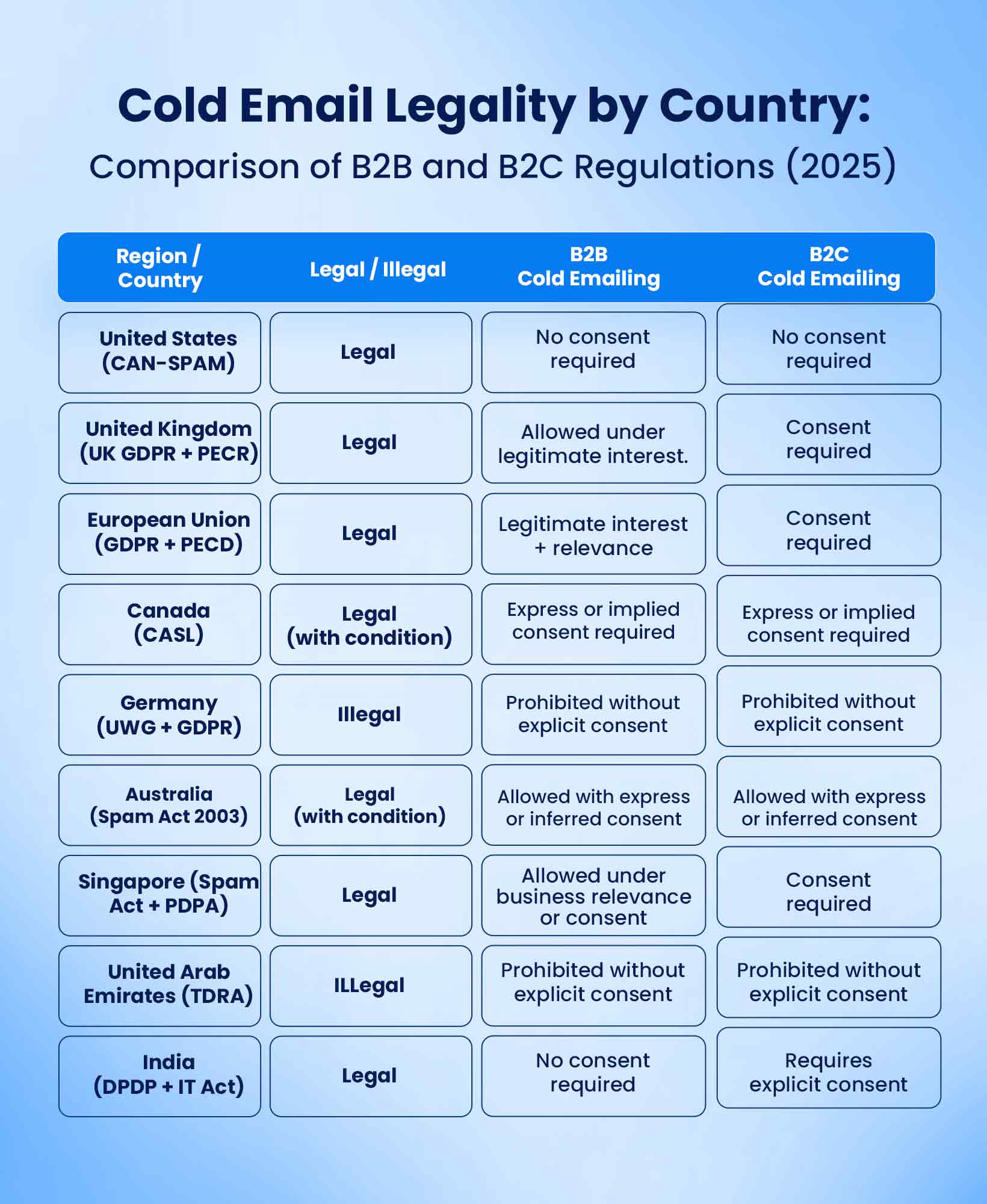
Cold emailing is a legal and accepted business practice in many parts of the world, including the United States, the UK, Europe, and Canada. Each country enforces its own laws governing commercial electronic messages. In the U.S., the CAN-SPAM Act allows sending unsolicited commercial emails if they contain accurate sender information, a physical address, and a clear method for opting out.
The UK and the broader European Union, governed by GDPR and the ePrivacy Directive, permit business-to-business (B2B) cold emails under the principle of “legitimate interest” but require explicit consent for contacting individual consumers (B2C).
Canada’s Anti-Spam Legislation (CASL) is more stringent, requiring either express or implied consent for all commercial electronic messages to both businesses and individuals. Other regions have their own frameworks. Australia’s Spam Act 2003 requires express or inferred consent, while Singapore’s laws authorize B2B outreach based on business relevance.
In contrast, Germany and the UAE enforce strict rules that make cold emailing illegal without explicit prior consent.
Across these jurisdictions, the key compliance elements are transparency, honesty, consent, and respect for recipient choice. Every lawful cold email clearly identifies the sender, states its commercial purpose, and provides a working opt-out link. Regulators such as the FTC (U.S.), ICO (UK), Data Protection Authorities (EU), and CRTC (Canada) impose severe penalties for illegal cold outreach which can reach millions of dollars per violation.
Is Cold Email Legal in the United States?
Yes, cold email is legal in the United States when you comply with the CAN-SPAM Act of 2003. You can send unsolicited commercial emails if you include accurate sender information, a truthful subject line, a valid physical address, and an easy opt-out method.
Cold emailing remains completely legal for businesses reaching out to potential customers in the U.S. Explicit consent isn’t required to send a cold email in the U.S., but you do need to follow specific rules set by the CAN-SPAM Act. The law differentiates between legitimate business outreach and spam, which is illegal, making space for professional communication when done correctly.
CAN-SPAM stands for Controlling the Assault of Non-Solicited Pornography and Marketing, a federal law implemented in 2003 to establish rules for sending commercial emails. This regulation creates clear guidelines that every business sending commercial messages must follow, whether you’re emailing one person or thousands. The law covers all commercial electronic messages primarily promoting a commercial product or service, including emails that promote content on commercial websites. The CAN-SPAM Act makes no exception for business-to-business email. Both B2B and B2C cold emails require compliance with the same federal requirements.
Mandatory Compliance Requirements Under CAN-SPAM Act
Meeting CAN-SPAM requirements protects your business from penalties while building trust with recipients. Here’s what the law requires you to include for every commercial email you send.
- Truthful Header Information: Your sender name and email address must clearly identify who’s sending the message. Use accurate “From,” “Reply-To,” and routing information, which includes the email address and originating domain name without any impersonation. Enable recipients to immediately recognize your business identity.
- Non-Deceptive Subject Lines: The subject line of your cold email needs to precisely reflect the content of the message or logically relate to it. The CAN-SPAM act makes illegal anything that is clickbait-style or misleading to the receiver, including subject lines like “Your business is in peril” or “You’re a winner”. Don’t try to “trick the open” with vague or deceptive subject lines, such as adding “re” to make it look like a reply instead of a cold email.
- Physical Mailing Address: Every commercial email you send must contain the current and valid physical business address, or you may use a P.O. box if you don’t receive mail at your business location. Place this information at the bottom of your emails where recipients expect to find it.
- Functional Unsubscribe Mechanism: The CAN-SPAM Act requires that cold email campaigns provide recipients with a clear and conspicuous way to opt out of further email communication. Recipients should be able to easily stop receiving your emails. The opt-out method must be completely free for recipients to use. You cannot charge any fees or require recipients to provide additional information beyond their email address during the opt-out process. You have 10 business days to stop sending commercial emails, once someone requests to opt out.
Cold emailing is illegal in the U.S. without these specific requirements.
State-Specific Laws and Considerations
While the CAN-SPAM Act provides federal requirements, individual states have additional regulations that affect cold email practices.
- California Email Marketing Laws: California maintains stricter privacy requirements through laws like the California Consumer Privacy Act (CCPA). CCPA applies to businesses that collect the personal information of California residents and meet specific criteria. You need to provide additional privacy disclosures and data rights, if you target California residents.
- Texas Anti-Spam Regulations: Texas enforces its own anti-spam laws alongside federal requirements. The state authorizes its attorney general to pursue violations that affect Texas residents, adding another layer of enforcement for businesses operating in the state.
Enforcement and Penalties
The Federal Trade Commission (FTC) enforces the CAN-SPAM Act and updates regulations and prosecutes individuals and organizations that violate the Act’s provisions. State agencies now take action too against those who break the rules. State attorneys general actively enforce both federal CAN-SPAM requirements and their own state-specific regulations, creating multiple levels of accountability for businesses sending cold emails to residents of their states.
Each separate email in violation of the CAN-SPAM Act is subject to penalties of up to $53,088. These civil penalties accumulate rapidly, especially for businesses sending large volumes of emails. The FTC recently imposed its largest ever CAN-SPAM penalty of $2.95 million on Verkada for violations.
organizations violating the CAN-SPAM Act face maximum penalties up to $2 million and both the organization that created the spam message and the one whose product is advertised are held legally accountable. Violating certain provisions carries aggravated criminal penalties, including imprisonment.
Is Cold Email Legal in the UK?
Yes, cold email is legal in the UK for B2B outreach if emails target corporate addresses, include accurate sender information, and offer opt-out options. You require consent for emailing sole traders or individuals. UK GDPR, PECR, and the Data Protection Act govern this, with fines up to £17.5 million for violations.
Cold emailing is legal in the United Kingdom when you comply with two key regulations.
- The Privacy and Electronic Communications Regulations (PECR) controls when you can send marketing emails without prior consent. It defines the difference between contacting individuals for personal purposes (B2C) and reaching businesses for commercial purposes (B2B).
- The General Data Protection Regulation (GDPR) governs how you collect, store, and process personal data including contact information, email addresses and related data during your campaigns.
You must satisfy both regulations simultaneously to operate legally. GDPR requires a lawful basis for processing data, when you collect a business email address. PECR determines if consent is required, when you send an email to that address. Violating either regulation triggers the Information Commissioner’s Office (ICO) enforcement action.
Legitimate Interest Permitted for B2B Cold Emails
You can send cold emails to businesses without prior consent under the legitimate interest basis. PECR allows you to contact corporate email addresses (name@company.com) and generic role addresses (info@, sales@) for relevant business purposes. The recipient’s business must reasonably expect your type of communication. Your cold emails must include clear sender identification, contact details, and a valid option to opt out of any future communications. Your subject line must accurately reflect your email content.
Explicit Consent Required B2C Cold Email
You must obtain explicit consent before you send marketing emails to individuals in the UK. PECR treats personal email addresses (Gmail, Outlook, Yahoo) as B2C contacts that require prior permission. Do not contact individual consumers using legitimate interest as your legal basis. The consent must be specific, informed, and freely given before your first email. Recipients must actively opt in through a clear affirmative action like checking a box. Pre-ticked boxes or assumed consent violates PECR regulations.
Mandatory Compliance Requirements Under the UK GDPR
The mandatory compliance requirements in the UK refer to the various legal obligations and regulatory frameworks and include the following primary categories.
- Honest Subject Lines: Your subject lines must accurately reflect the content inside your email. PECR prohibits deceptive or misleading subject lines that trick recipients into opening your message. You cannot use false urgency, fake personalization, or unrelated topics to boost open rates.
- Clear Identification of Sender: You must clearly identify yourself and your company in every email you send. Your “From” name should display your real business name, not a personal name that hides your commercial intent. You must include your company name within the email body.
- Clear Opt-Out Mechanism: Every marketing email must include a functional unsubscribe link. PECR mandates an easy and accessible opt-out process that recipients can use immediately. The unsubscribe link must be visible and clickable in every email. You must honor unsubscribe requests within a reasonable timeframe, typically 24-48 hours.
Cold emailing is illegal in the United Kingdom without these specific requirements.
Data Collection, Storage, and Processing in the UK
The data collection, storage, and processing in the UK refer to the various operational practices and include the following.
- Collect email addresses through lawful and transparent methods.
- Document where you obtained each contact and your legal basis for processing.
- Store collected email addresses securely to prevent unauthorized access.
- Retain data only for as long as necessary for your marketing purposes.
- Process email addresses only for the specific purposes you documented.
- Do not share or sell your email list to third parties without explicit consent.
Comply with UK data protection regulations by following these guidelines.
Enforcement and Penalties
The Information Commissioner’s Office issues warnings, enforcement notices, and monetary penalties for PECR and GDPR violations in the UK. The ICO imposes fines up to £17.5 million or 4% of your annual global turnover, whichever is higher under GDPR. The penalty amount reflects the severity, duration, and scale of your violation. Intentional violations receive higher fines than negligent mistakes.
Is Cold Email Legal in Europe?
Yes, cold email is legal in the European Union when you comply with the GDPR and the PECD. B2B contact under GDPR on legitimate interest is legal if emails include clear sender information and an easy opt-out and comply with local ePrivacy laws. B2C contacting individuals requires prior consent.
Cold emailing is legal across the EU when you comply with two regulations.
- The General Data Protection Regulation (GDPR) governs how you collect email addresses from prospects. It governs how you store contact information securely in your systems. GDPR mandates that you process personal data only with a valid lawful basis like consent or legitimate interest.
- The ePrivacy Directive (PECD) controls when you can send marketing emails without prior consent. PECD defines the distinction between contacting individuals (B2C) and reaching businesses (B2B). Each EU member state enforces PECD through national laws that may vary slightly.
EU Consent Models by Audience Type (B2B vs. B2C)
You can send cold emails to businesses without prior consent under the legitimate interest basis. PECD allows you to contact corporate email addresses (name@company.com) and generic role addresses (info@, sales@, contact@) for relevant business purposes.
You must obtain explicit opt-in consent before you send marketing emails to individuals in the EU. PECD classifies personal email addresses (Gmail, Yahoo, Hotmail) as B2C contacts that require prior permission. Do not contact individual consumers using legitimate interest as your lawful basis. The consent must be freely given, specific, informed, and unambiguous before your first email.
Mandatory Compliance Requirements Under the GDPR
The mandatory compliance requirements in the EU refer to the various legal obligations and regulatory frameworks and include the following primary categories.
- Clear Identification of Sender: You must clearly identify yourself and your organization in every email you send. Your email body must include your company name and relevant business details.
- Clear Commercial Purpose: You must disclose the commercial nature of your email clearly. Your email should identify your business purpose early in the message. You cannot disguise marketing emails as personal correspondence.
- Relevance to Professional Role: Your cold emails must be relevant to the recipient’s professional responsibilities. PECD permits B2B emails only when your offer aligns with their business role. You must target individuals whose job functions relate to your product or service.
- Non-Intrusive Approach: Your emails must not be intrusive or excessively frequent. You cannot send multiple emails in short periods to the same contact.
- Avoid Spam Tactics: You must avoid spam tactics that irritate or mislead recipients. You cannot use manipulative language, excessive capitalization, or misleading claims. Your emails should provide genuine value and clear information.
- Physical Contact Address: You must include your physical business address or contact information in every email. GDPR requires this disclosure so recipients can reach you with questions or complaints.
- Source of Information: Your privacy notice link should be clearly visible and accessible. The notice must explain how you collect, process, and store personal data.
- Functional Opt-out Mechanism: Every marketing email must include a working opt-out mechanism. The unsubscribe link must be visible and clickable in every email. You cannot require recipients to log in or complete complex steps to opt out. You must honor unsubscribe requests immediately after receiving them.
Cold emailing is illegal in Europe without these specific requirements.
Non-EU businesses contacting European recipients must comply with both GDPR and PECD. The US CAN-SPAM Act does not exempt you from European regulations when you target EU contacts. You must follow the stricter consent requirements of EU law regardless of where your business operates. Your physical location does not protect you from EU penalties if you process European personal data.
Enforcement and Penalties
Each EU member state operates a Data Protection Authority that enforces GDPR and national ePrivacy laws. These authorities investigate complaints from recipients who report violations. They issue warnings, enforcement notices, and monetary penalties for violations.
Data Protection Authorities can impose fines up to €20 million or 4% of your annual global turnover under GDPR, whichever is higher. The penalty amount depends on the severity, duration, and scale of your violation. EU member states set their own penalty structures for ePrivacy violations. The penalty structure depends on your specific violation and the jurisdiction involved.
Is Cold Email Legal in Canada?
Yes, cold email is legal in Canada under CASL if you have express or implied consent. Every message must include sender identification, contact info, and a working unsubscribe link. Implied consent lasts up to 2 years while express consent does not expire unless withdrawn. Fines can reach $10 million per business for violations.
Cold emailing is legal in Canada when you comply with Canada’s Anti-Spam Legislation (CASL). CASL came into force in 2014 to protect Canadians from unsolicited spam and deceptive marketing practices. This legislation applies to any Commercial Electronic Message sent to or from a Canadian computer system. CASL covers emails, text messages, and other electronic messages with commercial purposes.
A Commercial Electronic Message (CEM) is any electronic message that encourages participation in commercial activity. CASL defines CEMs as emails that promote products, services, business opportunities, or commercial content.
CASL controls when you can contact individuals and businesses without prior consent. CASL requires you to obtain either express or implied consent before sending CEMs. The legislation protects both individual consumers and business professionals from unwanted commercial messages.
Canadian Consent Models
The Canadian consent models have two primary categories including express consent and implied consent. Express consent is explicit permission that recipients give you before you send Commercial Electronic Messages. CASL requires you to obtain this consent through clear opt-in actions like checking an unchecked box or signing up through a form. Express consent does not expire unless the recipient unsubscribes.
Implied consent allows you to send CEMs based on existing business relationships with the recipient from a purchase, inquiry, or contract within the past two years. You can rely on implied consent when someone provides their email address without restricting its use. Implied consent expires after specific timeframes, typically 6 months for inquiries or 2 years for purchases.
CASL Rules Based on Audience Type (B2B vs. B2C)
CASL applies equally to business-to-business (B2B) and business-to-consumer (B2C) communications. Canadian law does not distinguish between contacting businesses and individuals the way European regulations do. You must obtain consent whether you contact a corporate email address or a personal one.
Mandatory Compliance Requirements Under the CASL
The mandatory compliance requirements in Canada refer to the various legal obligations and regulatory frameworks and include the following primary categories.
- Consent Requirement: You must obtain express or implied consent before you send any Commercial Electronic Message. CASL prohibits cold emailing without a valid consent basis that you can document. Publicly listed email addresses offer limited exceptions only when the address relates to business functions and your message is relevant.
- Sender Information Requirement: You must clearly identify yourself in every Commercial Electronic Message you send. CASL requires you to include the name of the person or business, your physical mailing address, at least one additional contact method such as a phone number, email address, or web address.
- Functional Unsubscribe Mechanism: Every Commercial Electronic Message must include a clear unsubscribe option that remains valid for at least 60 days after you send the message. The opt-out process must be easy to use and require no more than one or two clicks.
- Honoring Opt-Outs: You must honor unsubscribe requests promptly after receiving them. CASL requires you to process opt-out requests within 10 business days.
- Cold emailing is illegal in Canada without these specific requirements for any commercial electronic messages (CEMs).
- Proof of Consent and Documentation: You must maintain documented proof of all consent you obtain. CASL requires records that demonstrate when, where, and how each recipient consented. You must store these records for as long as you rely on the consent, plus one additional year.
Enforcement and Penalties
The Canadian Radio-television and Telecommunications Commission (CRTC) enforces CASL violations. The CRTC investigates complaints from recipients who report unsolicited Commercial Electronic Messages. The CRTC issues warnings, compliance orders, and monetary penalties for violations.
The CRTC can impose penalties up to $1 million per violation for individuals and up to $10 million per violation for businesses. CASL penalty amounts depend on the severity, frequency, and scale of your violations.
Is Cold Email Legal in Germany?
No, cold email is illegal in Germany without explicit prior consent. The Unfair Competition Act (UWG) and GDPR prohibit unsolicited emails to both consumers and businesses. Only existing customers can be emailed about similar products. Violations can trigger cease-and-desist orders and fines reaching thousands of euros per message.
Cold emailing is legal in Germany only in extremely narrow circumstances with documented consent or proven business relationships. Cold emailing faces severe restrictions in Germany under the world’s toughest marketing laws. The Federal Republic enforces strict consent requirements that prohibit most unsolicited business emails. German law combines GDPR data protection rules with the Unfair Competition Act (UWG) to create a compliance framework stricter than any other European nation. Violations trigger immediate cease-and-desist letters, substantial fines, and damage claims from recipients.
You must obtain explicit opt-in consent before you send marketing emails in Germany. German law presumes all unsolicited commercial emails violate privacy rights unless you prove valid consent. The consent must be freely given, specific, and documented with clear evidence.
Germany permits extremely narrow exceptions to the consent requirement under specific conditions. You can contact existing customers about similar products if you collected their email during a sale and they did not opt out. You may contact business professionals when your offer directly relates to their published role and responsibilities. These exceptions require extensive documentation and proof of relevance.
Mandatory Compliance Requirements Under the GDPR and UWG
The mandatory compliance requirements in Germany refer to the various legal obligations and regulatory frameworks and include the following primary categories.
- Legal Basis for Processing: Consent provides the safest legal basis for processing email addresses in Germany. Legitimate interest offers a very narrow B2B exception that courts interpret restrictively. You must document your legal basis before you send any marketing email.
- Consent is Mandatory: You must obtain consent before your first message through transparent opt-in forms. Double opt-in processes strengthen your legal position by requiring email verification.
- Identification of Sender: You must clearly identify yourself and your business in every marketing email. Your company name must be visible in the email header and body. You must provide complete contact details including your physical address.
- Clear Commercial Purpose: You must disclose the commercial nature of your email immediately. Your email should clearly state your business purpose at the beginning. Recipients must understand they are receiving a commercial communication.
- Functional Opt-out Mechanism: Every marketing email must include a working unsubscribe option. The unsubscribe link must be clearly visible and functional. You cannot require recipients to complete complex steps to opt out. You must honor unsubscribe requests within 24-48 hours maximum.
You can cold email legally in Germany by following these specific requirements.
Strict Enforcement and High Penalties
German Data Protection Authorities impose fines up to €20 million or 4% of annual global turnover for GDPR violations, whichever amount is higher. Processing email addresses without valid legal basis triggers substantial penalties. The Unfair Competition Act allows recipients to issue cease-and-desist letters (Abmahnungen) that demand immediate compliance. You must pay legal fees to the recipient’s lawyer, typically €1,000-€3,000 per violation.
Alternative Strategies to Cold Email in Germany
The alternative approaches and engagement methods to cold email in Germany include the following primary categories.
- Focus your efforts on building consent-based email lists through opt-in forms. Offer valuable content or resources in exchange for explicit email permission.
- Engage prospects through LinkedIn InMail and social media platforms. These channels operate under different legal frameworks than email marketing.
- Create valuable content that attracts prospects to your website organically. Use SEO and content marketing to drive inbound interest from German businesses.
- Request warm introductions from mutual contacts instead of cold emailing. Referral-based outreach operates under existing relationship frameworks.
These methods comply with German regulations and generate higher-quality leads through trust-based engagement.
Is Cold Email Legal in Australia?
Yes, cold email is legal in Australia if you have express or inferred consent under the Spam Act 2003. Messages must include your business name, contact info, and a working unsubscribe link valid for 30 days. Violations can lead to fines up to $313,000 per day.
Cold emailing operates under strict restrictions in Australia through the Spam Act 2003. This legislation requires consent before you send commercial electronic messages to Australian recipients. The Privacy Act 1988 governs how you collect, store, and use personal information in Australia. The Privacy Act contains Australian Privacy Principles (APPs) that regulate data handling practices. Both laws work together to protect Australians from spam while ensuring their personal information remains secure.
The Spam Act permits either express consent or inferred consent based on existing business relationships. The Act applies to both business-to-consumer (B2C) and business-to-business (B2B) communications equally, unlike European regulations. Australian law does not distinguish between personal and corporate email addresses for consent requirements. You cannot send unsolicited marketing emails without a valid consent basis that you can document. This requirement protects Australian recipients from unwanted commercial communications regardless of their business status.
Australian Consent Models
The Spam Act permits two types of consent including express consent and inferred consent.
- Express consent is explicit permission that recipients give you through direct opt-in actions. This consent type requires clear affirmative actions like checking an unchecked box or submitting a signup form.
- Inferred consent allows you to send CEMs based on existing business relationships or specific circumstances. You can infer consent when someone purchased from you, inquired about your products, or provided their contact details within the past 24 months.
Mandatory Compliance Requirements for Legal Cold Emailing Under the Spam Act 2003
The mandatory compliance requirements in Australia refer to the various legal obligations and regulatory frameworks and include the following primary categories.
- Consent Before Sending: You must verify and maintain proof you have valid express or inferred consent before you send any commercial electronic message. You cannot assume consent based on publicly available email addresses alone.
- Accurate Information Requirement: You must ensure all header information and sender details are accurate and not misleading. Your email headers must correctly identify you as the sender.
- Sender Identification Requirement: You must clearly identify yourself and your business in every commercial electronic message. You must provide this identification in a way recipients can easily understand. Your sender name should match your business identity without confusion.
- Physical Contact Address: You must include your current physical business address or contact details in every message. Australian law requires this information so recipients can reach you with questions or complaints.
- Functional Unsubscribe Option: Every commercial electronic message must include a working and simple unsubscribe mechanism that requires minimal steps. The Spam Act requires this option to remain functional for at least 30 days after you send the message.
- Honor Unsubscribe Requests Promptly: You must process unsubscribe requests within five business days of receiving them. You cannot send additional commercial messages after receiving an opt-out request.
You can cold email legally in Australia by following these specific requirements.
Enforcement and Penalties
The Australian Communications and Media Authority (ACMA) enforces the Spam Act 2003 and investigates complaints from Australian recipients. This authority monitors compliance through audits and complaint investigations.
ACMA can impose civil penalties up to AUD 50 million for serious violations by businesses or 3x the value of any benefit obtained from the misuse of information or 30% of the company’s adjusted turnover during the breach period, whichever is higher. Individual violations can attract penalties up to AUD 2.5 million. The penalty amount depends on the severity, scale, and duration of your violations.
Is Cold Email Legal in Singapore?
Yes, cold email is legal in Singapore under the PDPA and Spam Control Act if you meet consent and content requirements. Consumer emails require explicit or implied consent. B2B cold emails are allowed with business relevance.
Cold emailing operates under consent requirements in Singapore through two key regulations. The Spam Control Act governs unsolicited commercial communications and mandates consent before you send marketing messages. The Personal Data Protection Act (PDPA) regulates how you collect, use, and disclose personal data including email addresses. You must comply with both laws simultaneously to operate legally. These regulations create a balanced framework that protects privacy while enabling business development.
B2B Has More Flexibility Than B2C
Singaporean law provides more flexibility for business-to-business communications than consumer marketing. The Spam Control Act allows business interest exceptions for B2B cold emails under specific conditions. You face stricter consent requirements when you contact individual consumers. This distinction recognizes that business professionals expect certain commercial communications related to their roles. B2B flexibility makes Singapore more permissive than some international jurisdictions.
Mandatory Compliance Requirements for Cold Emailing Under the Spam Control Act and PDPA
The mandatory compliance requirements in Singapore refer to the various legal obligations and regulatory frameworks and include the following primary categories.
- Consent Requirement: You must obtain consent before you send marketing messages to Singapore recipients. The Spam Control Act and PDPA both mandate consent for commercial communications. Express consent provides the clearest legal basis for your campaigns. You can rely on deemed consent in specific circumstances, such as existing business relationships.
- Business Interest Exception (B2B): You can send marketing emails to businesses based on legitimate business interest without prior consent. This exception applies when your message relates directly to the recipient’s professional responsibilities. Your product or service must be relevant to their business operations or role. You must still comply with all other requirements
- Identification Requirement: You must clearly identify yourself and your organization in every marketing message. The Spam Control Act requires accurate sender information so recipients know who contacted them.
- Truthful Content Requirement: You must ensure your subject lines and message content are accurate and not misleading. The Spam Control Act prohibits false or deceptive information in marketing messages.
- Unsubscribe Mechanism Required: Every marketing message must include a functional and visible unsubscribe mechanism that requires minimal steps. The Spam Control Act mandates an easy and accessible opt-out option in each message.
- Prompt Opt-Out Honoring: You must honor unsubscribe requests within 10 business days of receiving them. The Spam Control Act requires prompt processing of all opt-out requests.
- No Address Harvesting: You cannot harvest email addresses through automated means or dictionary attacks. The Spam Control Act prohibits collecting addresses from websites using scraping tools. You must collect email addresses through legitimate, transparent methods with proper consent.
You can cold email legally in Singapore by following these specific requirements.
Enforcement and Penalties
The Personal Data Protection Commission (PDPC) enforces PDPA violations related to data handling and consent. The Infocomm Media Development Authority (IMDA) enforces Spam Control Act violations involving unsolicited messages.
PDPC can impose financial penalties up to 10% of annual local turnover for organizations with an annual turnover in Singapore exceeding SGD $10 million or up to SGD $1 million for others per PDPA violation. The Spam Control Act imposes fines up to SGD $1 million for serious violations. Individuals responsible for violations can face fines of up to SGD $5,000 and/or imprisonment up to two years. Penalty amounts depend on violation severity, duration, and scale.
Is Cold Email Legal in the UAE?
No, cold email is illegal in the United Arab Emirates without explicit consent under TDRA regulations. Emails must include sender info, unsubscribe options, and comply with cultural and legal standards to avoid penalties.
Cold emailing without explicit prior consent is illegal in the United Arab Emirates. UAE regulations prohibit unsolicited marketing communications across all channels including email, SMS, and voice calls. The Telecommunications and Digital Government Regulatory Authority (TDRA) enforces strict consent requirements that apply equally to businesses and consumers. Emirati law requires documented approval before you send any commercial message. Violations trigger substantial fines, business license suspensions, and other enforcement actions.
Mandatory Compliance Requirements for Legally Cold Emailing Under The TDRA
The mandatory compliance requirements in the United Arab Emirates refer to the various legal obligations and regulatory frameworks and include the following primary categories.
- Explicit Consent Required Before Sending: You must obtain explicit consent before you send marketing emails to UAE recipients. Emirati law does not permit implied consent, legitimate interest, or business relationship exceptions. It does not distinguish between B2C and B2B communications for consent requirements. Every recipient must actively opt in and approve receiving your communications. This strict requirement makes the UAE one of the most restrictive jurisdictions for cold emailing globally.
- Clear Identification of Sender: You must clearly identify yourself and your organization in every marketing email. UAE regulations require visible business names and contact details including a physical address. Recipients must understand who sent the message and why. Your identification must be accurate and complete.
- Clear Commercial Purpose: You must disclose the commercial purpose of your email transparently. UAE law requires clear indication that your message is marketing communication. Recipients must understand your business intent immediately.
- Functional Unsubscribe Mechanism: Every marketing email must include a working opt-out mechanism. UAE regulations mandate easy and accessible unsubscribe options in each message. The opt-out link must be clearly visible and require minimal steps. You must honor unsubscribe requests immediately. Missing or hidden opt-out mechanisms violate TDRA regulations.
You can cold email legally in the United Arab Emirates by following these specific requirements.
Enforcement and Penalties
TDRA enforces UAE marketing communication laws and investigates violations. This authority monitors compliance through complaint reviews and proactive audits. TDRA issues warnings, fines, and operational restrictions for non-compliance. The UAE Office of Data Protection enforces Federal Decree-Law No. 45 regarding data handling violations.
TDRA can impose fines up to AED 150,000 for serious telecommunications violations. Data protection violations carry penalties up to AED 10 million under Federal Decree-Law No. 45. Authorities can suspend your telemarketing activities and recommend business license cancellations. Penalty amounts depend on violation severity, scale, and frequency.
Is Cold Email Legal in India?
Yes, cold email is legal in India if you include accurate sender info, a clear unsubscribe link, and do not contain misleading content.
Cold email is legal in India under the Digital Personal Data Protection Act 2023. India previously lacked specific email marketing legislation, but the DPDP Act now governs commercial electronic communications and establishes clear requirements for businesses sending marketing emails.
The Information Technology Act 2000 prohibits sending cold emails containing false or misleading information. While it doesn’t explicitly regulate cold emailing, it ensures businesses respect user data and avoid deceptive practices. The Telecom Regulatory Authority of India (TRAI) regulates electronic marketing through the Telecom Commercial Communication Customer Preference Regulations.
You must obtain explicit consent before sending marketing emails to personal addresses. Simply providing an email for a business transaction doesn’t automatically grant consent for marketing communications.
Mandatory Compliance Regulations for Cold Emailing in India
The mandatory compliance requirements in India refer to the various legal obligations and include the following primary categories.
- Include Accurate Sender Information: You must clearly identify yourself and your organization in every marketing email. Indian regulations require visible business names and contact details including email and physical address.
- Avoid Deceptive Content: Your subject lines and message content must be honest and not misleading. Indian regulations prohibit deceptive marketing practices that trick recipients. You cannot use false claims or misleading information to boost engagement. Your commercial purpose must be clear from the beginning.
- Provide Clear Opt-Out Options: Every marketing email must include a functional unsubscribe mechanism. Your unsubscribe link should be clearly visible and simple to use. You must honor unsubscribe requests immediately after receiving them. Indian regulations expect prompt processing, typically within 48-72 hours.
- Proof of Consent: Obtain explicit consent before sending marketing emails, particularly to individuals. Business-to-business outreach may not always require this, but maintaining a clean list remains best practice.
- Relevance and Value: Email content must be pertinent and provide value to recipients. Generic or irrelevant messages waste recipient time and damage sender credibility.
- Record Keeping: Keep records of your communication and any consent obtained. Records should include consent timestamps, communication logs, and opt-out processing dates.
Cold emailing is illegal in India without these specific requirements.
Enforcement and Penalties
The Data Protection Board of India enforces DPDPA violations related to consent and data handling. DPDPA imposes penalties up to ₹250 crore for serious data protection violations. The IT Act permits fines and imprisonment for cyber offenses and data breaches. Penalty amounts depend on violation severity, scale, and organizational response.
How Does Cold Email Differ From Spam?
The main difference between cold email and spam is intent and compliance. Cold email is targeted outreach you send to prospects who have not interacted with your business before. This approach focuses on building professional relationships through personalized, relevant messages to carefully researched recipients with legal consent.
Spam is unsolicited bulk email sent to mass audiences without consent or personalization. Spam prioritizes volume over quality and disregards recipient preferences. It uses deceptive tactics, and violates laws like CAN-SPAM and GDPR.
The key differences between cold email and spam refer to the various intent-based, value-based, targeting, scale and legal distinctions and include the following primary categories.
Intent
Cold email focuses on relationship-building and delivering value to prospects. You send cold emails to start genuine business conversations with relevant contacts. Your intent centers on offering solutions that solve specific problems recipients face.
Spam exists purely for mass advertising without regard for recipient preferences. Spammers send bulk messages as nuisance communications that interrupt rather than help. The intent behind spam is sales-driven without context or relevance to recipients.
Value Proposition
Cold email provides relevant value tailored to recipient circumstances. You research prospects to offer contextual solutions that address their specific challenges.
Spam delivers generic promotional content irrelevant to recipient needs. Spammers send identical messages to everyone without considering individual circumstances.
Targeting and Recipients
Cold email uses a permission-conscious approach with researched, specific recipients. You carefully select audiences based on fit with your offering and their potential needs.
Spam gets mass-sent to random lists without recipient qualification. Spammers use purchased or scraped email addresses from unverified sources.
Personalization and Customization
Cold email features tailored subject lines and body content specific to each recipient. You customize messages to reflect recipient roles, companies, and situations.
Spam uses generic messages with no meaningful customization. Spammers rely on template-based bulk content sent identically to thousands.
Scale and Volume
Cold email prioritizes lower volume with higher quality. You send carefully controlled campaigns to selected prospects. Quality of targeting and messaging matters more than quantity sent.
Spam involves high-volume bulk sending to maximize reach. Spammers use mass distribution approaches that prioritize quantity over quality.
Content Quality and Tone
Cold email maintains a professional and helpful tone throughout messages. You present factual, transparent information with clear value propositions.
Spam uses pushy, aggressive tones that pressure recipients. Spammers employ deceptive or misleading claims to manipulate responses.
Follow best practices to refrain from spamming and comply with cold email regulations.
How to Keep Cold Emails Compliant in Practice?
To keep cold emails compliant in practice, obtain and document consent, use verified lists, include accurate sender details and honest subjects, add a visible unsubscribe and honor it promptly, ensure relevance, avoid misleading content, and audit records regularly.
To keep cold emails compliant in practice follow these 15 general best practices.
- Target prospects carefully: Target prospects by researching their professional roles and business needs before contact. Your prospect list should include only contacts whose roles and needs align with your offering.
- Avoid buying email lists: Never purchase email lists from third-party brokers. Bought lists lack documented consent and create compliance risks. You cannot verify how brokers obtained addresses or whether recipients opted in.
- Use email verification tools: Verify email addresses before sending to reduce bounces and improve deliverability. Verification tools identify invalid or inactive addresses.
- Write compliant subject lines: Compliant subject lines accurately reflect your email content without deception. Write honest subject lines that clearly indicate commercial purpose.
- Explain how you got their contact info: Explain your data source to demonstrate transparency and build trust. Mentioning where you found their contact information reduces suspicion.
- Write with transparency and honesty: Write transparently by clearly stating your identity and purpose immediately. Explain what you offer and why it matters to the recipient.
- Personalize your message: Personalize by including details that demonstrate you have researched the recipient’s role or company. Reference their business challenges, recent company achievements, or industry position to show genuine interest.
- Provide a clear opt-out: Include a visible, functional unsubscribe link in every email footer. The opt-out mechanism must work with one or two clicks maximum.
- Honor unsubscribe requests promptly: Process unsubscribe requests within the timeframe your jurisdiction requires. CAN-SPAM allows 10 business days, while GDPR expects it within 24-48 hours.
- Document everything: Maintain comprehensive records of your cold email operations. Documentation includes data sources, legitimate interest assessments, and consent records where applicable.
- Start with low volume: Begin campaigns with small sending volumes to test deliverability and compliance. Low volume prevents large-scale violations if issues arise. Gradually increase sending as you confirm positive engagement.
- Maintain a “Do Not Contact” (DNC) list: Add opted-out individuals to a suppression list so they are never contacted again. DNC lists prevent accidental re-contact and demonstrate respect for recipient preferences.
- Regularly clean your database: Remove old, inactive, or bounced email addresses to keep lists healthy. Database cleaning improves deliverability and sender reputation.
- Monitor deliverability and engagement: Track open rates, bounce rates, and spam complaints to assess campaign health. Poor deliverability signals compliance or quality issues.
- Partner with a cold email agency: Hire a cold email agency if you are just starting, lack time, or lack expertise to manage compliance. A reliable cold email outreach service provider like Reachoutly handles setup, warming, and multi-jurisdiction regulations for you.
Giving prospects a chance to opt-out from getting unwanted emails is the most important practice.
Do Cold Emails Need an Unsubscribe Link?
Yes, cold emails need an unsubscribe link in most countries. Laws like CAN-SPAM, GDPR, CASL, and Australia’s Spam Act require a clear, working opt-out option. Links must be easy to find and process requests quickly. Failure to comply can lead to legal penalties and harm your sender reputation.
Legal requirements: The CAN-SPAM Act in the United States mandates that every commercial email must include a clear, functional opt-out mechanism. You must honor unsubscribe requests within 10 business days. The unsubscribe process cannot charge fees or require recipients to provide personal information beyond their email address.
GDPR in Europe and the UK requires providing easy ways for recipients to opt out of future communications. GDPR expects you to process unsubscribe requests within 24-48 hours, much faster than CAN-SPAM’s 10-day window.
Canada’s CASL demands that unsubscribe links remain functional for at least 60 days after sending the email. You must process opt-out requests promptly and maintain records of these requests.
Australia’s Spam Act requires including a functional unsubscribe mechanism that remains operational for at least 30 days. You must honor opt-out requests within five business days.
Penalties for non-compliance: The FTC can impose penalties up to $51,744 per email that violates CAN-SPAM requirements. Each email without a proper unsubscribe link constitutes a separate violation. Penalties multiply quickly in bulk campaigns. European Data Protection Authorities can impose fines up to €20 million or 4% of annual global turnover. Canadian authorities can impose penalties up to CAD $10 million per violation for businesses.
Best practices: Your unsubscribe link must be clearly visible and easy to find. Avoid hiding it in small fonts, embedding it within images, or making the process complicated. A simple one-click unsubscribe option works best and demonstrates respect for recipient preferences. Place the unsubscribe link in a consistent location, typically in your email footer. Use clear language like “Unsubscribe” or “Opt Out” rather than vague terminology.
Is It Okay to Cold Email Someone’s Personal Gmail, Outlook, or Yahoo Account?
No, it is not okay to cold email someone’s personal Gmail, Outlook, or Yahoo account. Personal email addresses like Gmail, Outlook, and Yahoo raise serious privacy, legal, and reputational concerns. Most jurisdictions treat personal accounts as B2C contacts requiring explicit consent before marketing contact. Cold emailing personal addresses violates regulations in the UK, Europe, Canada, and many other regions. Recipients perceive unsolicited messages to personal accounts as invasive spam. You should target business email addresses instead to maintain compliance and professionalism.
Personal email accounts are private spaces recipients use for family, friends, and personal matters. Cold commercial outreach to these addresses invades privacy boundaries and triggers negative reactions. Sending cold emails to personal accounts damages your sender reputation. Recipients are more likely to mark these messages as spam, which hurts your deliverability across all campaigns. Email service providers track spam complaints and may block your domain entirely.
Business email addresses like robin@company.com indicate professional use and allow business-to-business cold outreach under legitimate interest provisions. Personal email addresses lack this professional context, making unsolicited commercial messages illegal in most jurisdictions.
Build your prospect lists using only business email addresses obtained through legitimate research methods. Verify that email addresses belong to company domains rather than personal email providers. Target decision-makers at their professional email addresses where they expect business communications.
There are some circumstances when cold emailing a personal account is acceptable. You might contact personal addresses when freelancers or solopreneurs publicly list them as their business contact. Some professionals use personal domains exclusively for their work communications. These rare exceptions require clear evidence the address serves business purposes. You can use personal email addresses in academia and internships too.
Is Cold Emailing Legal in Academia, Nonprofits, and Internships?
Yes, cold emailing is legal in academia, nonprofits, and internships when you follow proper compliance guidelines. These emails must include accurate sender info, truthful subject lines, and opt-out options. Academic and nonprofit emails are often exempt from strict commercial spam laws, but deceptive or unsolicited mass emails are still prohibited.
Academic cold emails for research collaboration, conference invitations, or scholarly discussions typically fall outside commercial electronic messaging laws. The CAN-SPAM Act and similar regulations primarily target commercial advertisements rather than academic correspondence. You must still identify yourself clearly and provide contact information.
Nonprofit organizations can send cold emails for fundraising, volunteer recruitment, or awareness campaigns. Many jurisdictions recognize legitimate nonprofit activities as distinct from commercial marketing. CASL in Canada provides exemptions for registered charities and political organizations. GDPR allows legitimate interest as a legal basis when nonprofit activities align with recipient interests.
Internship and job opportunity emails receive favorable treatment under most regulations. Reaching out to students or professionals about career opportunities serves legitimate business purposes rather than purely promotional marketing. These messages provide genuine value to recipients seeking employment or educational advancement.
You must still include accurate sender identification, honest subject lines, and clear opt-out mechanisms. Respect unsubscribe requests promptly regardless of your organization type. Avoid purchasing email lists or using deceptive practices even for nonprofit or academic purposes.
Target recipients thoughtfully based on their field of study, professional interests, or career goals. Personalize messages to demonstrate genuine interest rather than sending mass, generic emails. Don’t spam because it has severe consequences in B2B context even if less so in academia or internships.
What Are the Penalties for Getting Cold Email Wrong?
Penalties for getting cold email wrong are diverse including severe financial penalties, legal action, and operational damage across jurisdictions. Regulatory authorities impose fines ranging from thousands to millions per violation depending on location and severity. You face civil penalties, potential criminal charges for aggravated conduct, and lawsuits from recipients or ISPs.
Violating cold email laws exposes your business to severe financial and operational consequences across multiple jurisdictions.
| Country | Law/Act | Organization Fine (Maximum) | Individual Fine (Maximum) |
|---|---|---|---|
| United States | CAN-SPAM Act | $53,088 per violation; ISPs can sue up to $2 million per case | $53,088 per violation; Up to 5 years imprisonment |
| Canada | CASL | CAD $10 million per violation | CAD $1 million per violation |
| European Union | GDPR | €20 million or 4% of global turnover | €20 million or 4% of global turnover |
| United Kingdom | UK GDPR | £17.5 million or 4% of global turnover | £17.5 million or 4% of global turnover |
| Australia | Spam Act 2003 | AUD $50 million | AUD $2.75 million |
| Germany | GDPR + UWG | €20 million or 4% of global turnover; Additional UWG fines | €20 million or 4% of global turnover |
| Singapore | PDPA + Spam Control Act | PDPA: SGD $1 million; Spam Act: SGD $1 million or $25,000 per message | PDPA: SGD $5,000 and/or imprisonment |
| UAE | Federal Decree-Law No. 45 + TDRA Regulations | AED 10 million (data protection); AED 150,000 million (telecom); License suspension possible | AED 10 million (data protection); AED 150,000 million (telecom) |
| India | DPDPA + IT Act | Up to INR 250 crores (approx. USD $30 million) | Fines and imprisonment |
The combined financial, legal, and reputational damage from non-compliance exceeds the cost of proper compliance by orders of magnitude.